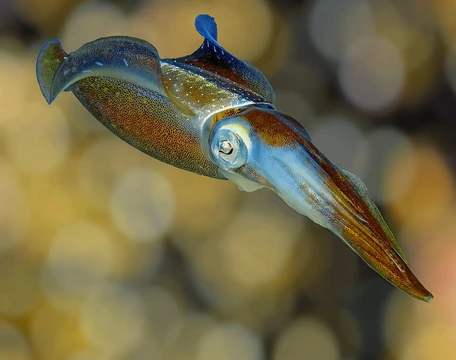
Sepia braggi
A small cuttlefish with a slender cuttlebone and purple arm markings.

Sepia braggi, commonly known as the slender cuttlefish, is a species of cuttlefish native to the Indo-Pacific Ocean, found in coastal waters of southern Australia. It is notable for being one of 41 species in the subgenus Doratosepion and for its distinctive slender, lanceolate cuttlebone, which gives the species its common name.
Quick Facts
- Genus
- Sepia
- Parent
- Sepia (Doratosepion)
- Species
- braggi
Facts from the source article.
Lore & Background
Sepia braggi was first collected in South Australia by its namesake, William Lawrence Bragg, and described by Sir Joseph Cooke Verco in 1907. The mantle is cigar-shaped and triangular towards the anterior, elongating to three times longer than wide. Narrow fins extend along the lateral margin and widen posteriorly. The head is short and narrower than the mantle. The cuttlebone is lanceolate and similar in length to the mantle. The tentacular club is short with five rows of suckers; most suckers are similar in size except for five or six in the middle row that are two to three times larger. Arm suckers are minute and dispersed. Males have larger arms (35.2–57.8 mm) than females (30.6–39.6 mm), and the hectocotylus is absent. The beak is distinctive: Sepia braggi is the only species of Sepia without a darkened lateral band on the upper and lower beak, and the fully darkened section on the upper beak is only 2.6 mm. The head and mantle are buff, pinkish brown; fins are pale brown; mantle ridges are orange-pink. The species is uniquely identified by short purple bars and blotches on the arms, visible even on juveniles.
Reader's Guide
Sepia braggi is a rarely encountered cuttlefish of low commercial value, caught only as by-catch. Its distribution spans southern Australia from southern New South Wales to Western Australia, typically at depths of 30–86 meters, though a maximum depth of 176 m has been reported with possible misidentification with S. limata, S. rhoda, or S. vercoi. It is one of three cuttlefish species known in Spencer Gulf, South Australia, where specimens are rarely taken by prawn trawlers. The species is demersal and feeds on small crabs, other crustaceans, and fish. Predators include sharks, large fish, and seals. Its main competitors are the larger, more common Sepia apama and Sepia novaehollandiae. The species is notable for its distinctive beak pigmentation, which aids in identifying it from stomach contents of fish, and for its unique purple arm markings that separate it from all other cuttlefish.
Did You Know?
- Sepia braggi was named after William Lawrence Bragg, who first collected it in South Australia.
- Females grow to a mantle length of 80 mm, while males reach only 49 mm.
More in Reef Cephalopods, Part 2 1-24
Spotted an error? Know more?
Reader corrections go straight into our review queue. Suggest an edit · How this site is sourced