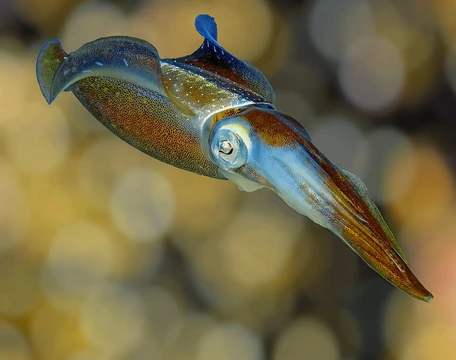
Sepia australis
A deep-water cuttlefish of southern Africa with a distinctive cuttlebone.

Sepia australis, the southern cuttlefish, is a species of cuttlefish found in the eastern South Atlantic Ocean and the western Indian Ocean off the coasts of Southern Africa, possibly extending into the waters off East Africa. It is notable for its distinctive cuttlebone morphology and its role as an opportunistic predator in deep, low-oxygen waters.
Quick Facts
- Genus
- Sepia
- Parent
- Sepia (Anomalosepia)
- Species
- australis
Facts from the source article.
Lore & Background
Sepia australis was described by Jean René Constant Quoy and Joseph Paul Gaimard in their 1932 account of the zoological collections from the second exploratory voyage of the Astrolabe under Jules Dumont d'Urville (1826–1829). The type specimen is lodged at the Museum National d'Histoire Naturelle in Paris. The species has widely-separated, posteriorly rounded fins and a short, crescent-shaped tentacular club with five suckers in crosswise rows, including three very enlarged suckers near the base. Its oval cuttlebone is bluntly rounded anteriorly, sharp posteriorly, with a strong ventral recurving, a convex smooth creamy white dorsal surface, and an ochre-coloured smooth glaze covering the long, straight spine and posterior quarter. The overall colour is purplish-brown with pale fins bearing a broad orange-pink band along their base dorsally.
Reader's Guide
Sepia australis is not currently subject to commercial exploitation, but as an apparently abundant species with 'tasty flesh', it may be of interest to fisheries in the future. It forms an important part of the diet of Cape fur seals, hake, skate, and other commercially exploited whitefish. The species is an opportunistic predator, taking both benthic and pelagic crustaceans, fish, and cephalopods; cannibalism has been recorded, more frequently in the eastern part of its range. Krill make up just over half the volume of prey taken. Spawning can occur all year, depending on water temperature and depth, with the largest cuttlefish occurring in cooler, deeper waters of the west. Males mature earlier than females and are sexually reproductive for longer; increased temperatures accelerate sexual maturation and spawning. The main spawning grounds off the south coast of South Africa are thought to be in deeper water on the western flank of the Agulhas Bank.
Did You Know?
- Sepia australis grows up to 85 mm in mantle length and 50 g total weight.
- The species thrives in low-oxygen waters, with highest catches off Namibia where oxygen levels are between 1.5 and 3.5 ml per litre.
- Cannibalism has been recorded in this species and was more frequent in the eastern, less optimal part of its range.
- The type specimen was collected during the second exploratory voyage of the Astrolabe (1826–1829) and is lodged at the Museum National d'Histoire Naturelle in Paris.
More in Reef Cephalopods, Part 2 1-24
Spotted an error? Know more?
Reader corrections go straight into our review queue. Suggest an edit · How this site is sourced