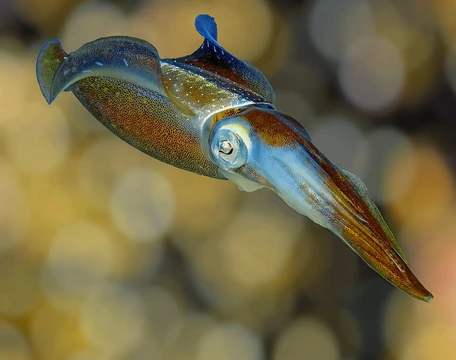
Giant cuttlefish
World's largest cuttlefish, known for mass spawning aggregations in Australia.

The giant cuttlefish (Ascarosepion apama), also known as the Australian giant cuttlefish, is the world's largest cuttlefish species, reaching up to 50 cm in mantle length and 100 cm in total length, and weighing over 10.5 kg. It is native to temperate and subtropical waters of Australia, from Brisbane to Shark Bay and Tasmania, and is notable for its spectacular color-changing displays and the unique mass spawning aggregation in the Upper Spencer Gulf.
Quick Facts
- Genus
- Ascarosepion
- Species
- apama
Facts from the source article.
Lore & Background
The giant cuttlefish has eight arms and two feeding tentacles, blue blood, and three hearts. Using chromatophores, iridophores, and leucophores in three skin layers, it can change color and pattern in a fraction of a second, and can also alter skin texture to imitate rock, sand, or seaweed. It is primarily diurnal, spends 95% of the day resting, and has a small home range, though it travels large distances to breed. It is a carnivorous, opportunistic predator feeding on crustaceans and fish.
Reader's Guide
The giant cuttlefish is significant as the largest cuttlefish species and for its unique mass spawning aggregation in the Upper Spencer Gulf, where hundreds of thousands gather between May and August. This aggregation, discovered by divers in the late 1990s, has become a major ecotourism attraction. The Upper Spencer Gulf population is genetically distinct, possibly a separate species, and displays two alternative lifecycles: rapid growth with maturity in seven to eight months, or slow growth with maturity in two years. The species is listed as near threatened due to a declining trend. Predators include Indo-Pacific bottlenose dolphins, long-nosed fur seals, and yellowtail kingfish, the latter raising ecological concerns regarding aquaculture escapees. The cuttlefish is semelparous, dying after a single breeding season, and females attach eggs to undersides of rocks, hatching in three to five months.
Did You Know?
- The giant cuttlefish can weigh over 10.5 kg (23 lb).
- It spends 95% of the day resting, with very little time foraging.
- The Upper Spencer Gulf population is the world's only known mass cuttlefish-spawning aggregation.
- Indo-Pacific bottlenose dolphins use a specialized technique to remove the ink and cuttlebone before eating the cuttlefish.
More in Reef Cephalopods, Part 2 1-24
Spotted an error? Know more?
Reader corrections go straight into our review queue. Suggest an edit · How this site is sourced