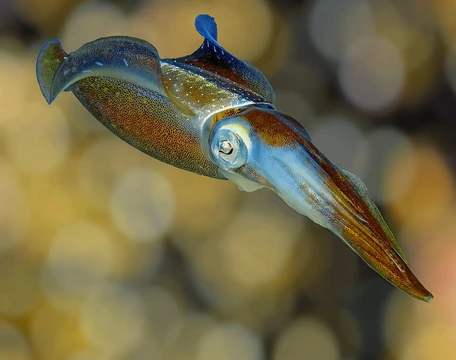
Erythalassa trygonina
A monotypic cuttlefish from the Red Sea and Indian Ocean.

Erythalassa trygonina, commonly known as the trident cuttlefish, is a species of cuttlefish in the monotypic genus Erythalassa. It is found in the Red Sea and the western Indian Ocean and serves as a major food source for larger marine life such as dolphins, seals, and seabirds.
Quick Facts
- Parent
- Erythalassa
- Taxon
- Erythalassa trygonina
Facts from the source article.
Lore & Background
The trident cuttlefish is characterized by 10 appendages: two tentacles and eight arms covered in suckers. Its tentacle clubs have eight suckers in distinct rows plus five larger ones, and some arms have hollowed sections replacing suckers. The legs are placed below the eyes and held together like a swimming keel, while free fins on the head aid maneuverability. Propulsion is achieved by pumping water through a siphon. The eyes are covered with a transparent membrane and false eyelids, are laterally placed for 177° vision and binocular vision used in hunting and camouflage. The body is small, with slender tentacles and a lanceolate or leaf-like shape. Males have one set of arms significantly shorter than the others, with suckers in rows of four on their tentacles. Females have suckers in rows of four on two pairs of arms, and on the other pair only on the distal third; the buccal membrane has longitudinal ridges. Females are generally larger than males.
Reader's Guide
The trident cuttlefish is notable for its rapid camouflage ability, changing skin color in 270-730 milliseconds using chromatophores. It can respond to conflicting patterns on either side of its body, replicating them due to its laterally placed eyes. It favors its right eye for adjusting camouflage patterns and uses its left eye to scan for predators. Camouflage occurs regardless of predator presence. The species is known from the Indian Ocean, including the Saya de Malha Bank, Mascarene Ridge, Zanzibar, Red Sea, Persian Gulf, and southern India. It occurs at depths of 20 to 410 metres and undergoes vertical migration, staying near 400 m during the day and rising to about 20 m at night. It is an occasional catch for trawlers in India and is listed as heavily exploited by native fishermen in Yemen.
Did You Know?
- The trident cuttlefish can change skin color in 270-730 milliseconds.
- It is a major food source for dolphins, seals, and seabirds.
More in Reef Cephalopods, Part 2 1-24
Spotted an error? Know more?
Reader corrections go straight into our review queue. Suggest an edit · How this site is sourced