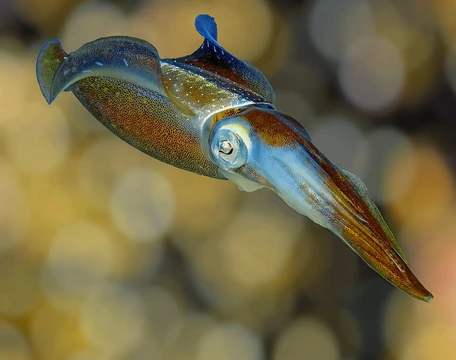
Dwarf cuttlefish
A small cuttlefish used as a model in neuroscience research.

The dwarf cuttlefish, also called the stumpy-spined cuttlefish, lives in the shallow coastal waters of the Central Indo-Pacific. Its scientific name is *Ascarosepion bandense*, a change from its former name *Sepia bandensis* following a 2023 phylogenetic study. The genus name *Ascarosepion* combines Greek words for "shoe" and "cuttlefish," while *bandense* likely refers to Banda Neira, where the first specimen was collected. It is commonly found on coral reefs and sandy coasts, often alongside sea cucumbers and sea stars.
Like other cephalopods, this cuttlefish can rapidly alter its skin patterns for camouflage and communication. Its skin contains chromatophores and papillae—muscles that change texture—both controlled by its nervous system. Chromatophores develop just before hatching, enabling quick pattern shifts. The dwarf cuttlefish has a mantle about 4–7 cm long as an adult, eight arms, and two feeding tentacles usually tucked inside its head. It swims by undulating translucent fins along its mantle and can jet quickly by expelling water from its funnel. It also "walks" along the sea floor using its lowest pair of arms.
After reaching sexual maturity, males grow larger than females and live slightly longer—roughly 9–12 months for males, 6–9 months for females. Females are reproductively active for 1–2 months, laying multiple clutches of eggs. Each egg is about 1 cm across, covered in jelly and ink for protection, and laid in clusters of 5–40 that look like grapes. Eggs attach to corals or firm surfaces and receive no parental care. After about four weeks, they hatch into miniature adults that can swim, camouflage, and hunt within days. They reach sexual maturity at 3–4 months, mating with multiple partners. Males compete for females with aggressive displays of white bars on a black background, sometimes leading to grappling and biting. During mating, a male uses a specialized arm (hectocotylus) to place a sperm bundle into the female's buccal area; she can store sperm until ready to lay eggs. After the reproductive period, senescence begins, and they die around 9 months old.
Dwarf cuttlefish are generalist carnivores, hunting crustaceans and small fish. They spot prey by sight, stalk slowly with raised arms, then launch their tentacles to grab it. They hold prey with their arms, inject venom to paralyze it, and bite off pieces with their beak.
Quick Facts
- Genus
- Ascarosepion
- Species
- bandense
Facts from the source article.
Lore & Background
The genus name Ascarosepion comes from the Latinized forms of the Ancient Greek ἄσκαρος (áskăros) meaning 'shoe' or 'slipper' and σηπία (sēpía) meaning 'cuttlefish'. Ascarosepion was considered synonymous with Sepia until a 2023 phylogenetic study resurrected the genus. The species name bandense likely refers to the location the holotype was collected from, Banda Neira, along with the suffix -ense meaning 'of' or 'from'. A 2023 phylogenetic analysis reassigned this species from its former name (Sepia bandensis). Sepia baxteri and Sepia bartletti are possible synonyms.
As is typical of cuttlefish, the body of A. bandense consists of a mantle (generally around 4–7 cm at adult size), 8 visible arms, and 2 feeding tentacles. Their skin is covered in chromatophores and subcutaneous muscles known as papillae, both under neural control. After reaching sexual maturity, dwarf cuttlefish become sexually dimorphic: males tend to grow larger than females and often live slightly longer. Dwarf cuttlefish swim by undulating translucent fins and are also capable of moving at high speeds by rapidly expelling water from their funnel. They are often observed 'walking' along the sea floor—pulling themselves forward using their lowest pair of arms.
Dwarf cuttlefish are generalist obligate carnivores, hunting a variety of crustaceans and small fish. They are mostly solitary in the wild, though some social behaviors have been observed. Males will compete for females using a characteristic aggressive display consisting of high-contrast longitudinal white bars on a black background. During mating, males use their hectocotylus to place a bundle of spermatophores into the females' buccal area. Females can store sperm internally until they are ready to lay their eggs.
Reader's Guide
The dwarf cuttlefish is notable for its increasing use as a model organism in neuroscience and behavior research, owing to its manageable size, rich behavioral repertoire, and growing genetic tools. Its nervous system includes a centralized brain and extensive networks of neurons in its arms, with arms shown to be able to learn certain tasks without the central brain's involvement. The central brain consists of 32 distinct lobes arranged around the esophagus, with the optic lobes comprising 75% of the brain by volume. Despite diverging from vertebrates over 500 million years ago, cuttlefish display a remarkable degree of intelligence, and many aspects of their nervous system are organized in ways resembling those of vertebrates. Only a single type of photoreceptor has been found in cuttlefish retinae, suggesting they may be colorblind, which makes it unclear how they camouflage so well to different colored backgrounds. Research is currently ongoing into the precise makeup and evolution of cuttlefish venoms. The species was reassigned from Sepia bandensis to Ascarosepion bandense in a 2023 phylogenetic analysis, which also resurrected the genus Ascarosepion.
Did You Know?
- The dwarf cuttlefish is also known as the stumpy-spined cuttlefish.
- Its eggs are covered in embryonic jelly mixed with ink for protection.
- Males often live longer than females, with a lifespan of 9–12 months compared to 6–9 months for females.
More in Reef Cephalopods, Part 2 1-24
Spotted an error? Know more?
Reader corrections go straight into our review queue. Suggest an edit · How this site is sourced