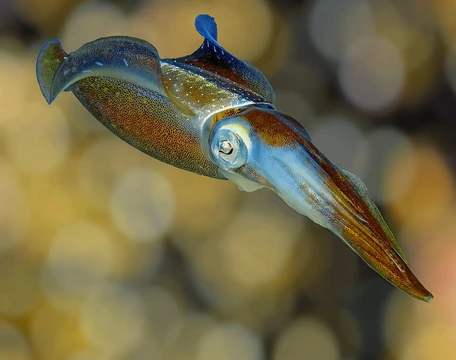
Cuttlebone
Internal shell of cuttlefish, used for buoyancy and as a dietary supplement.

Cuttlebone is the internal shell of cuttlefish, the animals in the family Sepiidae. (In other cephalopods, this structure is called a gladius.) It is hard and brittle, made mostly of aragonite, and is divided into chambers. The cuttlefish controls its buoyancy by filling these chambers with gas or liquid through a specialized organ called the siphuncle, located on the underside. Under a microscope, the cuttlebone shows thin horizontal layers connected by many vertical pillars.
Depending on the species, cuttlebones collapse under pressure at depths between 200 and 600 meters. This limits most cuttlefish to shallow seafloor habitats, usually on the continental shelf. When a cuttlefish dies, its body decomposes, leaving only the cuttlebone, which often washes up on beaches.
Humans have used cuttlebone in several ways. In the past, it was ground into powder for goldsmiths to polish metal, added to toothpaste, and used as an antacid or absorbent in medicine. During the 19th and 20th centuries, it was also carved as an artistic medium.
Today, cuttlebones are sold in pet stores as calcium supplements for birds, chinchillas, hermit crabs, reptiles, shrimp, snails, and laying hens. They are not intended for human consumption. Because cuttlebone is rich in carbonate, it can also be used to produce calcitic lime.
In jewelry making, cuttlebone withstands high temperatures and is easy to carve, making it useful as a mold for small metal castings and pewter casting.
The internal structure of cuttlebone has two main parts: horizontal septa and vertical pillars, both made mostly of aragonite. The septa divide the bone into chambers, and the pillars—which are corrugated, or wavy—support them. Pillar thickness varies by species but is typically a few microns. The septa are thicker than the pillars and have a double-layered structure: the upper layer has vertically aligned crystals, while the lower layer consists of nanorods arranged like plywood. This chambered design gives cuttlebone a porosity of over 90% by volume.
Researchers have studied cuttlebone extensively because it is lightweight, stiff, and resistant to damage—an unusual combination for a brittle material like aragonite. This has inspired biomimetic ceramic foams. Cuttlebone has also been used as scaffolding in superconductors and tissue engineering. Its lightness comes from its high porosity.
- Implosion depth range
- 200 to 600 metres (660 to 1,970 ft)
- Porosity
- over 90% by volume
- Aragonite content
- approximately 95%
- Organic material content
- 5%
- Specific stiffness measured
- 8.4 [(MN)m/kg]
Lore & Background
Depending on the species, cuttlebones implode at a depth of 200 to 600 metres. Because of this limitation, most species of cuttlefish live on the seafloor in shallow water, usually on a continental shelf. Upon the death of a cuttlefish, its body decomposes, leaving only the cuttlebone, which often washes up on beaches. In the past, cuttlebones were ground up to make polishing powder used by goldsmiths, added to toothpaste, and used as an antacid or absorbent. They were also used as an artistic carving medium during the 19th and 20th centuries.
Reader's Guide
Today, cuttlebones are commonly used as calcium-rich dietary supplements for caged birds, chinchillas, hermit crabs, reptiles, shrimp, snails, and laying hens; they are not intended for human consumption and are commonly available at pet stores. As a carbonate-rich biogenic raw material, cuttlebone has potential to be used in the production of calcitic lime. Because cuttlebone can withstand high temperatures and is easily carved, it serves as a mold-making material for small metal castings in jewelry and small sculptural objects, and can be used in pewter casting. The cuttlebone has been studied extensively due to its ability to be simultaneously lightweight, stiff, and tolerant to damage, leading to research into cuttlebone-inspired biomimetic ceramic foams. Its mechanical properties have also led to its use as scaffolding in superconductors and tissue engineering applications. The high energy absorption under compression results from a three-stage failure process: local crack formation, crack expansion, and densification, with the wavy structure of the walls inhibiting crack propagation and the stronger septum between chambers increasing total energy needed for structural failure.
Did You Know?
- Cuttlebone is composed primarily of aragonite and has a porosity over 90% by volume.
- Depending on the species, cuttlebones implode at depths of 200 to 600 metres.
- The cuttlebone's microstructure consists of horizontal septa and vertical pillars, both predominantly aragonite.
Frequently Asked Questions
What exactly is a cuttlebone?
The cuttlebone is the rigid internal shell housed inside cuttlefish of the family Sepiidae. It is a hard, brittle structure that is roughly 95% aragonite with about 5% organic material, and it is divided into numerous small chambers.
How does a cuttlefish use its cuttlebone to control buoyancy?
The animal fine-tunes its overall density by pumping gas or liquid in and out of the cuttlebone's chambers through a specialized tube called the siphuncle, which sits on the underside of the shell. This lets the cuttlefish hold a neutral depth without having to swim constantly.
What is the cuttlebone made of and how is it structured internally?
By volume the cuttlebone is over 90% porous, and the solid fraction is approximately 95% aragonite with 5% organic material. Under a microscope, the interior reveals thin horizontal layers linked together by a dense network of vertical pillars, giving it a measured specific stiffness of 8.4 (MN·m)/kg.
At what depth does a cuttlebone collapse under pressure?
Depending on the species, the chambered structure implodes at water pressures encountered between roughly 200 and 600 metres (about 660 to 1,970 feet). This depth ceiling constrains how far most cuttlefish can safely descend in the water column.
How is a cuttlebone different from a gladius?
The name 'cuttlebone' is reserved for the internal shell of cuttlefish (family Sepiidae), whereas the analogous structure in other cephalopod groups is called a gladius. The cuttlebone's highly porous, multi-chambered architecture is what makes it especially well suited to active buoyancy regulation.
More in Reef Cephalopods, Part 2 1-24
Spotted an error? Know more?
Reader corrections go straight into our review queue. Suggest an edit · How this site is sourced