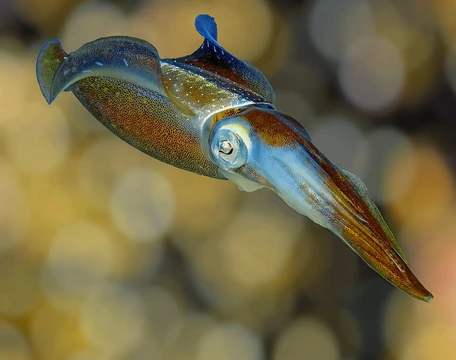
Ascarosepion latimanus
Second largest cuttlefish, common on coral reefs to 30 m depth.

The broadclub cuttlefish, *Ascarosepion latimanus*, is a common sight on coral reefs across the Indo-Pacific, ranging from the Andaman Sea east to Fiji and south to northern Australia. It lives in shallow waters no deeper than 30 meters and is the second-largest cuttlefish species, reaching a mantle length of 50 cm and a weight of 10 kg, with only the giant cuttlefish growing larger.
The type specimen for this species was collected in New Guinea and now resides at the Muséum National d’Histoire Naturelle in Paris. Because of its vast geographic range, scientists suspect *A. latimanus* may actually be a species complex—a group of closely related species—rather than a single species, though further taxonomic study is needed to clarify its boundaries. In 2023, it was reclassified into the genus *Ascarosepion*, joining 13 other species including the Metasepia cuttlefish, the reaper cuttlefish, and the giant cuttlefish.
Like many cephalopods, the broadclub cuttlefish can rapidly change its color and texture. It is typically light brown or yellowish with white mottled markings, though males often turn dark brown during courtship and mating. Its arms feature longitudinal white bands that appear as broad white blotches when extended, and some arms have brown bands that run up to the head. The dorsal mantle may display a saddle mark with small white and brown spots, along with narrow brown transverse bands and bold white transverse stripes and spots. The eyes are yellow around the ventral margins, and the fins are pale with white transverse stripes that extend onto the mantle, plus narrow white bands along the outer edges.
This species has a wide Indo-Pacific distribution, following continental coastlines from eastern Africa through southern Asia to southern Japan, and south to northern Australia and the Coral Sea. Records from southern Australia and Madagascar are likely misidentifications. It is a coastal, diurnal species that inhabits coral reefs in shallow water down to 30 meters. In the western Pacific, off Guam and Okinawa, it is found in the shallows from January to May, with eggs hatching in 38 to 40 days.
The broadclub cuttlefish hunts fish and crustaceans, including shrimp and prawns of the genus *Palaemon*. It uses a mesmerizing display of rhythmic color bands running along its body to subdue prey.
Quick Facts
- Genus
- Ascarosepion
- Species
- latimanus
Facts from the source article.
Lore & Background
The type specimen of Ascarosepion latimanus was collected in New Guinea and is deposited at the Muséum National d'Histoire Naturelle in Paris. The species has a wide geographic range, and it is probable that it represents a species complex rather than a single species, though more taxonomic work is needed. In 2023, the species was moved into genus Ascarosepion, where it is grouped with 13 other species including the Metasepia cuttlefish, the reaper cuttlefish, and the giant cuttlefish.
The broadclub cuttlefish grows to 50 cm in mantle length and 10 kg in weight. It displays a range of colors and textures, commonly light brown or yellowish with white mottled markings; males are sometimes dark brown during courtship and mating. The arms have longitudinal white bands that appear as broad white blotches when extended, and some arms have longitudinal brown bands extending to the head. The dorsal mantle may show a saddle mark with small white and brown spots, narrow brown transverse bands, and bold white transverse stripes and spots. The eyes are yellow around the ventral margins, and the fins are pale with white transverse stripes and narrow white bands along outer margins.
A. latimanus is a coastal species occurring in coral reefs in shallow water to 30 m. In the western Pacific, off Guam and off Okinawa, it is found in shallows from January to May, with eggs hatching in 38 to 40 days. It is diurnal and appears to mesmerize prey using a display of rhythmic color bands along its body. It preys on fishes and crustaceans, including shrimp and prawns of the genus Palaemon. Breeding males are territorial, defending a coral head (typically Porites); females lay eggs after mating in the male's territory. Courtship is highly ritualized and includes striking visual displays. Males frequently guard females, and mating occurs head-to-head, with the male placing spermatophores in the buccal membrane below the female's mouth. After laying, the eggs harden and are very hard to remove from the coral. Hatchlings hide among coral and rubble, often mimicking mangrove leaves in coloration and posture.
Reader's Guide
The broadclub cuttlefish is significant as the most common cuttlefish on coral reefs and the second largest cuttlefish species. Its wide distribution from eastern Africa to southern Japan and northern Australia, with records from southern Australia and Madagascar likely misidentifications, underscores its ecological importance in reef systems. The species exhibits complex hunting behavior using motion camouflage: it hunts prey such as shore crabs by swimming directly toward them while making a 'passing-stripe' display on its front. The cuttlefish colors its head white and forms six arms into a forward-pointing cone, with two arms stretched sideways. Dark stripes move downward over the forward-facing parts, and the posture masks mantle movements. This combination reduces the crab's reaction to looming, effectively deceiving the prey. The species' ritualized courtship and territorial defense of Porites coral heads highlight its role in reef dynamics. The uncertainty that it may represent a species complex indicates that further taxonomic work is needed to clarify its species limits, making it a subject of ongoing scientific interest.
Did You Know?
- The broadclub cuttlefish is the second largest cuttlefish species, reaching 50 cm mantle length and 10 kg weight.
- It is probable that Ascarosepion latimanus represents a species complex rather than a single species.
- The species was moved into genus Ascarosepion in 2023, grouped with 13 other species including the giant cuttlefish.
- Hatchlings often mimic mangrove leaves in coloration and posture to hide among coral rubble.
More in Reef Cephalopods, Part 2 1-24
Spotted an error? Know more?
Reader corrections go straight into our review queue. Suggest an edit · How this site is sourced