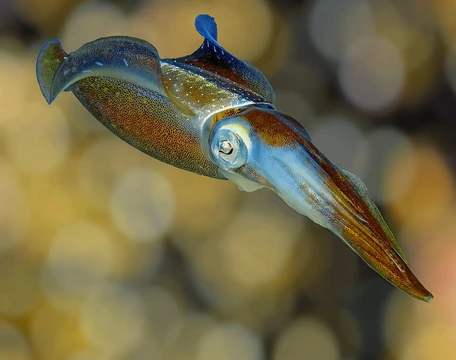
Acanthosepion lycidas
Large cuttlefish with complex behaviors and economic value.

**Acanthosepion lycidas**, known as the kisslip cuttlefish, belongs to the genus *Acanthosepion* and the family Sepiidae, which includes many well-known cuttlefish. Its closest relatives are *Acanthosepion aculeata*, *Acanthosepion esculenta*, and *Acanthosepion pharaonis*. This species typically appears reddish brown to purple, with patches and stripes running along its dorsal mantle. Adults average about 38 cm in length and can reach a maximum weight of 5 kg. The kisslip cuttlefish is found mainly in the Indo-West Pacific, at depths of 15 to 100 meters. It displays a range of complex reproductive behaviors, including courtship, mating displays, and competition for mates. When hunting, it turns toward a preferred direction to “jump on” and engulf small fish and crustaceans. Economically important in many Southeast Asian countries, it is valued for its high nutritional content and is also being studied as an alternative source of collagen, since its thick outer skin—often discarded as waste or bycatch—contains high levels of this protein.
The cuttlebone, typically ellipsoid in shape, sits inside the dorsal mantle and provides protection, support, and buoyancy. *Acanthosepion lycidas* is a large cuttlefish species, with an average mantle size of 38 cm and a maximum weight of 5 kg. Like other cuttlefish, it has binocular vision, allowing it to judge distances accurately. Its coloring ranges from reddish brown to purple, with scattered ocellate patches and lighter stripes on the dorsal mantle. The species has small suckers, all roughly the same size, and a hectocotylus on its left ventral arm.
Studies have found a morphological asymmetry in the curvature of the cuttlebone. The cuttlebone may be more convex on one side than the other, leading the cuttlefish to show a preference for turning to its right or left when hunting. For instance, if the cuttlebone is more convex on the right side, the cuttlefish typically turns to its right while pursuing prey.
Kisslip cuttlefish are native to the Indo-West Pacific, ranging from Japan to Myanmar, the Philippines, and Indonesia. They prefer tropical to temperate environments and are benthic, living only in marine ecosystems. They are usually found at depths of 15 to 100 meters, but migrate to shallow coastal areas from April to July for mating and breeding.
Quick Facts
- Taxon
- Acanthosepion lycidas
Facts from the source article.
Lore & Background
The kisslip cuttlefish is typically reddish brown to purple, with scattered ocellate patches and lightened stripes along its dorsal mantle. It has small suckers all similar in size, and a hectocotylus on its left ventral arm. Its cuttlebone is ellipsoid and located within the dorsal mantle, providing protection, support, and buoyancy. Studies show morphological asymmetry in cuttlebone curvature, which influences hunting direction: a more convex right side leads to a clockwise turning preference, and vice versa.
This species is native to the Indo-West Pacific, from Japan to Myanmar, Philippines, and Indonesia, preferring tropical to temperate environments. It is benthic and found at depths of 15–100 meters, migrating to shallow coastal areas from April to July for mating and breeding. In the South China Sea, it inhabits areas covered with shells, gravel, sand, and seaweed.
Reproductive behaviors include courtship, mating displays, and mate competition. Males perform displays to attract females, then grasp them and insert the hectocotylus into the female's mantle cavity for fertilization. Females lay amber-colored eggs similar in shape to hen eggs. The species is gonochoristic and has been used in studies of reproductive behaviors due to ease of captive breeding.
Reader's Guide
Acanthosepion lycidas holds significance in both ecological and economic contexts. It is an important food source in Southeast Asia, particularly in Japan and Hong Kong, due to its high nutritional value, and is caught by hook, live cuttlefish lures, or as bycatch. Its rapid population growth and high food conversion make it a candidate for commercial aquaculture. Additionally, the species is being studied as an alternative source of collagen for human use in cosmetics, biomedical materials, and foods, as its thick outer skin contains high levels of collagen that currently go to waste. Improving thermal stability of this collagen could reduce pollution and odor from discarded skins. The species has also been used as a model organism in studies of gonadal sex differentiation and GnRH-like peptide levels, which increase significantly during sex differentiation. Phylogenetically, it is most closely related to Acanthosepion aculeata, Acanthosepion esculenta, and Acanthosepion pharaonis. However, populations have declined due to overexploitation, bycatch, and overwintering of adults and juveniles, leading to its IUCN Red List status as Data Deficient.
Did You Know?
- The kisslip cuttlefish can grow to an average mantle length of 38 cm and a maximum weight of 5 kg.
- Its cuttlebone curvature asymmetry influences whether it turns clockwise or counterclockwise when hunting.
More in Reef Cephalopods, Part 2 1-24
Spotted an error? Know more?
Reader corrections go straight into our review queue. Suggest an edit · How this site is sourced