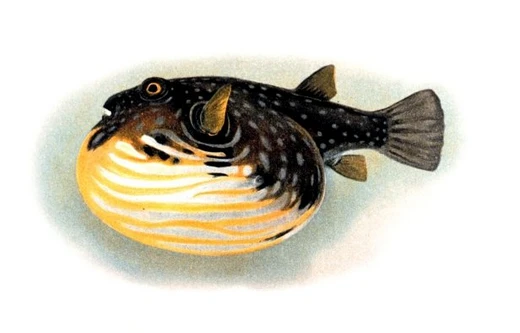
Yellow boxfish
A box-shaped fish that secretes toxic mucus when threatened.

The yellow boxfish (*Ostracion cubicum*) is a marine ray-finned fish in the boxfish family Ostraciidae. It is best known for its cube-shaped body, bright yellow skin dotted with black spots, and its ability to release a poisonous mucus when stressed. The fish lives on reefs across the Pacific and Indian Oceans, as well as the southeastern Atlantic; since 2011, it has also been spotted occasionally in the Mediterranean Sea near the Levant, likely having entered through the Suez Canal. It is also sold in the aquarium trade.
First formally described by Carl Linnaeus in 1758 in the 10th edition of *Systema Naturae*, with India listed as the type locality, the species’ classification was initially debated. Linnaeus used both *O. cubicum* and *O. tuberculatum* to describe it, but because his descriptions were brief, it was unclear whether these names referred to different species. Albert Günther later resolved the issue, concluding they were the same fish—since the two forms were hard to tell apart—and kept *O. cubicum* as the valid name, placing *O. tuberculatum* as a synonym. This species is the type species of the genus *Ostracion*, which, according to the 5th edition of *Fishes of the World*, belongs to the family Ostraciidae within the suborder Ostracioidea of the order Tetraodontiformes. The family includes other boxy fish like cowfishes and trunkfishes.
The genus name *Ostracion* means “little box,” a reference to the fish’s shape, while the specific name *cubicum* means “cubic,” also pointing to its box-like form.
Adults can reach up to 45 centimeters (18 inches) in length. The body is encased in a rigid, armored covering called a carapace, which has openings for the mouth, nostrils, gills, anus, tail base, and fins. Scientists once thought this carapace helped stabilize the fish in turbulent water, but it actually increases drag and destabilizes the fish; instead, the tail fin acts as a rudder for stability. Despite its stiff shell, the yellow boxfish is a strong, swift swimmer that can move steadily for long periods and maneuver through complex reefs. It does not swim with bursts or by sculling its fins like oars. Instead, it uses a combination of its dorsal, anal, and pectoral fins. The dorsal and anal fins move stiffly, either together or separately, to reach top speed. The pectoral fins provide thrust by moving in a figure-eight pattern.
Quick Facts
- Taxon
- Ostracion cubicum
Facts from the source article.
Lore & Background
The yellow boxfish was first formally described by Carl Linnaeus in the 10th edition of Systema Naturae published in 1758 with its type locality given as India. The classification of O. cubicum was at first debated; Linnaeus used both the names O. cubicum and O. tuberculatum. Albert Gunther resolved this debate, concluding they were one species and placing O. cubicum as the valid name. This species is the type species of the genus Ostracion, which the 5th edition of Fishes of the World classifies within the family Ostraciidae in the suborder Ostracioidea within the order Tetraodontiformes.
The yellow boxfish reaches a maximum length of 45 cm. As the name suggests, it is box-shaped, with an armored and rigid body called a carapace covering the head and body. When juvenile, it is bright yellow; as it ages, the brightness fades and very old specimens have blue-grey to black coloration with faded yellow. Yellow boxfish are solitary animals, and breeding occurs during spring in small groups of 1 male and 2–4 females. The yellow boxfish could be confused with the spotted boxfish (Ostracion meleagris), but the yellow boxfish is mainly bright yellow with dark spots while the spotted boxfish is darker with white spots.
Reader's Guide
The yellow boxfish has a wide Indo-Pacific distribution extending from the Red Sea and eastern coast of Africa to Hawaii, north to Japan and south to northern New Zealand, and has been recorded in the eastern Mediterranean Sea, probably having travelled through the Suez Canal. It is found at depths between 1 and 75 m on sheltered coastal and offshore coral reefs and areas of flat seabed. Its diet consists mainly of benthic organisms and marine algae, also including worms, sponges, crustaceans, molluscs, and small fish.
The yellow boxfish is able to secrete the neurotoxin ostracitoxin as mucus when stressed, which is highly toxic to marine fishes. It has a symbiotic relationship with the bacterium Vibrio parahaemolyticus found in the toxic mucus. The bright yellow color and black spots are a form of warning coloration (aposematism). The yellow boxfish is able to produce hums and clicking noises using the muscles of the swim bladder, thought to communicate with members of the same species or deter predators.
In 2006, Mercedes-Benz unveiled its Bionic concept car inspired by the shape of the yellow boxfish. Box girders were also modeled after the yellow boxfish, incorporating its box-like body shape and mouth structure to reduce drag. Engineers used the boxfish carapace and shape to design an airship with higher maneuverability, stability, and overall flight. The yellow boxfish is listed as Least Concern according to the IUCN Red List.
Did You Know?
- The yellow boxfish can secrete the neurotoxin ostracitoxin as mucus when stressed.
- The yellow boxfish was the inspiration for Mercedes-Benz's 2006 Bionic concept car.
- Males have a longer call duration than females and juveniles when producing sounds.
More in Pufferfish and Boxfish 1-24
Spotted an error? Know more?
Reader corrections go straight into our review queue. Suggest an edit · How this site is sourced