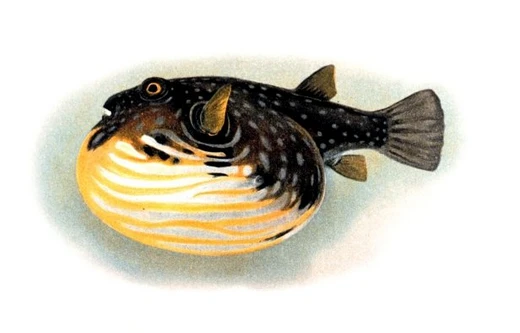
Lactophrys
Western Atlantic trunkfishes with armored carapace and toxic skin secretion.

Lactophrys is a genus of marine ray-finned fishes belonging to the family Ostraciidae, the boxfishes. These fishes, known as trunkfishes, are found in the western Atlantic Ocean. The genus is notable for its thick, oblong body encased in a carapace of hexagonal plate-like scales, and for secreting a colorless toxin from skin glands when touched.
Quick Facts
- Taxon
- Lactophrys
- Type Species
- Ostracion trigonus
- Type Species Authority
- Linnaeus, 1758
Facts from the source article.
Lore & Background
Lactophrys was first proposed in 1839 as a subgenus of Tetrosomus by British zoologist William Swainson. In 1865, Pieter Bleeker designated Ostracion trigonus as the type species of this taxon. Ostracion trigonus was first formally described by Carl Linnaeus in the 10th edition of Systema Naturae published in 1758, with the type locality mistakenly given as India when it is actually the Western Atlantic. The 5th edition of Fishes of the World classifies this genus within the family Ostraciidae in the suborder Ostracioidea within the order Tetraodontiformes. The etymology of Lactophrys is a compound of lactaria, meaning 'milkcow', and ophrys, meaning 'eyebrow', a reference to the spines above the eyes resembling the horns of a cow. Some fishes in this family are known as cowfishes. The genus contains three recognized species. Lactophrys trunkfishes have thick oblong bodies, most of which is encased in a carapace made up of thickened and enlarged hexagonal plate-like scales joined to each other. There are gaps in the carapace for the mouth, eyes, gill slits, fins and tail, although the bases of the dorsal and anal fins are completely encircled by the carapace. This genus does not have spines at the eyes, but sometimes has a spine at each corner of the lower rear carapace and there are no spine-like scales on the caudal peduncle. They have small mouths with fleshy lips and a row of no more than 15 moderately sized conical teeth in each jaw. The largest species is the buffalo trunkfish (L. trigonus) with a maximum published total length of 55 cm (22 in).
Reader's Guide
Lactophrys trunkfishes are significant for their unique defensive adaptations. Their entire body, except for openings for the mouth, eyes, gill slits, fins and tail, is encased in a rigid carapace of hexagonal plate-like scales, providing physical protection. Additionally, they secrete a colorless toxin from glands on their skin when touched, which is only dangerous when ingested, so divers are not immediately harmed. However, predators as large as nurse sharks can die from eating a trunkfish. The genus also has taxonomic significance: its type species was originally mislocalized by Linnaeus as India when it actually occurs in the Western Atlantic. The etymology reflects the cow-like appearance of the spines above the eyes in related species, linking the genus to the common name 'cowfishes'. With only three recognized species, Lactophrys represents a small but distinctive group within the boxfish family Ostraciidae, classified in the order Tetraodontiformes.
Did You Know?
- The type species Ostracion trigonus was described by Carl Linnaeus in 1758 with the type locality mistakenly given as India instead of the Western Atlantic.
- Lactophrys trunkfishes secrete a colorless toxin from skin glands when touched, which can kill predators as large as nurse sharks if ingested.
- The largest species in the genus, the buffalo trunkfish (Lactophrys trigonus), reaches a maximum published total length of 55 cm (22 in).
Frequently Asked Questions
What is Lactophrys?
Lactophrys is a genus of marine ray-finned fishes classified within the boxfish family Ostraciidae. Members of this genus are commonly referred to as trunkfishes and are recognized for their heavily armored, oblong bodies.
What are Lactophrys's defining traits?
These trunkfishes are encased in a rigid carapace made up of hexagonal, plate-like scales that give them a distinctly boxy silhouette. They also possess skin glands that release a colorless toxin when the fish is handled or touched.
Where does Lactophrys live?
Lactophrys species are native to the western Atlantic Ocean, where they inhabit the marine environments of that region.
Who described Lactophrys and when?
William Swainson first proposed the name as a subgenus back in 1839. Pieter Bleeker later designated Ostracion trigonus—originally described by Carl Linnaeus in the 10th edition of Systema Naturae—as the type species for the genus.
Why is Lactophrys important to boxfish enthusiasts?
It stands out within Ostraciidae because of the combination of its thick hexagonal-plate armor and its chemical defense mechanism, making it a prime example of the evolutionary diversity among trunkfishes. Fans of the family often point to Lactophrys when discussing how boxfishes balance physical and chemical protection.
More in Pufferfish and Boxfish 1-24
Spotted an error? Know more?
Reader corrections go straight into our review queue. Suggest an edit · How this site is sourced