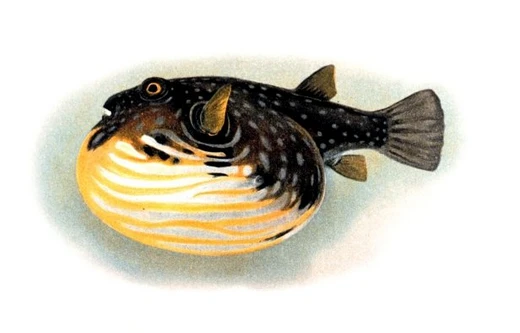
Paracanthostracion lindsayi
A monospecific boxfish genus found only in New Zealand waters.

Paracanthostracion lindsayi, commonly known as Lindsay's boxfish, is the only species in the monospecific genus Paracanthostracion. This marine ray-finned fish belongs to the family Ostraciidae and is found in the Southwestern Pacific Ocean, known only from the waters around New Zealand.
Quick Facts
- Taxon
- Paracanthostracion lindsayi
Facts from the source article.
Lore & Background
Paracanthostracion was first proposed as a genus in 1933 by the British-born Australian ichthyologist Gilbert Percy Whitley, with Ostracion lindsayi designated as its type species and only species. The species O. lindsayi was first formally described in 1932 by the New Zealand ichthyologist William J. Phillipps, with its type locality given as Otago, New Zealand. The specific name honours Phillipps's colleague at the Dominion Museum in Wellington, the curator of technology and taxidermist Charles John Lindsay.
The genus name Paracanthostracion prefixes para-, meaning 'close to', to the genus name Acanthostracion, from which it differs in the shape of its carapace and the distribution of its spines. The fish is characterized by an oblique anterior head profile, with the eye diameter only slightly less than the snout length. The space between the eyes is clearly concave, and the carapace is quadrangular with a poorly developed ridge along the middle of the back. It has a forward-pointing spine before each eye, a large spine in the middle of the back, and another large spine directed rearwards along the edge of the carapace near the anal fin. The hexagonal plate-like scales are very rough towards the rear and on the head. The body is irregularly streaked and spotted with grey, and there are spots on the cheeks that tend to merge into short streaks.
Reader's Guide
Paracanthostracion lindsayi is significant as the sole representative of its genus, Paracanthostracion, which was established in 1933 by Gilbert Percy Whitley. Its taxonomic placement within the family Ostraciidae, suborder Ostracioidea, and order Tetraodontiformes is based on the 5th edition of Fishes of the World. The species was first described in 1932 by William J. Phillipps from a specimen collected at Otago, New Zealand, and named after Charles John Lindsay, a colleague at the Dominion Museum. The genus name reflects its close relationship to Acanthostracion, distinguished by carapace shape and spine distribution. The fish's distribution is restricted to the Southwestern Pacific Ocean, known only from New Zealand waters. Its physical description includes a quadrangular carapace with specific spine arrangements and rough hexagonal scales, as well as a grey streaked and spotted body pattern. These features contribute to its identity within the boxfish family, though no further ecological or behavioral details are provided in the source.
Did You Know?
- Paracanthostracion lindsayi is the only species in the genus Paracanthostracion.
- The species was first described in 1932 by New Zealand ichthyologist William J. Phillipps.
- Its type locality is Otago, New Zealand.
- The specific name honors Charles John Lindsay, a curator and taxidermist at the Dominion Museum in Wellington.
Frequently Asked Questions
What is Paracanthostracion lindsayi?
Paracanthostracion lindsayi, commonly called Lindsay's boxfish, is a marine ray-finned fish that stands as the sole representative of its own genus. It belongs to the boxfish family Ostraciidae within the order Tetraodontiformes.
Where can Paracanthostracion lindsayi be found?
This species is known exclusively from the Southwestern Pacific Ocean, specifically the waters surrounding New Zealand. No confirmed populations have been recorded outside that region.
What makes Paracanthostracion lindsayi taxonomically unique?
It is the only species described within the genus Paracanthostracion, making it a monospecific genus. Its original type species designation was Ostracion lindsayi before it was reclassified into its own genus.
How does Paracanthostracion lindsayi relate to other boxfish?
As a member of the family Ostraciidae, it shares the rigid, bony body plan characteristic of boxfish and pufferfish relatives in the order Tetraodontiformes. However, its restricted New Zealand range and solitary genus status set it apart from more widespread boxfish species.
Why do fish enthusiasts and researchers care about Paracanthostracion lindsayi?
Its extremely limited geographic range and status as the only member of its genus make it a rare and noteworthy subject for marine biodiversity studies. For aquarium hobbyists and pufferfish fans, it represents one of the most geographically isolated boxfish species known to science.
More in Pufferfish and Boxfish 1-24
Spotted an error? Know more?
Reader corrections go straight into our review queue. Suggest an edit · How this site is sourced