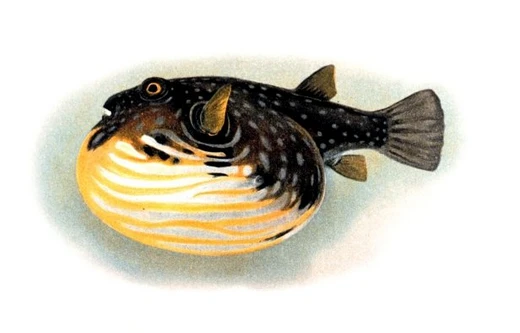
Island cowfish
A mid-Atlantic cowfish with a spine on its back.

The island cowfish (Acanthostracion notacanthus) goes by several common names, including hogfish, bottlefish boxfish, and island boxfish. This marine ray-finned fish is a member of the family Ostraciidae, which includes the cowfishes. Its range covers islands in the mid-Atlantic Ocean, with additional records from Western Africa.
In terms of classification, the species was first formally described in 1863 by Dutch physician and ichthyologist Pieter Bleeker, who originally placed it in the genus *Ostracion* under the name *Ostracion notacanthus*. The type locality is Saint Helena. Modern taxonomy, as reflected in the 5th edition of *Fishes of the World*, places the genus *Acanthostracion* within the family Ostraciidae, suborder Ostracioidea, order Tetraodontiformes.
The genus name *Acanthostracion* combines the Greek words *acanthus* (meaning "spine" or "thorn") with *ostracion*. The specific name *notacanthus* joins *notos* ("back") and *acanthos* ("spine" or "thorn"), referring to the spine-like projection on the third plate-like scale of the carapace, located at the origin of the dorsal fin.
This fish has 10 soft rays in both its dorsal and anal fins. A spine sits on the carapace in front of the dorsal fin, near the middle of the back. The carapace is closed at the rear, lacks a ventral ridge, and has only poorly developed lateral ridges. There are also spines in front of the eyes. The body is yellowish overall, with each plate-like scale of the carapace—which covers most of the body—often bearing an incomplete dark margin that may be rounded or polygonal. The island cowfish reaches a maximum total length of 50 cm (20 in).
The species is found around several mid-Atlantic islands, including the Azores, Saint Helena, and Ascension Island. Off Western Africa, it has been recorded from Ghana, Angola, and São Tomé. It inhabits depths between 3 and 25 m (9.8 and 82.0 ft), living over rocks, rubble, and sand, and has also been observed on shallow reefs.
Quick Facts
- Taxon
- Acanthostracion notacanthus
Facts from the source article.
Lore & Background
The island cowfish was first formally described in 1863 as Ostracion notacanthus by the Dutch physician, herpetologist and ichthyologist Pieter Bleeker, with its type locality given as Saint Helena. The 5th edition of Fishes of the World classifies the genus Acanthostracion within the family Ostraciidae in the suborder Ostracioidea within the order Tetraodontiformes. The genus name Acanthostracion combines acanthus, meaning 'spine' or 'thorn', with ostracion; Bleeker originally proposed this taxon as a subgenus of Ostracion. The specific name notacanthus combines notos, meaning 'back', with acanthos, meaning 'spine' or 'thorn', a reference to the spine-like projection on the third plate-like scale of the carapace from the origin of the dorsal fin.
Reader's Guide
The island cowfish is notable for its distinctive morphology and restricted distribution. It has 10 soft rays in both the dorsal and anal fin, and a spine on the carapace to the front of the dorsal fin, near the middle of the back. The carapace is closed at its rear end and has no ventral ridge, with only poorly developed lateral ridges. There are spines in front of the eyes. The overall colour is yellowish, with each plate-like scale of the carapace having a frequently incomplete dark margin that may be rounded or polygonal. The species reaches a maximum published total length of 50 cm. It is found around the Azores, Saint Helena, and Ascension Island in the mid-Atlantic, and off Western Africa from Ghana, Angola, and São Tomé. It inhabits depths between 3 and 25 m over rocks, rubble, and sand, and has been recorded on shallow reefs. Its taxonomy, first described by Bleeker in 1863, places it within the cowfish family Ostraciidae.
Did You Know?
- The island cowfish is also known as the hogfish, bottlefish boxfish, or island boxfish.
- Its specific name notacanthus means 'back spine', referring to a spine-like projection on the carapace.
- It has been recorded from the Azores, Saint Helena, Ascension Island, Ghana, Angola, and São Tomé.
- The carapace has no ventral ridge and only poorly developed lateral ridges.
Geographic Home and Archipelagic Setting
The Island cowfish calls the Hawaiian archipelago home, a vast volcanic chain stretching roughly 1,500 miles across the central North Pacific. Situated southwest of the continental United States, southeast of Japan, and northeast of Australia, this island group falls under the political jurisdiction of the U.S. state of Hawaii. The state encompasses nearly the entire volcanic chain, with 137 islands and atolls covering a combined land area of about 6,423 square miles. Physiographically and ethnologically, the archipelago and its surrounding oceans belong to the Polynesian subregion of Oceania. At the southeastern tip, eight main islands—Niʻihau, Kauaʻi, Oʻahu, Molokaʻi, Lānaʻi, Kahoʻolawe, Maui, and Hawaiʻi—form the most familiar part of the chain, while the Northwestern Hawaiian Islands contribute numerous atolls and reefs that extend the habitat far to the northwest.
Isolation and Endemism
One of the most remarkable consequences of the Hawaiian archipelago's remoteness is the extraordinary level of biological uniqueness found in its waters. Because the islands sit thousands of miles from any continental landmass, evolutionary isolation has produced a fauna unlike anywhere else on Earth. Approximately thirty percent of the fish species encountered in Hawaiian waters are endemic, meaning they exist nowhere else in the world. This high rate of endemism reflects millions of years of independent evolution in a geographically fragmented ocean environment. The archipelago's hundreds of islands, spread across 1,500 miles, create a mosaic of distinct microhabitats, from the shallow reefs of the Northwestern atolls to the deeper channels between the main islands. For a species like the Island cowfish, this isolation means its evolutionary story is written entirely within the Pacific, shaped by volcanic geology, ocean currents, and the sheer distance from other fish populations.
Environmental Pressures and Conservation Challenges
The Hawaiian marine environment, while rich in unique life, faces mounting threats from both local and global sources. Effluents generated on the islands themselves flow into surrounding waters, while floating plastic debris and refuse carried by the Great Pacific Garbage Patch wash onto Hawaiian beaches, degrading coastal habitats. Industrial fishing has long exerted heavy pressure on marine stocks; in the past century, several commercially targeted species have suffered population declines of eighty to eighty-five percent. Whaling, another historical pressure on ocean ecosystems, continued until the International Whaling Commission imposed its moratorium in 1986. For endemic species confined to this isolated chain, such losses are especially consequential because there is no external population to replenish depleted numbers. The combination of pollution, overharvest, and the inherent vulnerability of island-endemic fauna makes the conservation of Hawaiian marine life an urgent and ongoing challenge.
Freshwater Ecology and Broader Island Fish Biology
Although the Island cowfish is a marine species, understanding the broader aquatic ecology of Hawaii illuminates the full picture of island fish biology. Notably, very few native freshwater fish species exist in the archipelago, and none are restricted entirely to freshwater—every one is either anadromous or also inhabits brackish and marine waters during its adult stage. The seven native species regularly observed in fresh streams include the flagtail, the mullet, the sleeper goby, and four gobies. Three of those gobies are celebrated for their remarkable ability to climb waterfalls, ascending to reach higher reaches of freshwater streams. Several non-native species have since been introduced to Hawaiian freshwater habitats, some of which have become invasive and disrupted the delicate balance of these small populations. This scarcity of true freshwater specialists underscores how the marine environment remains the primary evolutionary theater for Hawaiian fish diversity.
Frequently Asked Questions
What is the Island cowfish?
The Island cowfish (Acanthostracion notacanthus) is a small marine boxfish in the family Ostraciidae, also known as hogfish, bottlefish boxfish, or island boxfish. It is set apart from its boxfish relatives by a single spine on its back.
Where does the Island cowfish live in the wild?
This species is found around mid-Atlantic Ocean islands, with Saint Helena serving as its type locality, and additional records come from the Western African coast. It typically occupies depths between roughly 3 and 25 meters.
How big does the Island cowfish get?
The Island cowfish reaches a maximum total length of about 50 centimeters (20 inches), making it a modestly sized member of the boxfish family.
Who first described the Island cowfish scientifically?
Dutch physician and ichthyologist Pieter Bleeker formally named the species in 1863, originally placing it in the genus Ostracion under the name Ostracion notacanthus. It was later transferred to the genus Acanthostracion.
What physical features distinguish the Island cowfish from other cowfishes?
It bears a distinctive spine on its back, a trait that gives the genus Acanthostracion its name. Both its dorsal and anal fins carry exactly 10 soft rays, and its body is enclosed in the rigid bony carapace typical of all Ostraciidae.
More in Pufferfish and Boxfish 1-24
Spotted an error? Know more?
Reader corrections go straight into our review queue. Suggest an edit · How this site is sourced