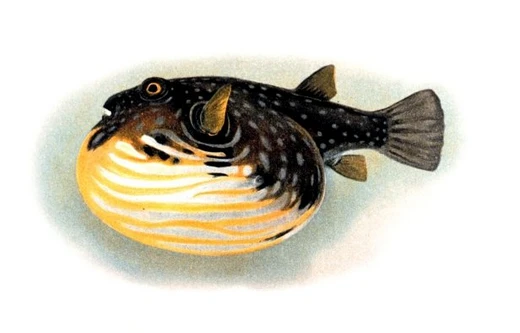
Ostraciidae
Armored boxfish with hexagonal patterns and toxic skin secretions.

Ostraciidae, or Ostraciontidae, is a family of bony, square-shaped fish within the order Tetraodontiformes, making them relatives of pufferfishes and filefishes. Their common names include boxfishes, cofferfishes, cowfishes, and trunkfishes. The family contains roughly 23 living species spread across six living genera.
The family was first proposed in 1810 by the French scholar Constantine Samuel Rafinesque. It was once treated as a subfamily, Ostraciinae, alongside the subfamily Aracaninae within a broader Ostraciidae. More recent phylogenetic work, however, recognizes Aracanidae and Ostraciidae as separate families that together form the clade Ostracioidei. The fifth edition of *Fishes of the World* places this clade as the suborder Ostracioidea within Tetraodontiformes.
The name Ostraciidae comes from its type genus, *Ostracion*, which means "little box"—a reference to the body shape of its type species, *O. cubicus*.
Boxfishes come in various colors and are known for hexagonal or honeycomb patterns on their skin. They swim with a rowing motion. Their scales are fused into a solid, triangular or box-like carapace, leaving only the fins, tail, eyes, and mouth exposed. This heavy armor limits them to slow movement, but it also protects adults from most predators. Some boxfish in the genus *Lactophrys* also release poisons from their skin into the water for extra defense. While adults are generally quite square, young boxfish are more rounded and often have brighter colors. The scrawled cowfish (*Acanthostracion quadricornis*) can reach 50 centimeters in length, though it tends to be smaller at higher latitudes.
Ostraciids are found in the Atlantic, Indian, and Pacific oceans, mostly at middle latitudes. The common or buffalo trunkfish (*Lactophrys trigonus*), for example, lives mainly in Florida waters but can appear as far north as Cape Cod.
Members of this family can secrete cationic surfactants through their skin as a chemical defense. One such toxin is pahutoxin, a water-soluble, crystalline chemical found in the mucus of *Ostracion lentiginosus* and other trunkfish when stressed. Pahutoxin is a choline chloride ester of 3-acetoxypalmitic acid, similar to steroidal saponins in echinoderms. When released, it quickly dissolves in the water and harms nearby fish.
Quick Facts
- Taxon
- Ostraciidae
Facts from the source article.
Lore & Background
The family Ostraciidae was first proposed in 1810 by French polymath Constantine Samuel Rafinesque. In the past, it was regarded as a subfamily (Ostraciinae) alongside Aracaninae within a wider Ostraciidae, but recent phylogenetic studies have concluded that Aracanidae and Ostraciidae are valid families within the same clade, the suborder Ostracioidei. The 5th edition of Fishes of the World classifies this clade as the suborder Ostracioidea within Tetraodontiformes.
Ostraciidae boxfishes occur in a variety of colors and are noted for hexagonal or honeycomb patterns on their skin. Their hexagonal plate-like scales are fused into a solid, triangular or box-like carapace, from which the fins, tail, eyes, and mouth protrude. Because of this heavy armor, they are limited to slow movements, but few other fish can eat the adults. Young Ostraciidae are more rounded and often exhibit brighter colors than the adults. The scrawled cowfish can grow up to 50 cm in length but is generally smaller at higher latitudes.
Members of the genus Lactophrys secrete poisons from their skin into surrounding water. The family is able to secrete cationic surfactants through the skin as a chemical defense; an example is pahutoxin, a water-soluble crystalline toxin contained in mucus secreted by Ostracion lentiginosus and other trunkfish when stressed. This toxin resembles certain detergents, and adding such detergents as pollutants to seawater may interfere with receptor-mediated processes in marine life.
Reader's Guide
Ostraciidae holds significance as a family of armored, slow-moving fish that rely on both physical protection and chemical defenses. Their fused hexagonal scales form a rigid carapace that deters predators, while species like those in Lactophrys secrete poisons such as pahutoxin into the water. This toxin, a choline chloride ester of 3-acetoxypalmitic acid, behaves similarly to steroidal saponins found in echinoderms and quickly dissolves to affect nearby fish. The family's taxonomy has been debated: originally proposed by Rafinesque in 1810, it was once treated as a subfamily, but recent phylogenetic studies support Ostraciidae and Aracanidae as separate families within the suborder Ostracioidei (or Ostracioidea per Fishes of the World). The name Ostraciidae derives from the type genus Ostracion, meaning 'little box,' alluding to the body shape of its type species O. cubicus. Ostraciids occur in the Atlantic, Indian, and Pacific oceans at middle latitudes, with the common trunkfish found as far north as Cape Cod. The family's unique combination of armor and chemical defense, along with its distinctive hexagonal patterns, makes it a notable group within Tetraodontiformes.
Did You Know?
- Ostraciidae was first proposed as a family in 1810 by Constantine Samuel Rafinesque.
- The name Ostracion means 'little box,' referring to the body shape of O. cubicus.
Frequently Asked Questions
What is Ostraciidae?
Ostraciidae is a family of bony, box-shaped fish that sit within the order Tetraodontiformes, making them close relatives of pufferfishes and filefishes. They go by several common names, including boxfishes, cofferfishes, cowfishes, and trunkfishes.
How many living species belong to Ostraciidae?
The family currently holds roughly 23 to 25 extant species distributed across six living genera. The type genus anchoring the family name is Ostracion.
What makes boxfish visually distinct from their pufferfish cousins?
Unlike the round, inflatable bodies of pufferfishes, Ostraciidae members are encased in rigid, square-shaped bony plates that give them a distinctive armored, boxy silhouette. Many species also display striking hexagonal patterns across their carapace.
Are boxfish dangerous to handle?
Yes — many species in the family produce toxic secretions from their skin, which can be harmful if ingested or if the mucus contacts open wounds. This chemical defense is a key adaptation that keeps predators at bay.
Who first described Ostraciidae as a family?
The family was originally proposed in 1810 by the French naturalist Constantine Samuel Rafinesque. It was later reorganized in taxonomy, with some classifications treating it as a subfamily (Ostraciinae) before more recent phylogenetic studies reaffirmed its status as a distinct family.
More in Pufferfish and Boxfish 1-24
Spotted an error? Know more?
Reader corrections go straight into our review queue. Suggest an edit · How this site is sourced