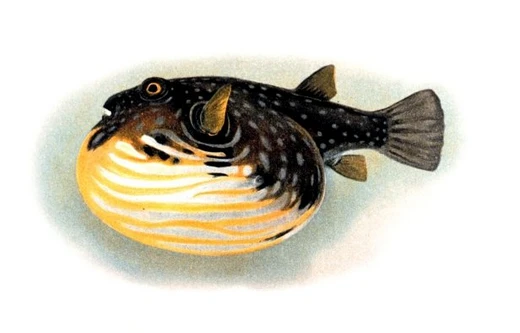
Honeycomb cowfish
A boxfish with hexagonal armor and protective horns.

The honeycomb cowfish (Acanthostracion polygonius) is a marine ray-finned fish in the boxfish family Ostraciidae, found in the western Atlantic. Its body is covered in tough, hexagonal scales that resemble armor, and it gets its name from both its honeycomb-like pattern and the two spines above its eyes. These spines and scales help protect it from predators. The fish can be blue, yellow, gray, or green, with juveniles usually more colorful than adults. It lacks pelvic fins and has a rounded tail fin. Its mouth is small and protruding, with fleshy lips. The average length is 25 centimeters, with a maximum of 50 centimeters.
This species lives in warm, clear waters near coral reefs, seagrass beds, and estuaries, ranging across the western Atlantic, the Caribbean, and waters near Brazil. It is mostly absent from the Gulf of Mexico except around Florida. It is an uncommon and cautious fish, usually solitary but sometimes seen in groups of one male and two females. Little is known about its reproduction, but it mates in open water, with pairs swimming quickly to the surface to release gametes before diving back down. It can change color to blend in with its surroundings and remain still for long periods. Juveniles swim better than adults due to their rounder bodies.
Feeding happens during the day on small marine invertebrates like shrimp, sponges, algae, tunicates, and worms. Humans consider it a valuable food fish, sold fresh and prized in the Caribbean, though ciguatera poisoning has been reported from eating it. It is also sold as an aquarium fish.
Quick Facts
- Taxon
- Acanthostracion polygonius
Facts from the source article.
Lore & Background
The honeycomb cowfish was first formally described as Acanthostracion polygonius in 1876 by the Cuban zoologist Felipe Poey, with Cuba given as its type locality. The genus name Acanthostracion combines acanthus, meaning 'spine' or 'thorn,' with ostracion, and was originally proposed as a subgenus of Ostracion. The specific name polygonius means 'many angled,' referring to the hexagonal patterning on its carapace.
This fish has armor-like, hexagonal scales covering most of its body, and its honeycomb-like pattern and 'horns' help it blend in with coral reefs. Most honeycomb cowfish are blue, but can also be yellow, gray, or green. Juveniles are generally more colorful than adults. They have no pelvic fins, and the caudal fin is rounded. They can be distinguished from similar fish by the two spines above their eyes and hexagonal pattern, and they have a smaller, protruding mouth with fleshy lips.
The honeycomb cowfish lives in warm, clear waters near coral reefs, sea grass beds, and estuaries. It is an uncommon and cautious species. It is usually solitary but can be seen in groups of threes consisting of one male and two females. Little is known about their reproduction, but they mate in open water, quickly swimming to the surface in pairs to release gametes and then swimming back down. They can change color to protect themselves from predation and remain stationary for long periods. Juveniles have better swimming abilities than adults due to their rounder bodies.
Reader's Guide
The honeycomb cowfish is considered a valuable food fish, marketed fresh and prized in the Caribbean where it is abundant. However, there have been several reports of ciguatera poisoning from its consumption. It is also sold commercially as an aquarium fish. Its significance lies in its unique morphology—the hexagonal, armor-like scales and protective horns—which distinguish it from other boxfish. The species is distributed throughout the western Atlantic, the Caribbean Sea, and waters near Brazil, though it is absent from most of the Gulf of Mexico except for populations around Florida. Its diet consists of small marine invertebrates including shrimp, sponges, algae, tunicates, and worms, with feeding occurring during the day. The honeycomb cowfish's ability to change color and remain stationary for long periods aids in predator avoidance, and its reproductive behavior, though little known, involves open-water spawning. The species was first described by Cuban zoologist Felipe Poey in 1876, and its taxonomy places it within the family Ostraciidae in the suborder Ostracioidea of the order Tetraodontiformes.
Taxonomic Identity and Family Ties
The Honeycomb cowfish belongs to the family Tetraodontidae, placing it in the same taxonomic group as boxfish, blowfish (pufferfish), and porcupinefishes. These relatives share a common lineage that sets them apart from most other marine fish families. Within this group, cowfishes occupy a distinctive niche — they are close cousins to the more widely recognized pufferfish and boxfish, yet they carry their own identity in the aquarium world. Understanding this family connection is important for keepers, because the care considerations, behavioral tendencies, and even the defensive mechanisms shared across Tetraodontidae members all stem from this shared biological heritage. The cowfish's place among these relatives means it inherits certain traits — including the capacity for chemical defense — that distinguish it from the vast majority of reef-dwelling species and demand a different level of respect from anyone considering adding one to a display.
Personality and Rising Popularity in the Hobby
Cowfishes have long been overlooked as ordinary community tank companions, yet they are steadily earning a devoted following among marine aquarists. Those who take the time to prepare a suitable environment often find these fish to be remarkably personable and quirky in their behavior — qualities that make them memorable pets for the dedicated keeper. Their growing popularity in the hobby reflects a shift in what enthusiasts are willing to take on: rather than defaulting to the most predictable species, keepers are increasingly drawn to fish that offer a unique character and a sense of interaction. This rise in interest is notable because cowfishes were not traditionally considered go-to choices for a reef or display tank. Their appeal lies in their individuality and the bond a prepared owner can develop with them, provided the right conditions are established from the very beginning of the setup.
The Chemical Defense Mechanism
Perhaps the most critical fact a prospective cowfish keeper must understand is the species' capacity to release a highly potent toxin. This chemical defense is powerful enough to kill other fish sharing the same tank and, in some cases, can even prove fatal to the cowfish itself. Under normal, calm conditions, this mechanism remains entirely dormant. The toxin is generally deployed only when the fish is severely threatened or in the process of dying. However, the threshold for what constitutes a genuine threat can be lower than a keeper might expect. Aggressive tank mates, sudden disturbances, or an overcrowded aquarium can all trigger stress responses that push the cowfish toward deploying this dangerous chemical. This makes the careful selection of tank companions and the maintenance of a stable, low-stress environment absolutely essential to the safety of every organism in the system.
Reef Compatibility and Feeding Considerations
In terms of reef tank suitability, cowfishes are generally classified as reef safe, meaning they do not typically consume corals or invertebrates under normal circumstances. However, this designation carries an important caveat: if a cowfish is not receiving adequate nutrition, it may begin picking at invertebrates in the tank. Proper feeding is therefore not merely a matter of keeping the fish healthy — it is a direct factor in protecting the rest of the reef ecosystem. Keepers should ensure their cowfish receives sufficient, appropriate food to prevent this behavioral shift. Additionally, the overall tank environment plays a role. Overcrowding and the presence of aggressive species can elevate the cowfish's stress levels, which in turn raises the risk of the chemical defense response. A well-stocked but not overstocked tank, with peaceful companions and consistent feeding, represents the ideal setup for maintaining both the cowfish's welfare and the reef's integrity.
Frequently Asked Questions
Who is Honeycomb cowfish?
The honeycomb cowfish (Acanthostracion polygonius) is a small marine boxfish belonging to the family Ostraciidae, native to the western Atlantic Ocean. It was first formally described by Felipe Poey in 1876, with Cuba designated as its type locality.
What are Honeycomb cowfish's powers/role?
Its body is encased in rigid hexagonal scales that function as natural armor, and two prominent spines sit above its eyes to further deter predators. Together, these features make the fish extremely difficult to swallow or injure, giving it a strong passive defense.
Why is Honeycomb cowfish important?
Its combination of hexagonal scale armor and dual supra-ocular spines makes it one of the most visually striking members of the boxfish family and a living example of evolved biological defense. It also contributes to western Atlantic reef communities as a small, slow-moving inhabitant.
How big does Honeycomb cowfish get?
The average adult measures roughly 25 centimeters in length, while the species can reach a maximum of 50 centimeters. It has a compact build with a rounded tail fin and lacks pelvic fins entirely.
More in Pufferfish and Boxfish 1-24
Spotted an error? Know more?
Reader corrections go straight into our review queue. Suggest an edit · How this site is sourced