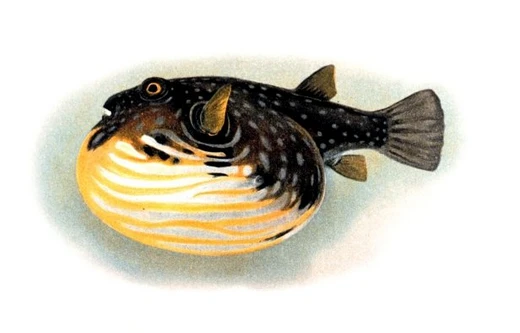
Acanthostracion
A genus of Atlantic boxfishes with a bony carapace and spines.

Acanthostracion is a genus of marine ray-finned fishes in the boxfish family Ostraciidae, found only in the Atlantic Ocean. These fish are commonly called cowfishes and are known for their rigid, box-like bodies.
The genus was first proposed in 1865 by Dutch scientist Pieter Bleeker as a subgroup within the genus Ostracion. He later designated the species Ostracion quadricornis as the type species. The name Acanthostracion combines the Greek word for "spine" or "thorn" with Ostracion, reflecting Bleeker’s original placement.
There are four recognized species: the West African cowfish, the island cowfish, the honeycomb cowfish, and the scrawled cowfish.
Acanthostracion cowfishes have an oblong, broad body enclosed in a bony carapace made of thickened, usually hexagonal plate-like scales that are fused together. This carapace does not cover the mouth, eyes, gill slits, fins, or the tail stalk, but it does surround the bases of the dorsal and anal fins. Large spines project in front of the eyes, and additional spines are present at the lower rear corner of the carapace. The rearmost scales on the upper and lower tail stalk are expanded into small spines. The small mouth sits at the front of the snout, with fleshy lips and about 15 moderately sized conical teeth in each jaw. Their maximum total lengths range from 18 cm in the West African cowfish to 55 cm in the scrawled cowfish.
These cowfishes are restricted to the Atlantic Ocean. Two species live in the western Atlantic, from New Jersey to Brazil, and two species are found in the eastern Atlantic off West Africa, as well as around the Azores, Saint Helena, and Ascension Island.
Quick Facts
- Taxon
- Acanthostracion
- Type Species
- Ostracion quadricornis
- Type Species Authority
- Linnaeus, 1758
Facts from the source article.
Lore & Background
Acanthostracion was first proposed as a subgenus of Ostracion in 1865 by the Dutch physician, herpetologist and ichthyologist Pieter Bleeker. Bleeker did not designate a type species when he first used the name in his paper Notice sur les ostracions, confondus sous le nom d'Ostracion quadricornis L. et description des Ostracion notacanthus et guineensis, but designated Ostracion quadricornis as the type species later in 1865 when he published his Atlas ichthyologique des Indes Orientalis Neerlandais. The 5th edition of Fishes of the World classifies this genus within the family Ostraciidae in the suborder Ostracioidea within the order Tetraodontiformes.
The etymology of Acanthostracion comes from ἄκανθα (ákantha), meaning 'spine, thorn', and Ostracion, as Bleeker originally proposed this taxon as a subgenus of the latter genus. There are currently four recognized species: Acanthostracion guineense (West African cowfish), Acanthostracion notacanthus (Island cowfish), Acanthostracion polygonius (Honeycomb cowfish), and Acanthostracion quadricornis (Scrawled cowfish).
Acanthostracion cowfishes have an oblong, broad body encased within a bony carapace made up of thickened, typically hexagonal plate-like scales which are sutured together. This carapace does not enclose the mouth, eyes, gill slits, fins and the caudal peduncle and caudal fin, although it does encircle the bases of the dorsal and anal fins. There are large spines which project in front of the eyes, as well as spines at the lower rear angle of the carapace, and the rearmost plate-like scales on the upper and lower caudal peduncle are expanded into small spines. The small mouth sits at the front of the snout and has fleshy lips and around 15 moderately sized conical teeth in each jaw. These cowfishes have maximum published total lengths from 18 cm in the West African cowfish to 55 cm in the scrawled cowfish.
Reader's Guide
Acanthostracion is significant as a genus of boxfishes restricted to the Atlantic Ocean, with two Western Atlantic species distributed from New Jersey to Brazil and two Eastern Atlantic species off West Africa, as well as the Azores, Saint Helena, and Ascension Island. The genus was first proposed as a subgenus by Pieter Bleeker in 1865, and its type species was designated later that same year. The name reflects the spiny nature of these fishes, combining Greek for 'spine' with the genus Ostracion. The four recognized species vary in size from 18 cm to 55 cm in total length. The bony carapace and spines, including those in front of the eyes and at the rear of the carapace, are characteristic features. The carapace does not enclose the mouth, eyes, gill slits, fins, or caudal peduncle, but does encircle the bases of the dorsal and anal fins. The mouth has fleshy lips and about 15 conical teeth per jaw. These details, along with the geographic distribution, define the genus's legacy in the family Ostraciidae.
Did You Know?
- The genus name comes from Greek words meaning 'spine' and 'Ostracion'.
- There are four recognized species, with maximum lengths ranging from 18 cm to 55 cm.
- These cowfishes are found only in the Atlantic Ocean, from New Jersey to Brazil and off West Africa.
Frequently Asked Questions
What is Acanthostracion?
Acanthostracion is a small genus of Atlantic boxfishes—commonly called cowfishes—that belong to the family Ostraciidae. They are easily recognized by their rigid, box-shaped bony carapace and the spines protruding from its surface.
How many species are in Acanthostracion?
Four species are currently recognized within the genus. They range in total length from about 18 cm up to roughly 55 cm.
Where do Acanthostracion live?
All four species are restricted to the Atlantic Ocean, making the genus a purely Atlantic group of boxfishes.
What does the name Acanthostracion actually mean?
The name blends the Greek word for 'spine' or 'thorn' (akantha) with the genus Ostracion, a nod to the spiny carapace that sets these cowfishes apart from other boxfish.
Who originally described Acanthostracion?
Dutch ichthyologist Pieter Bleeker proposed the genus in 1865 as a sub-group within Ostracion and later named Ostracion quadricornis as its type species.
More in Pufferfish and Boxfish 1-24
Spotted an error? Know more?
Reader corrections go straight into our review queue. Suggest an edit · How this site is sourced