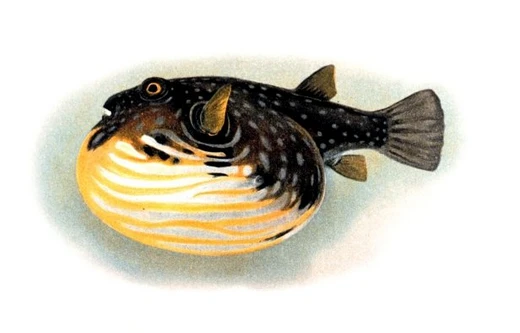
Acanthostracion notacanthus
A mid-Atlantic cowfish with a spine on its back.

The island cowfish (Acanthostracion notacanthus)—also called the hogfish, bottlefish boxfish, or island boxfish—is a marine ray-finned fish in the family Ostraciidae. It lives around islands in the mid-Atlantic Ocean and has also been spotted off the coast of Western Africa.
This species was first scientifically described in 1863 by Dutch naturalist Pieter Bleeker, who named it *Ostracion notacanthus* based on a specimen from Saint Helena. Its genus name, *Acanthostracion*, combines the Greek words for “spine” and “box,” while the species name *notacanthus* refers to the spine-like projection on the back, just in front of the dorsal fin.
The island cowfish has 10 soft rays in both its dorsal and anal fins. A prominent spine sits on the carapace near the middle of the back, ahead of the dorsal fin. The carapace is closed at the rear, lacks a ventral ridge, and has only weak lateral ridges. There are also spines in front of the eyes. The body is mostly yellowish, with each plate-like scale on the carapace often showing an incomplete dark border that may be rounded or polygonal. The largest recorded total length is 50 cm (20 inches).
This fish is found around the Azores, Saint Helena, and Ascension Island in the mid-Atlantic, as well as off West African locations including Ghana, Angola, and São Tomé. It lives at depths between 3 and 25 meters (9.8 to 82 feet), over rocky, rubble, or sandy bottoms, and has been observed on shallow reefs.
Quick Facts
- Taxon
- Acanthostracion notacanthus
Facts from the source article.
Lore & Background
The island cowfish was first formally described in 1863 as Ostracion notacanthus by the Dutch physician, herpetologist and ichthyologist Pieter Bleeker, with its type locality given as Saint Helena. The 5th edition of Fishes of the World classifies the genus Acanthostracion within the family Ostraciidae in the suborder Ostracioidea within the order Tetraodontiformes.
The genus name Acanthostracion combines acanthus, meaning 'spine' or 'thorn', with ostracion. The specific name notacanthus combines notos, meaning 'back', with acanthos, meaning 'spine' or 'thorn', a reference to the spine-like projection on the third plate-like scale of the carapace from the origin of the dorsal fin. The fish has 10 soft rays in both the dorsal and anal fin, a spine on the carapace in front of the dorsal fin near the middle of the back, and spines in front of the eyes. The carapace is closed at its rear end, has no ventral ridge, and only poorly developed lateral ridges. The overall colour is yellowish, with each plate-like scale of the carapace having a frequently incomplete dark margin that may be rounded or polygonal.
Reader's Guide
The island cowfish is notable as a member of the family Ostraciidae, the cowfishes, and is one of several species in the genus Acanthostracion. Its original description by Pieter Bleeker in 1863, based on a specimen from Saint Helena, places it within the historical ichthyological work of the 19th century. The species is recorded from the Azores, Saint Helena, Ascension Island, and off Western Africa including Ghana, Angola, and São Tomé, indicating a distribution across mid-Atlantic islands and the African coast. It inhabits depths between 3 and 25 meters over rocks, rubble, and sand, and has been recorded on shallow reefs. The maximum published total length is 50 cm, making it a moderately sized boxfish. Its distinctive spine on the back, referenced in both its genus and species names, and its yellowish coloration with dark-margined scales contribute to its identification. The species is also known by several common names—hogfish, bottlefish boxfish, and island boxfish—reflecting regional variations in nomenclature. Its presence in the scientific literature and its classification within the order Tetraodontiformes underscore its place among the pufferfish and boxfish group.
Did You Know?
- The island cowfish was first described in 1863 by Dutch ichthyologist Pieter Bleeker.
- Its specific name notacanthus means 'back spine', referring to a spine-like projection on the carapace.
Frequently Asked Questions
What is Acanthostracion notacanthus?
It is a small boxfish belonging to the Ostraciidae family, popularly known as the island cowfish or bottlefish boxfish. This mid-Atlantic species is set apart by a distinctive spine-like projection on its back.
Where can you find Acanthostracion notacanthus in the wild?
The species inhabits island waters across the mid-Atlantic Ocean and has also been recorded off the coast of West Africa. It typically occupies depths between roughly 3 and 25 meters.
Who first described Acanthostracion notacanthus and when?
Dutch naturalist Pieter Bleeker published the original scientific description in 1863, working from a specimen collected at Saint Helena. He initially assigned it to the genus Ostracion before it was later transferred to Acanthostracion.
What does the name Acanthostracion notacanthus actually mean?
The genus name fuses the Greek words for 'spine' and 'box,' while the species epithet notacanthus highlights the spine-like structure on the fish's back. Put together, the name essentially describes a boxy fish marked by a spine.
How large does Acanthostracion notacanthus grow?
Adults reach a maximum total length of about 50 centimeters, or roughly 20 inches. The fish carries ten soft rays in both its dorsal and anal fins, giving it a fairly balanced fin layout.
More in Pufferfish and Boxfish 1-24
Spotted an error? Know more?
Reader corrections go straight into our review queue. Suggest an edit · How this site is sourced