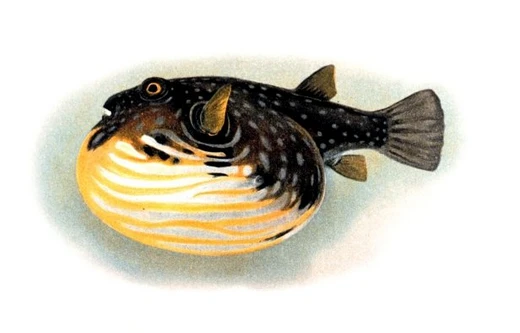
Tetrosomus gibbosus
A boxfish with a hump, poisonous flesh, and a Lessepsian migration story.

Tetrosomus gibbosus, commonly called camel cowfish because of the hump on its dorsal keel, is one of 22 species in the boxfish family, Ostraciidae. It is a ray-finned fish found in the wide Indo-West Pacific. It has been recorded since 1988 on rare occasions in the Levantine waters of the Mediterranean Sea, likely following entry via the Suez Canal, and is the first species from the family Ostraciidae to be found in the Mediterranean Sea.
Quick Facts
- Taxon
- Tetrosomus gibbosus
Facts from the source article.
Lore & Background
Tetrosomus gibbosus is characterized by a carapace—a hard upper shell formed by thick scale plates—that completely encases its body except for small openings for the mouth, eyes, and gills. Its mouth is small with fleshy lips and conical teeth usually numbering less than 15. The species is hermaphroditic: all individuals are born female, but some may change into males as they grow. Juveniles live together in small schools, but become solitary as adults. It is an omnivore, feeding on seaweeds, sponges, molluscs, worms, and crustaceans found on the bottom of its habitat.
The fish has poisonous flesh, organs, and spines, and is known to secrete poisonous mucus in defense or when disturbed. This poison can be fatal to humans or other marine organisms. It lives in shallow tropical waters or warm seas with muddy bottoms, sometimes near seagrass beds, and is also found in coral reefs. It is considered an endangered species in the South China Sea.
Reader's Guide
Tetrosomus gibbosus is notable as the first species from the boxfish family Ostraciidae to be found in the Mediterranean Sea, first recorded there in 1988. Its presence in the Mediterranean is considered a Lessepsian migration—a movement from the Red Sea to the Mediterranean facilitated by the opening of the Suez Canal in 1869. Both seas have similar salinity and temperature ranges, easing the transition. The species is now considered an invasive and established species in the Mediterranean, having formed a growing population in multiple locations. Because it cannot swim long distances, its migration likely took multiple generations, aided by northward currents moving eggs and larvae. The species carries some value in the aquarium trade but is difficult to keep. Its poisonous defenses and hermaphroditic life history add to its biological interest, and its endangered status in the South China Sea highlights conservation concerns within its native range.
More in Pufferfish and Boxfish 1-24
Spotted an error? Know more?
Reader corrections go straight into our review queue. Suggest an edit · How this site is sourced