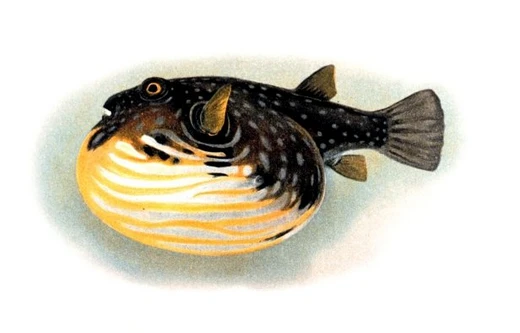
Tetrosomus concatenatus
A boxfish with chain-like markings and a disputed taxonomic status.

Tetrosomus concatenatus, commonly known as the triangular boxfish, is a species of marine ray-finned fish in the family Ostraciidae. It is one of the turretfishes found in the Indian and western Pacific Oceans, noted for its quadrangular body shape and chain-like markings.
Quick Facts
- Taxon
- Tetrosomus concatenatus
Facts from the source article.
Lore & Background
Tetrosomus concatenatus was first formally described in 1785 by the German physician and naturalist Marcus Elieser Bloch, who placed it in the genus Ostracion with the type locality given as the Antilles. The species is accepted as valid by most authorities, but some regard it as a synonym of Lactophrys triqueter of the Western Atlantic, arguing that Indo-Pacific specimens should be assigned to Tetrosomus reipublicae. The 5th edition of Fishes of the World classifies the genus Tetrosomus within the family Ostraciidae in the suborder Ostracioidea of the order Tetraodontiformes.
The genus name Tetrosomus combines tetra, meaning 'four', and somus, meaning 'body', referring to the fish's quadrangular body shape. The specific name concatenatus means 'linked together' or 'chained', an allusion to the chain-like markings on its body. Males have blue spots and a blue line that rapidly fade on capture. This solitary species inhabits bays and estuaries with large isolated sponges, as well as seagrass and seaweed beds in coastal waters, ranging from East Africa to southern Japan and New Caledonia.
Reader's Guide
Tetrosomus concatenatus holds significance as a representative of the turretfishes within the family Ostraciidae, illustrating the morphological diversity of boxfishes. Its taxonomic history reflects ongoing uncertainty in ichthyology: although Bloch's 1785 description is widely accepted, some authorities consider it a synonym of the Western Atlantic Lactophrys triqueter, suggesting that Indo-Pacific populations may belong to Tetrosomus reipublicae. This dispute underscores the challenges of species delimitation in marine fishes with broad distributions. The species' chain-like markings and quadrangular body shape are key identifying features, and the rapid fading of blue markings in males upon capture is a notable characteristic for field identification. Its solitary nature and habitat preferences—bays, estuaries with large sponges, and seagrass or seaweed beds—provide ecological context for its role in coastal Indo-West Pacific ecosystems. The classification within Tetraodontiformes, as per the 5th edition of Fishes of the World, places it among other highly derived fishes. The species' maximum length of 30 cm and fin ray counts offer concrete data for comparative studies. Overall, its legacy lies in its contested taxonomy and its representation of the morphological and ecological traits typical of boxfishes.
Did You Know?
- The specific name concatenatus means 'linked together' or 'chained', referring to its chain-like markings.
- It has 9 soft rays in both its dorsal and anal fins.
- Some authorities consider this taxon a synonym of Lactophrys triqueter of the Western Atlantic.
More in Pufferfish and Boxfish 1-24
Spotted an error? Know more?
Reader corrections go straight into our review queue. Suggest an edit · How this site is sourced