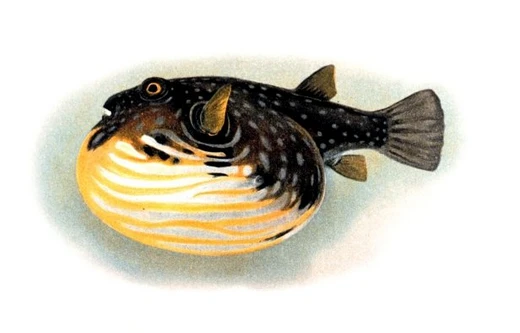
Spotted trunkfish
A Caribbean reef fish with a hard, box-like carapace.

The spotted trunkfish (*Lactophrys bicaudalis*) belongs to the Ostraciidae family. It inhabits coral reefs across the Caribbean and the southwestern Atlantic Ocean. Its common name comes from the black spots covering its whitish or yellow-golden body. In the Caribbean, it is also called the boxfish, cow-fish, or shellfish.
Carl Linnaeus first formally described this species in 1758 as *Ostracion bicaudalis* in the 10th edition of *Systema Naturae*, listing its type locality as "India." The 5th edition of *Fishes of the World* places the genus *Lactophrys* within the family Ostraciidae, suborder Ostracioidea, order Tetraodontiformes.
The genus name *Lactophrys* combines *lactaria* (meaning "milkcow") and *ophrys* ("eyebrow"), referring to the spines above the eyes that resemble cow horns. Some related fishes are called cowfishes. The species name *bicaudalis* means "two tailed," a reference to two spines "below the tail"—a puzzling description, since the fish has no spines under its tail but does have two spines on either side of the anal fin.
Boxfishes get their name from a hard outer covering of hexagonal, plate-like scales fused into a solid, triangular or box-like carapace. Only the eyes, snout, fins, and tail protrude. The spotted trunkfish is white or yellowish with a regular pattern of many black spots on the body and tailfin. Behind each eye, adults have a diagonal row of three white spots where black ones would be expected. The snout is plain white, with no spines above the eye and a pair of sharp spines in front of the anal fin.
This species lives in the Caribbean Sea, the southern Gulf of Mexico, Ascension Island, and the northeastern coast of South America down to Brazil. It prefers clear water and is usually found around coral reefs with crevices, holes, and overhangs, at depths up to about 30 meters (100 feet).
Due to its heavy armored scales, the spotted trunkfish moves slowly, rippling its dorsal and anal fins while gently beating its pectoral fins. For faster movement, it can also use its tail fin. It is a benthic feeder, eating crabs, shrimps, molluscs, sea urchins, starfish, brittle stars, sea cucumbers, tunicates, and seagrasses.
Like all trunkfish in the genus *Lactophrys*, it secretes a colorless toxin from skin glands when touched. The toxin is dangerous only if ingested, so divers are not immediately harmed.
Quick Facts
- Taxon
- Lactophrys bicaudalis
Facts from the source article.
Lore & Background
The spotted trunkfish was first formally described as Ostracion bicaudalis in 1758 by Carl Linnaeus in the 10th edition of Systema Naturae with its type locality given as 'India'. The 5th edition of Fishes of the World classifies the genus Lactophrys within the family Ostraciidae in the suborder Ostracioidea within the order Tetraodontiformes. The genus name Lactophrys is a compound of lactaria, meaning a 'milkcow', and ophrys, meaning 'eyebrow', a reference to the spines above the eyes resembling the horns of a cow. The specific name, bicaudalis, means 'two tailed', a reference to the two spines 'below the tail', a mystery because this fish does not have any spines under its tail but there are two spines on either side of the anal fin.
Members of this family are known as boxfishes because they have a hard outer covering consisting of hexagonal plate-like scales fused together into a solid, triangular or box-like carapace. The eyes, snout, fins and tail protrude from this. The spotted trunkfish is basically white or yellowish with a regular pattern of numerous black spots on the body and tailfin. Just behind the eye, adult fish have a diagonal row of three white spots where black ones would have been expected. The snout is plain white, with no spines above the eye and a pair of sharp spines in front of the anal fin.
The spotted trunkfish is found in the Caribbean Sea, the southern half of the Gulf of Mexico, Ascension Island and the northeastern coast of South America as far east as Brazil. It prefers clear water and is usually associated with coral reefs with fissures, holes and overhangs, at depths down to about 30 m (100 ft).
Reader's Guide
The spotted trunkfish is notable for its distinctive hard, box-like carapace formed from fused hexagonal scales, which limits its movement to slow rippling of its dorsal and anal fins and gentle beating of its pectoral fins, with the tail fin used only when faster motion is required. It is a benthic species, feeding on or near the seabed on a diet that includes crabs, shrimps, molluscs, sea urchins, starfish, brittle stars, sea cucumbers, tunicates and seagrasses. Like all trunkfish of the genus Lactophrys, it secretes a colorless toxin from glands on its skin when touched; the toxin is only dangerous when ingested, so there is no immediate harm to divers, but predators as large as nurse sharks can die from eating a trunkfish. Its colloquial names in Caribbean countries—boxfish, cow-fish or shellfish—reflect its appearance and local recognition. The species was first described by Carl Linnaeus in 1758, though its type locality was given as 'India', which is not its actual range. The specific name bicaudalis ('two tailed') is noted as a mystery because the fish has no spines under its tail, but rather two spines on either side of the anal fin.
Did You Know?
- The spotted trunkfish secretes a colorless toxin from glands on its skin when touched, which can kill predators as large as nurse sharks if ingested.
- Its specific name bicaudalis means 'two tailed', but the fish has no spines under its tail—only two spines on either side of the anal fin.
- Adult spotted trunkfish have a diagonal row of three white spots just behind the eye, where black spots would be expected.
- The genus name Lactophrys combines words meaning 'milkcow' and 'eyebrow', referring to spines above the eyes resembling cow horns.
More in Pufferfish and Boxfish 1-24
Spotted an error? Know more?
Reader corrections go straight into our review queue. Suggest an edit · How this site is sourced