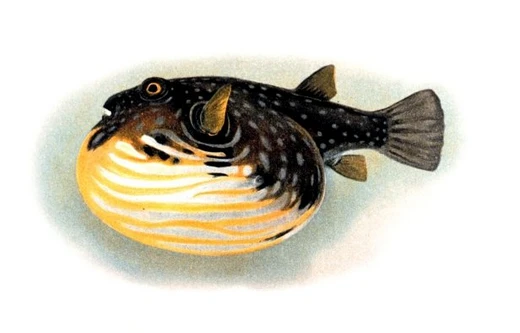
Spotted boxfish
A boxfish with a bony carapace and toxic slime.

The spotted boxfish (Ostracion meleagris), also known as the black boxfish, ornate boxfish or white-spotted boxfish, is a species of marine ray-finned fish belonging to the family Ostraciidae. It is found in the Indian and Pacific Oceans on reefs at depths of 1 to 30 metres. Males and females differ in colour, and the species is notable for its bony carapace, which gives it a distinctly angular appearance described as resembling an ottoman.
Quick Facts
- Taxon
- Ostracion meleagris
Facts from the source article.
Lore & Background
The spotted boxfish was first formally described in 1796 by the English naturalist George Shaw, with its type locality given as the Southern Ocean, i.e. the South Pacific. The genus name Ostracion means 'little box', alluding to the body shape of its type species, while the specific name meleagris refers to the helmeted guineafowl, an allusion to the white spots on a dark background. Males are blackish on the back with white spots and have bluish sides with bright yellowish bands and spots; females and juveniles are dark brown to blackish with white spots. Juveniles with male patterns have never been observed, suggesting either that juvenile males are born with female colors or that all young are female and change sex later. The fish is protected by a toxic slime that can kill other fish, making it unsuitable for aquariums.
Reader's Guide
The spotted boxfish is a member of the family Ostraciidae, within the order Tetraodontiformes. Its bony carapace, formed by thickened, joined, enlarged hexagonal scale plates, gives it an angular, box-like shape with openings for the mouth, eyes, gill slits, fins, and tail base. It has a small mouth with fleshy lips and 15 mid-sized teeth on each jaw, and lacks pelvic fins. Its diet consists of sponges, worms, tunicates, and other small invertebrates. The species makes sounds during mating: a low-pitched humming lasting about 6 seconds, and during fights between males, thumping and short buzzing sounds. Mating occurs in the afternoon and early evening, with a group typically consisting of one male and several females. After mating, other males may attempt to disrupt the process, leading to fights. The species is found in seaward and protected reefs, with juveniles often sheltering among the spines of tropical sea urchins.
Did You Know?
- The spotted boxfish's bony carapace has been described as resembling an ottoman.
- Males and females differ in colour: males have bluish sides with bright yellowish bands, while females are dark brown to blackish with white spots.
- The specific name meleagris is an allusion to the white spots of a helmeted guineafowl.
More in Pufferfish and Boxfish 1-24
Spotted an error? Know more?
Reader corrections go straight into our review queue. Suggest an edit · How this site is sourced