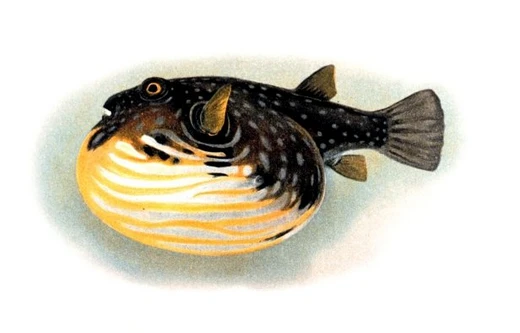
Smooth trunkfish
A boxfish with a triangular body and toxic skin secretions.

The smooth trunkfish (Lactophrys triqueter) is a marine ray-finned fish belonging to the boxfish family Ostraciidae. Its range spans the western Atlantic Ocean.
Carl Linnaeus first formally described this species in 1758, placing it in the genus *Ostracion* and giving the type locality as "India"—an error, as it actually occurs in the Western Atlantic. The genus name *Lactophrys* combines *lactaria* ("milkcow") and *ophrys* ("eyebrow"), referring to the spines above the eyes that resemble cow horns (a feature that gives some related fish the common name "cowfish"). The species name *triqueter* means "three-angled," describing the fish's triangular body when viewed head-on.
The body is angular and encased in plate-like scales that form a bony carapace. From the front, the shape is triangular—narrow at the top and wide at the base. Maximum length is 47 cm (19 in), though 20 cm (8 in) is more typical. The snout is pointed, with protruding lips around a small mouth, and the tail is brush-shaped. Adults are dark with small white spots, often arranged in hexagonal groups that create a honeycomb pattern on the midsection. The snout tip and area around the pectoral fins are dark with few spots; the eyes are black. Fins are usually yellowish with dark bases and tips, containing only soft rays (no spines). Juveniles have dark bodies covered in large yellow spots, later developing a pale area where the honeycomb markings will appear.
This fish inhabits coral reefs and sandy seabeds down to about 50 m (164 ft) in the Caribbean Sea, Gulf of Mexico, and western Atlantic, from Canada and the Gulf of Maine south to Brazil.
Normally solitary, it sometimes moves in small groups. Using its protruding lips, it expels a jet of water to disturb the sandy bottom and uncover buried benthic invertebrates, which it then eats. Its diet includes molluscs, polychaete worms, acorn worms, peanut worms, small crustaceans, sponges, and tunicates.
In some regions, smooth trunkfish are caught for human consumption. They are also kept in reef aquariums, but caution is required: when stressed, the fish releases a toxic substance called ostracitoxin in its skin mucus. This has poisoned aquarium systems, killing all other animals in the tank.
Quick Facts
- Taxon
- Lactophrys triqueter
Facts from the source article.
Lore & Background
The smooth trunkfish was first formally described as Ostracion triqueter in 1758 by Carl Linnaeus in the 10th edition of Systema Naturae, with its type locality given as 'India', in error for the Western Atlantic. Its genus name Lactophrys is a compound of lactaria, meaning 'milkcow', and ophrys, meaning 'eyebrow', a reference to the spines above the eyes resembling cow horns. The specific name triqueter means 'three angled', referring to the fish's triangular body when viewed head on.
The smooth trunkfish has an angular body sheathed in plate-like scales, enclosed in a bony carapace. When viewed from the front, it is triangular with a narrow top and wide base. It has a pointed snout with protuberant lips encircling a small mouth, and a brush-shaped tail. The general background colour is dark with small white spots, often in hexagonal groups giving a honeycomb-like appearance in the middle area of the body. The tip of the snout and area round the pectoral fins are dark with few spots, and the eyes are black. The fins are usually yellowish with a dark base and tip, and have only soft rays with no spines. Juveniles have dark bodies covered in large yellow spots, developing a pale area where honeycomb markings will later appear.
The smooth trunkfish is normally solitary but sometimes moves around in small groups. It uses its protuberant lips to expel a jet of water to disturb the sandy seabed and reveal shallowly buried benthic invertebrates, which it then feeds on. Its diet includes molluscs, polychaete worms, acorn worms, peanut worms, small crustaceans, sponges, and tunicates.
Reader's Guide
The smooth trunkfish is found down to a depth of about 50 m on coral reefs and over sandy seabeds in the Caribbean Sea, Gulf of Mexico, and the western Atlantic Ocean, ranging from Canada and the Gulf of Maine southwards to Brazil. In some regions, it is caught for human consumption. It is also sometimes kept in reef aquaria, but caution is needed because it is capable of producing a toxic substance, ostracitoxin, in mucous secretions from the skin. When the fish is stressed, this toxin is released into the water, and there have been examples of aquarium systems being poisoned by it, resulting in the loss of all other animal inhabitants. This toxicity makes the smooth trunkfish notable both as a potential hazard in captivity and as a species with a unique chemical defense mechanism. Its distinctive appearance—with a bony carapace, triangular body, and honeycomb-like spotting—also contributes to its recognition among reef fishes.
Did You Know?
- The smooth trunkfish can produce a toxic substance called ostracitoxin in its skin mucus.
- Its specific name triqueter means 'three angled', referring to its triangular body when viewed head on.
- Juveniles have dark bodies covered in large yellow spots, which later develop into honeycomb-like markings.
More in Pufferfish and Boxfish 1-24
Spotted an error? Know more?
Reader corrections go straight into our review queue. Suggest an edit · How this site is sourced