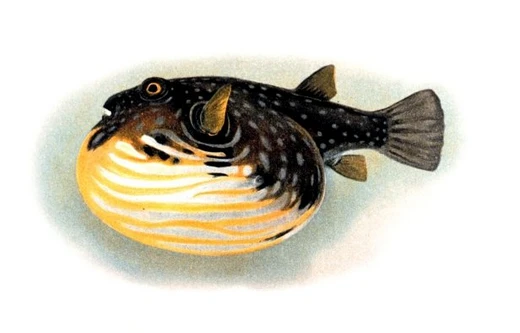
Acanthostracion polygonius
A boxfish with hexagonal armor and protective horns.

The honeycomb cowfish (Acanthostracion polygonius) is a marine ray-finned fish in the boxfish family Ostraciidae. It lives in the western Atlantic Ocean.
Its genus name, *Acanthostracion*, combines the Greek for "spine" with *Ostracion*, a reference to its thorny armor. The species name *polygonius* means "many-angled," describing the hexagonal pattern on its shell. Cuban zoologist Felipe Poey first described it in 1876, with Cuba as the type locality.
The fish is covered in armor-like hexagonal scales. Its honeycomb pattern and two spines above the eyes help it blend into coral reefs. Colors range from blue to yellow, gray, or green, with juveniles more colorful than adults. It has no pelvic fins and a rounded tail fin. Compared to other boxfish, it has a smaller, protruding mouth with fleshy lips. Maximum length is 50 centimeters, averaging 25 centimeters.
Found across the western Atlantic, Caribbean, and near Brazil, it is absent from most of the Gulf of Mexico except around Florida. It inhabits warm, clear waters near coral reefs, seagrass beds, and estuaries, and is an uncommon, cautious species.
Usually solitary, it sometimes forms groups of one male and two females. Little is known about its reproduction, but it mates in open water, with pairs swimming quickly to the surface to release gametes before diving back down. It can change color to hide from predators and remain still for long periods. Juveniles swim better than adults due to rounder bodies.
It feeds during the day on small marine invertebrates like shrimp, sponges, algae, tunicates, and worms.
Humans value it as a food fish, sold fresh and prized in the Caribbean where it is abundant. However, ciguatera poisoning has been reported from eating it. It is also sold as an aquarium fish.
Quick Facts
- Taxon
- Acanthostracion polygonius
Facts from the source article.
Lore & Background
The honeycomb cowfish was first formally described as Acanthostracion polygonius in 1876 by the Cuban zoologist Felipe Poey, with Cuba given as its type locality. The genus name Acanthostracion combines acanthus, meaning 'spine' or 'thorn', with ostracion; the specific name polygonius means 'many angled', referring to the hexagonal patterning on its carapace. The 5th edition of Fishes of the World classifies this genus within the family Ostraciidae in the suborder Ostracioidea of the order Tetraodontiformes.
This fish has armor-like, hexagonal scales covering most of its body, and is named for its honeycomb-like pattern and 'horns.' Most individuals are blue, but can also be yellow, gray, or green; juveniles are generally more colorful than adults. It has no pelvic fins, and its caudal fin is rounded. It can be distinguished from similar fish by the two spines above its eyes and its hexagonal pattern. Compared to other boxfish, it has a smaller, protruding mouth and fleshy lips. The maximum body length is 50 centimeters, with an average of 25 centimeters.
The honeycomb cowfish lives in warm, clear waters near coral reefs, sea grass beds, and estuaries. It is an uncommon and cautious species. It is usually solitary, but can be seen in groups of three consisting of one male and two females. Little is known about their reproduction, but they mate in open water, quickly swimming to the surface in pairs to release gametes and then swimming back down. They can change color to protect themselves from predation and remain stationary for long periods when camouflaged. Juveniles have better swimming abilities than adults due to their rounder bodies. Feeding occurs during the day on small marine invertebrates including shrimp, sponges, algae, tunicates, and worms.
Reader's Guide
The honeycomb cowfish is considered a valuable food fish, marketed fresh and prized in the Caribbean where it is abundant. However, there have been several reports of ciguatera poisoning from consumption of this fish, which is a significant health concern for those who eat it. It is also sold commercially as an aquarium fish, indicating its appeal in the ornamental trade. Its distinctive appearance—with hexagonal patterning, two spines above the eyes, and a small protruding mouth—makes it recognizable among boxfishes. The species is distributed throughout the western Atlantic, the Caribbean Sea, and waters near Brazil, though it is absent throughout most of the Gulf of Mexico except for populations around Florida. Its ability to change color and remain stationary for long periods aids in predator avoidance, and its armored scales and horns provide physical defense. Despite being uncommon and cautious, it plays a role in reef ecosystems as a diurnal feeder on invertebrates. The honeycomb cowfish's legacy is tied to its unique morphology and its dual value as both a food source and an aquarium species, tempered by the risk of ciguatera poisoning.
Did You Know?
- The honeycomb cowfish was first formally described in 1876 by Cuban zoologist Felipe Poey.
- Its specific name polygonius means 'many angled', referring to its hexagonal carapace pattern.
Frequently Asked Questions
What is Acanthostracion polygonius?
It is a marine boxfish in the family Ostraciidae, commonly known as the honeycomb cowfish. Its body is encased in a rigid carapace of hexagonal bony plates, giving it a striking geometric appearance.
What does the name Acanthostracion polygonius mean?
The genus name fuses the Greek word for "spine" with Ostracion, a nod to its thorny bony armor. The species epithet translates to "many-angled," referencing the polygonal scale pattern that covers its shell.
Where is Acanthostracion polygonius found?
This species is native to the western Atlantic Ocean, where it associates with coral reef habitats. Its honeycomb patterning and the two small spines above its eyes help it blend into the surrounding reef structure.
How large does Acanthostracion polygonius grow?
Adults typically measure around 25 cm in body length, though the species can reach roughly 50 cm at its maximum size.
Who first described Acanthostracion polygonius and when?
Cuban zoologist Felipe Poey provided the formal scientific description of the species in 1876. He designated Cuba as the type locality for the new name.
More in Pufferfish and Boxfish 1-24
Spotted an error? Know more?
Reader corrections go straight into our review queue. Suggest an edit · How this site is sourced