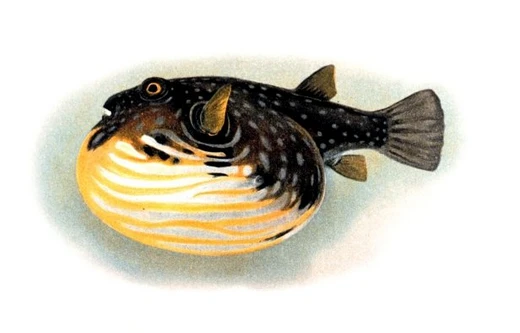
Ostracion
A genus of boxfishes with a bony, cuboidal carapace.

Ostracion is a genus of marine ray-finned fish in the boxfish family Ostraciidae. Its members inhabit the Indo-Pacific, ranging eastward to the eastern Pacific coasts of the Americas.
The genus was first proposed by Carl Linnaeus in the 10th edition of *Systema Naturae*. The type species is *Ostracion cubicus*, though early designations were confused: Pieter Bleeker named *O. teragonus* in 1865, while David Starr Jordan and Charles Henry Gilbert chose *O. cubiceps* in 1883. Ostracion serves as the type genus for the family Ostraciidae, which the 5th edition of *Fishes of the World* places in the suborder Ostracioidea within the order Tetraodontiformes.
The name *Ostracion* derives from the Greek *ostrắkion*, a diminutive of *óstrakon* meaning "shell," referring to the body shape of the type species *O. cubicum*.
These boxfishes occur in the Indian and Pacific Oceans, from the Red Sea and eastern Africa to the Eastern Pacific between Mexico and Ecuador. One species, the yellow boxfish, has entered the Mediterranean via the Suez Canal. They are solitary inhabitants of lagoons and reefs, typically in shallow water.
Their bodies are thick and oblong, largely enclosed in a carapace of thickened, bony hexagonal scales that are jointed together. The carapace is cuboidal, gently rounded on top and flat underneath. A pair of longitudinal ridges runs along the lower flanks, but no spines are present. Openings in the carapace accommodate the mouth, eyes, gill slits, fins, and caudal peduncle. The snout protrudes, bearing a small mouth with fleshy lips and up to 15 moderately sized conical teeth per jaw. The gill slits are short and oblique, located just in front of the pectoral-fin bases. The dorsal and anal fins are set toward the rear. The caudal peduncle is slender, and the caudal fin is a rounded fan.
The largest species is the yellow boxfish (*O. cubicum*), reaching a maximum total length of 45 cm. The smallest is the roughskin trunkfish (*O. trachys*), at 11.5 cm.
Recognized species within Ostracion are listed below.
Quick Facts
- Taxon
- Ostracion
- Type Species
- Ostracion cubicus
- Type Species Authority
- Linnaeus, 1758
Facts from the source article.
Lore & Background
Ostracion was first proposed as a genus by Carl Linnaeus in the 10th edition of Systema Naturae. The type species designation is historically unclear: Pieter Bleeker designated O. teragonus as the type in 1865, while David Starr Jordan and Charles Henry Gilbert designated O. cubiceps in 1883. The genus is the type genus of the family Ostraciidae, which the 5th edition of Fishes of the World classifies within the suborder Ostracioidea, order Tetraodontiformes.
The etymology of Ostracion derives from the Greek ὀστρᾰ́κιον (ostrắkion), a diminutive of ὄστρακον (óstrakon), meaning 'shell', alluding to the body shape of the type species O. cubicum. These fishes are solitary and inhabit lagoons and reefs in shallow water. Their carapace is cuboidal, gently rounded on the dorsal surface and flat ventrally, with no spines; it has gaps for the mouth, eyes, gill slits, fins, and caudal peduncle. They have a protruding snout with a small mouth, fleshy lips, and 15 or fewer conical teeth in each jaw.
Reader's Guide
Ostracion holds significance as the type genus of the family Ostraciidae, a group of marine fishes defined by their rigid, box-like carapace. The genus was established by Carl Linnaeus in the 10th edition of Systema Naturae, though the identity of its type species remains disputed among later ichthyologists. Its distribution spans the Indian and Pacific Oceans, from the Red Sea and eastern Africa to the eastern Pacific coasts of the Americas, with one species—the yellow boxfish—having entered the Mediterranean via the Suez Canal. The genus includes species ranging in size from the roughskin trunkfish at 11.5 cm to the yellow boxfish at 45 cm total length. The carapace, composed of thickened, jointed hexagonal scales, provides a distinctive protective structure, while the absence of spines and the presence of a slender caudal peduncle and rounded fan-shaped caudal fin are characteristic. These fishes are solitary inhabitants of shallow lagoons and reefs. The etymology of the name, meaning 'little shell', reflects the box-like form that defines the genus and its family.
Did You Know?
- The largest species in the genus is the yellow boxfish (O. cubicum) at 45 cm total length; the smallest is the roughskin trunkfish (O. trachys) at 11.5 cm.
- One species, the yellow boxfish, has reached the Mediterranean Sea through the Suez Canal.
More in Pufferfish and Boxfish 1-24
Spotted an error? Know more?
Reader corrections go straight into our review queue. Suggest an edit · How this site is sourced