Ostracion whitleyi
A sexually dimorphic boxfish from the Eastern Central Pacific.

Whitley's boxfish (Ostracion whitleyi) is a marine ray-finned fish in the boxfish family Ostraciidae. It lives in the Eastern Central Pacific Ocean.
American zoologist Henry Weed Fowler first formally described the species in 1931, giving the Marquesas Islands as the type locality. Fowler's name replaced an earlier name, *Ostracion ornatus*, proposed by Henri Hollard in 1857, which was already taken by a different species described by John Edward Gray in 1838. The genus *Ostracion* belongs to the family Ostraciidae, within the suborder Ostracioidea of the order Tetraodontiformes.
The genus name *Ostracion* means "little box," referring to the body shape of the type species, *O. cubicum*. The specific name honors British-born Australian ichthyologist Gilbert Percy Whitley, who alerted Fowler that Hollard's name needed replacing.
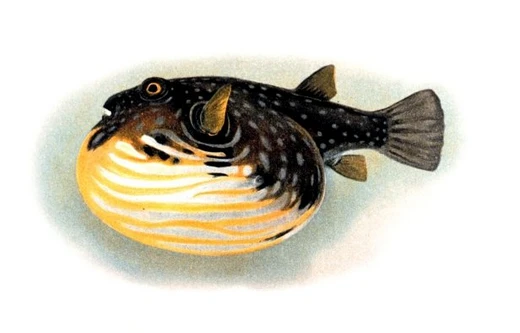
This species shows sexual dimorphism. Males have a navy blue body with pale blue lines along the upper and lower sides, and a black back dotted with pale blue spots. Females are golden yellow with white spots and a white band along the flank. The maximum recorded total length is 15.5 cm (6.1 in).
Whitley's boxfish occurs in the Eastern Central Pacific, including the Hawaiian Islands, Johnston Atoll, the Marquesas Islands, and the Tuamotu Islands. It inhabits clear lagoons and seaward reefs at depths between 3 and 27 m (9.8 and 88.6 ft).
Quick Facts
- Taxon
- Ostracion whitleyi
Facts from the source article.
Lore & Background
Whitley's boxfish was first formally described in 1931 by the American zoologist Henry Weed Fowler, with its type locality given as the Marquesas Islands. Fowler's name replaced Ostracion ornatus proposed by Henri Hollard in 1857, which was preoccupied by Ostracion (Aracana) ornata described by John Edward Gray in 1838. The species is classified in the genus Ostracion, which the 5th edition of Fishes of the World places within the family Ostraciidae in the suborder Ostracioidea within the order Tetraodontiformes.
The specific name honours the British-born Australian ichthyologist Gilbert Percy Whitley, who drew Fowler's attention to the fact that Hollard's name needed replacement. The genus name Ostracion means 'little box', an allusion to the body shape of its type species, O. cubicum.
Whitley's boxfish is sexually dimorphic: males have a navy blue body with pale blue lines along the upper and lower sides and a black dorsal surface marked with pale blue spots; females are golden yellow with white spots and a white band along the flank. The species reaches a maximum published total length of 15.5 cm (6.1 in). It occurs in the Hawaiian Islands, Johnston Atoll, the Marquesas Islands, and the Tuamotu Islands, at depths between 3 and 27 m in clear lagoons and seaward reefs.
Reader's Guide
Whitley's boxfish is notable as a distinct species within the genus Ostracion, first described by Henry Weed Fowler in 1931 based on material from the Marquesas Islands. Its taxonomy reflects a nomenclatural correction: Fowler replaced an earlier name by Henri Hollard that was already in use for a different species described by John Edward Gray. The species' specific name honors Gilbert Percy Whitley, an ichthyologist who identified the need for this replacement. This fish exhibits clear sexual dimorphism, with distinct coloration patterns in males and females, and inhabits clear lagoons and seaward reefs in the Eastern Central Pacific, including the Hawaiian Islands, Johnston Atoll, the Marquesas Islands, and the Tuamotu Islands. Its maximum recorded length of 15.5 cm places it among the smaller boxfishes. The species is classified within the family Ostraciidae, suborder Ostracioidea, order Tetraodontiformes, following the 5th edition of Fishes of the World. Its presence across multiple island groups in the Pacific highlights its distribution within a limited geographic range.
More in Pufferfish and Boxfish 1-24
Spotted an error? Know more?
Reader corrections go straight into our review queue. Suggest an edit · How this site is sourced