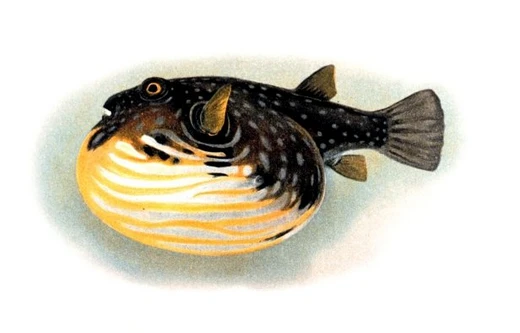
Ostracion trachys
A rough-skinned boxfish from Mascarene reefs.

**Ostracion trachys**, also called the rough boxfish or roughskin trunkfish, is a marine ray-finned fish in the Ostraciidae family. It lives in the western Indian Ocean near the Mascarene Islands.
American ichthyologist John Ernest Randall first described the species in 1975. He based it on a specimen collected from a patch reef about 800 meters northeast of Grand Baie, Mauritius. The fish belongs to the genus *Ostracion* (meaning "little box," a reference to the boxlike body shape of the type species *O. cubicum*). Its species name *trachys* means "rough," referring to the texture of its carapace, especially where each scale has a small central spinule.
The rough boxfish has nine soft rays in both its dorsal and anal fins. Its caudal fin has ten rays: the top and bottom rays are simple, while the other eight are branched, and the rear edge of the fin is convex. The carapace is oblong, with convex upper and lower surfaces and concave sides. The plate-like scales are hexagonal, and most—especially on the back and rear of the body—bear a spinule.
Adult males are blackish on the upper body, with small white spots that extend to the area between the eyes, where a white band with black margins appears. The snout and sides of the carapace are bluish grey, broken by a clear white stripe along the upper ridge. The caudal peduncle and fin are dark brown, with a few white spots near the fin’s base. The underside is bluish grey, and a large white spot with a black margin sits at the gill slit. The upper lip is dark with a white edge; the lower lip is white. Females are dark brown to black, with white spots on the back and sides of the carapace, and a whitish underside marked with brown bands and yellow-edged brown spots. Juveniles are also dark brown to black, with small circular white spots on the sides and a whitish underside with faint dark spots. The maximum recorded total length is 11 cm.
This secretive species inhabits rocky reefs at depths between 15 and 30 meters, hiding in holes and crevices. It occurs only around Mauritius and Réunion in the Mascarene Islands.
Quick Facts
- Taxon
- Ostracion trachys
Facts from the source article.
Lore & Background
Ostracion trachys was first formally described in 1975 by American ichthyologist John Ernest Randall, with its type locality given as a patch reef about 800 meters northeast of Grand Baie on Mauritius. The genus name Ostracion means 'little box,' referring to the body shape of its type species, while the specific name trachys means 'rough,' alluding to the feel of the carapace, especially where scales have a spinule at their center.
The carapace is oblong with convex dorsal and ventral surfaces and concave sides. The plate-like scales are hexagonal, with most having a spinule, particularly toward the rear and on the back. Adult males are blackish on the upper body with small white spots extending to between the eyes, where there is a white band with black margins. The snout and sides are bluish grey with a white stripe along the upper ridge. Females are dark brown to black with white spots on the back and sides, a whitish underside with brown bands, and yellow-margined brown spots. Juveniles are dark brown to black with small circular white spots on the sides and a whitish ventral surface with small indistinct dark spots.
This species is secretive, living at depths between 15 and 30 meters, hiding in holes and crevices in rocky reefs. It is found in the Western Indian Ocean off the Mascarene Islands of Mauritius and Réunion.
Reader's Guide
Ostracion trachys is a small, secretive boxfish restricted to the Western Indian Ocean around the Mascarene Islands of Mauritius and Réunion. Its significance lies in its distinctive rough carapace, which is covered with hexagonal scales bearing spinules, giving the fish its common name. The species was described relatively recently in 1975 by John Ernest Randall, adding to the known diversity of the Ostraciidae family. Its secretive nature, hiding in holes and crevices of rocky reefs at depths of 15 to 30 meters, makes it less commonly observed than other boxfish. The species exhibits sexual dimorphism in coloration, with adult males displaying a blackish upper body with white spots and a white band between the eyes, while females and juveniles have different patterns. The maximum recorded total length is 11 cm, making it a modest-sized member of its family. Its legacy is as a representative of the cryptic reef fauna of the Mascarenes, contributing to the understanding of boxfish diversity and distribution in the Indian Ocean.
Did You Know?
- The specific name 'trachys' means 'rough,' referring to the spinules on the carapace scales.
- Adult males have a white band with black margins between the eyes.
More in Pufferfish and Boxfish 1-24
Spotted an error? Know more?
Reader corrections go straight into our review queue. Suggest an edit · How this site is sourced