Ostracion solorense
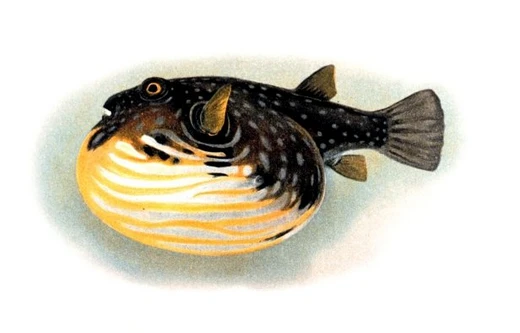
A boxfish with sinuous lines and bony protuberance above the lip.

The reticulate boxfish, also called the scribbled boxfish, Solor boxfish, or striped boxfish, is a marine ray-finned fish in the family Ostraciidae. It lives in the far eastern Indian Ocean and the western Pacific Ocean.
Dutch physician and ichthyologist Pieter Bleeker first described this species in 1853, basing it on a specimen from Lawajong on Solor Island, Indonesia. It belongs to the genus *Ostracion*, which means "little box"—a reference to the boxy shape of its type species, *O. cubicum*. The species name *solorense* means "of Solor," after its type locality. In the current classification (5th edition of *Fishes of the World*), *Ostracion solorense* sits within the family Ostraciidae, suborder Ostracioidea, order Tetraodontiformes.
This fish has nine soft rays in both its dorsal and anal fins. Males range from bluish-grey to blackish, with thin, light blue, wavy lines on the back; a wide dark stripe with paler wavy lines on the upper flank; and white spots edged in black along the flanks. Females show black lines on the upper body, while the sides are yellowish to greenish brown with a network of black lines. A bony bump sits above the upper lip. The maximum recorded total length is 12 cm (4.7 in).
The reticulate boxfish occurs in the eastern Indian Ocean (Rowley Shoals and Christmas Island) and the Pacific as far east as Palau and Fiji. It inhabits clear coastal reefs at depths between 1 and 20 m (3 ft 3 in and 65 ft 7 in).
Quick Facts
- Taxon
- Ostracion solorense
Facts from the source article.
Lore & Background
Ostracion solorense was first formally described in 1853 by the Dutch physician, herpetologist and ichthyologist Pieter Bleeker, with its type locality given as Lawajong on Solor Island, Indonesia. The species is classified in the genus Ostracion, which the 5th edition of Fishes of the World places within the family Ostraciidae in the suborder Ostracioidea within the order Tetraodontiformes. The genus name Ostracion means 'little box', an allusion to the shape of the body of its type species, O. cubicum, while the specific name solorense means 'of Solor', referring to the type locality.
Males of this species vary in overall colour from bluish-grey to blackish, with thin light blue sinuous lines on the back, a wide dark stripe with paler wavy lines on the upper flank, and white spots with black margins along the flanks. Females have black lines on the upper body, with sides that are yellowish to greenish brown and a network of black lines. A characteristic bony protuberance above the upper lip is present. The species has nine soft rays in both the dorsal and anal fins, and reaches a maximum published total length of 12 cm (4.7 in).
Ostracion solorense is found in the eastern Indian Ocean at Rowley Shoals and Christmas Island, and in the Pacific as far east as Palau and Fiji. It inhabits depths between 1 and 20 m on coastal reefs in clear waters.
Reader's Guide
The reticulate boxfish is notable for its distinctive colour patterns and the bony protuberance above the upper lip, which are key characteristics described in the source article. Its description by Pieter Bleeker in 1853 from Solor Island, Indonesia, places it within the long history of ichthyological exploration in the Indo-Pacific. The species is one of several boxfishes in the genus Ostracion, a group known for their box-like body shape. Its distribution across the far eastern Indian Ocean and Western Pacific, from Rowley Shoals and Christmas Island to Palau and Fiji, indicates a relatively wide range within clear coastal reef habitats at shallow depths. The sexual dimorphism in colouration—males with sinuous blue lines and white-spotted flanks, females with a yellowish-greenish brown network of black lines—is a notable biological detail. The species' maximum size of 12 cm makes it a small member of the boxfish family. The source article does not discuss any conservation status, economic importance, or cultural significance, so this entry strictly reflects the taxonomic, morphological, and distributional facts provided.
More in Pufferfish and Boxfish 1-24
Spotted an error? Know more?
Reader corrections go straight into our review queue. Suggest an edit · How this site is sourced