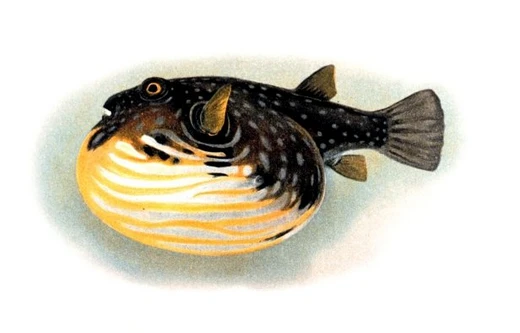
Ostracion rhinorhynchos
A boxfish with a blunt conical snout protuberance in males.

Ostracion rhinorhynchos, also called the horn-nosed boxfish or torpedo boxfish, is a ray-finned fish in the family Ostraciidae. It lives in the Indo-West Pacific.
The Dutch scientist Pieter Bleeker first described this species in 1851, based on a specimen from Jakarta, Java. It belongs to the genus Ostracion, which means "little box"—a reference to the box-like body of the type species, *O. cubicum*. The species name *rhinorhynchos* combines the Greek words for "beak" and "snout," referring to the cone-shaped bump on the snout of adults.
The fish has nine soft rays in both its dorsal and anal fins, and ten rays in its caudal fin (eight of them branched). Adult males have a large, blunt, conical bump above the mouth and in front of the eyes. The oblong body carapace has a weak ridge on the back and sharp ridges on the lower sides, but no spines. The upper body is pale grey, sometimes with spots—most visible on the tail stalk and less clear on the sides. The lower body is white, and the fins are dusky. The maximum recorded total length is 35 cm (14 inches).
This species has a wide range across the Indian and Pacific Oceans, from the Maldives and Sri Lanka east to Chuuk State in Micronesia, and north to southern Japan. It lives at depths of 1 to 50 meters, on rubble, flat areas, and reefs.
Quick Facts
- Taxon
- Ostracion rhinorhynchos
Facts from the source article.
Lore & Background
Ostracion rhinorhynchos was first formally described in 1851 by the Dutch physician, herpetologist and ichthyologist Pieter Bleeker, with its type locality given as Jakarta on Java. It is classified in the genus Ostracion, which means 'little box', an allusion to the body shape of its type species, O. cubicum. The specific name rhinorhynchos is a compound of rhinos, meaning 'beak' or 'bill', and rhynchos, meaning 'snout', referring to the cone-shaped protuberance on the snout of adults.
The species has 9 soft rays supporting both the dorsal and anal fins, while the caudal fin has 10 rays, 8 of which are branched. Males have a large, blunt, conical protuberance above the mouth and in front of the eyes. The oblong carapace has a poorly developed ridge on the back with sharp ridges on the lower flank, but no spines. The upper body is pale grey and may be spotted, with spotting more prominent on the caudal peduncle and less clear on the flanks; the lower body is white and the fins are dusky. The maximum published total length is 35 cm (14 in).
Ostracion rhinorhynchos has a wide distribution in the Indian and Pacific Oceans, from the Maldives and Sri Lanka east to Chuuk State in Micronesia, and north as far as southern Japan. It is found at depths between 1 and 50 m on substrates of rubble, as well as flat areas and on reefs.
Reader's Guide
The horn-nosed boxfish is a member of the family Ostraciidae, within the order Tetraodontiformes. Its description by Pieter Bleeker in 1851, with a type locality of Jakarta on Java, places it within the historical context of 19th-century ichthyological exploration of the Indo-West Pacific. The species' etymology—the genus name Ostracion meaning 'little box' and the specific name rhinorhynchos referring to the snout protuberance—highlights key morphological features used in its classification. The species is noted for its sexual dimorphism, with males possessing a large, blunt conical protuberance above the mouth. Its distribution across the Indian and Pacific Oceans, from the Maldives to southern Japan and Micronesia, indicates a broad tropical range. The species inhabits depths from 1 to 50 m on rubble, flat areas, and reefs. The maximum published total length of 35 cm provides a size reference for this boxfish. No further significance or legacy beyond these biological and taxonomic details is provided in the source article.
More in Pufferfish and Boxfish 1-24
Spotted an error? Know more?
Reader corrections go straight into our review queue. Suggest an edit · How this site is sourced