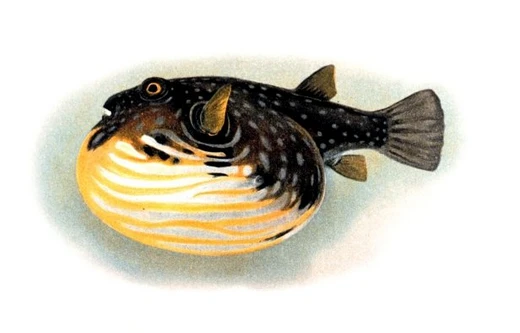
Ostracion nasus
A boxfish found in the Indian and Pacific Oceans.

The shortnose boxfish (Ostracion nasus) is a marine ray-finned fish in the boxfish family Ostraciidae. It lives in the Indian and Pacific Oceans. German physician and naturalist Marcus Elieser Bloch first formally described the species in 1785, listing its type locality as the Nile Delta, Egypt—likely a mistake. The genus name *Ostracion* means "little box," referring to the body shape of its type species, *O. cubicum*. The specific name *nasus* means "nose," a nod to the fish's short snout. Both males and females have a short, fleshy bump overhanging the lips, which is thicker and wider in males. The dorsal and anal fins each have nine soft rays; the caudal fin has ten rays, eight of which are branched. Juveniles are white to beige with large, uniform spots, while adults are tan with large, irregular brown spots mostly on the back. The maximum recorded total length is 30 cm (12 in). This species ranges from Sri Lanka east to Fiji, north to the Philippines, and south to northwestern Australia. It inhabits soft and rocky substrates at depths between 2 and 80 m (6 ft 7 in and 262 ft 6 in).
Quick Facts
- Taxon
- Ostracion nasus
Facts from the source article.
Lore & Background
The shortnose boxfish was first formally described in 1785 by the German physician and naturalist Marcus Elieser Bloch, with its type locality given as the Nile Delta, Egypt, probably erroneously. This species is classified in the genus Ostracion, which the 5th edition of Fishes of the World places within the family Ostraciidae in the suborder Ostracioidea within the order Tetraodontiformes. The genus name Ostracion means 'little box', alluding to the body shape of its type species, O. cubicum, while the specific name nasus means 'nose', referring to the short snout.
The shortnose boxfish has 9 soft rays supporting both the dorsal and anal fins, while the caudal fin has 10 rays, 8 of which are branched. Both sexes have a short, fleshy protuberance that overhangs the lips, which is thicker and wider in males. Juveniles are typically white-to-beige with large, uniform spots, while adults are typically tan with large, irregular, brown spots mostly centered on the dorsal side. This species has a maximum published total length of 30 cm (12 in).
The shortnose boxfish is found in the Indo-Pacific, occurring from Sri Lanka east to Fiji, north to the Philippines and south to northwestern Australia. It inhabits soft and rocky substrates at depths between 2 and 80 m (6 ft 7 in and 262 ft 6 in).
Reader's Guide
The shortnose boxfish is a member of the family Ostraciidae, known for its box-like body shape. Its description by Marcus Elieser Bloch in 1785, with a likely erroneous type locality at the Nile Delta, highlights the historical challenges in early ichthyological classification. The species' etymology—Ostracion meaning 'little box' and nasus meaning 'nose'—directly reflects its physical form. The fish exhibits sexual dimorphism in the fleshy protuberance over the lips, which is thicker and wider in males, and ontogenetic color changes from spotted juveniles to irregularly spotted adults. Its distribution across the Indo-Pacific, from Sri Lanka to Fiji and from the Philippines to northwestern Australia, and its habitat over soft and rocky substrates at depths up to 80 m, define its ecological niche. The maximum recorded length of 30 cm provides a size reference for this species. The article does not discuss conservation status, behavior, or other aspects, so its significance is limited to the taxonomic, morphological, and distributional details provided.
Did You Know?
- Its type locality is given as the Nile Delta, Egypt, probably erroneously.
- Both sexes have a short, fleshy protuberance overhanging the lips, thicker and wider in males.
More in Pufferfish and Boxfish 1-24
Spotted an error? Know more?
Reader corrections go straight into our review queue. Suggest an edit · How this site is sourced