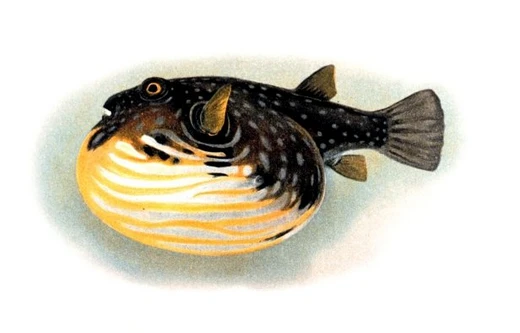
Ostracion immaculatum
A boxfish with blue spots, found in Western Pacific reefs.

Ostracion immaculatum, called the bluespotted boxfish or immaculate boxfish, is a marine ray-finned fish belonging to the family Ostraciidae. Its range is the Western Pacific Ocean off Eastern Asia.
The species was first formally described in 1850 by Coenraad Jacob Temminck and Hermann Schlegel, who gave it the scientific name *Ostracion immaculatus*, with Japan as the type locality. The genus name *Ostracion* means "little box," referring to the body shape of the type species, *O. cubicum*. The specific name *immaculatum* means "unspotted," a reference to how the fish appears without spots when preserved in alcohol, even though living individuals are covered in spots.
Adults are yellow and blue, with light blue spots on each of the plate-like scales that form the carapace. Juveniles are bright yellow with small pale blue and black spots; as the fish grows, the black spots fade and the blue spots enlarge. The maximum published standard length is 25 cm (9.8 in).
This species occurs in the northwestern Pacific Ocean, from the southern coasts of Hokkaido south through the Japanese archipelago to Taiwan, and along the mainland Asian coast from Korea to Hong Kong. It lives at depths between 1 and 60 m (3 ft 3 in and 196 ft 10 in) on nearshore reefs with rocky bottoms in shallow water.
In terms of social structure, *Ostracion immaculatum* forms small groups composed of one male and three or four females.
Quick Facts
- Taxon
- Ostracion immaculatum
Facts from the source article.
Lore & Background
Ostracion immaculatum was first formally described in 1850 by Coenraad Jacob Temminck and Hermann Schlegel, with its type locality given as Japan. The genus name Ostracion means 'little box,' alluding to the body shape of the type species, while the specific name immaculatum means 'unspotted,' referring to the fish's unspotted appearance when preserved in alcohol, though in life it is covered with spots.
Adults are yellow and blue with light blue spots on each plate-like scale forming the carapace. Juveniles are bright yellow with small pale blue and black spots; the black spots fade as the fish grows and the blue spots expand. This species reaches a maximum published standard length of 25 cm.
It is found in the northwestern Pacific Ocean from the southern coasts of Hokkaido south through the Japanese archipelago to Taiwan and along the mainland coast of Asia from Korea to Hong Kong, at depths between 1 and 60 m on reefs close to shore in shallow water with a rocky bottom. It lives in small groups consisting of a single male and three or four females.
Reader's Guide
Ostracion immaculatum, the bluespotted boxfish, is a species within the family Ostraciidae, first described in 1850 by Temminck and Schlegel from Japan. Its significance lies in its distinctive coloration and social structure. The fish exhibits a striking color change from juvenile to adult: juveniles are bright yellow with both pale blue and black spots, but as they mature, the black spots fade and the blue spots enlarge, resulting in the adult's yellow and blue body with light blue spots on each scale of the carapace. This species is found in the northwestern Pacific, ranging from southern Hokkaido through Japan to Taiwan and along the Asian mainland from Korea to Hong Kong. It inhabits shallow, rocky reefs at depths of 1 to 60 m. Its social behavior is notable: it lives in small groups composed of a single male and three or four females. The specific name immaculatum, meaning 'unspotted,' is a reference to its appearance when preserved in alcohol, contrasting with its spotted living form. This boxfish contributes to the biodiversity of Western Pacific reef ecosystems and is a subject of taxonomic and ecological interest due to its color patterns and group living.
Did You Know?
- The specific name immaculatum means 'unspotted,' referring to its appearance when preserved in alcohol, though it is spotted in life.
- Adults have light blue spots on each plate-like scale of the carapace.
- This species lives in small groups of one male and three or four females.
More in Pufferfish and Boxfish 1-24
Spotted an error? Know more?
Reader corrections go straight into our review queue. Suggest an edit · How this site is sourced