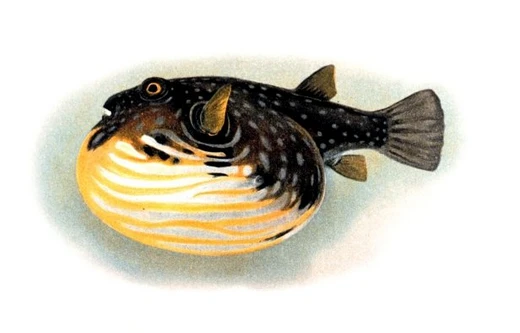
Longhorn cowfish
A boxfish with cow-like horns and a toxic defense.

The longhorn cowfish (Lactoria cornuta), sometimes called the horned boxfish, is a marine ray-finned fish in the boxfish family Ostraciidae. Its most distinctive feature is the pair of long, cow-like horns that jut forward from its head. Found across the Indo-Pacific, it can reach up to 50 cm (20 in) in length. Adults are solitary, territorial reef dwellers, typically living over sandy or rubble bottoms down to about 50 m (160 ft). They are omnivores, feeding on benthic algae, microorganisms, foraminiferans, sponges, polychaete worms, mollusks, small crustaceans, and small fish. To catch buried prey, they blow jets of water into the sand. By preying on invertebrates that damage coral, they help protect and even promote coral reef growth. **Taxonomy** Carl Linnaeus first formally described the species as *Ostracion cornutus* in the 10th edition of *Systema Naturae* (1758), listing India as the type locality. In 1902, David Starr Jordan and Henry Weed Fowler proposed the subgenus *Lactoria* within *Ostracion*, designating *O. cornutus* as its type species. The 5th edition of *Fishes of the World* places this genus in the family Ostraciidae, suborder Ostracioidea, order Tetraodontiformes. **Etymology** The genus name *Lactoria* means “milkcow,” referencing the large spines above the eyes that resemble cow horns. The specific name *cornutus* means “horned,” also alluding to these spines. **Habitat** Its primary habitat is coral reefs in lagoons, reef flats, estuaries, bays, and protected seaward reefs. Juveniles associate with *Acropora* corals. Depth range is typically 1–45 m (3 ft 3 in – 147 ft 8 in), possibly up to 100 m (330 ft). **Distribution** The longhorn cowfish ranges from the Red Sea and East Africa eastward through Indonesia to the Marquesas, north to southern Japan, including the Tuamotus, southern Korea, the Ryukyu Islands, and south to Australia and Lord Howe Island. It inhabits tropical and subtropical waters. The specimens found in India are a new development in the last couple years, and it is speculated that cyclones or typhoons brought Lactoria cornuta to a new environment. **Description** No sexual dimorphism is known in coloration: both sexes display a yellow to olive base color with white or bluish spots. Females are generally larger and heavier than males.
Quick Facts
- Genus
- Lactoria
- Species
- cornuta
Facts from the source article.
Lore & Background
The longhorn cowfish was first formally described as Ostracion cornutus by Carl Linnaeus in the 10th edition of Systema Naturae in 1758, with the type locality given as India. In 1902, David Starr Jordan and Henry Weed Fowler proposed the subgenus Lactoria within Ostracion, designating O. cornutus as its type species. The genus name Lactoria means 'milkcow', referring to the large spines above the eyes resembling cow horns, and the specific name cornutus means 'horned'. This species is a resident of the Indo-Pacific region, from the Red Sea and East Africa eastward through Indonesia to the Marquesas, north to southern Japan, and south to Australia and Lord Howe Island. Specimens found in India are a recent development, possibly brought by cyclones or typhoons. Adults are reef fish, often solitary and territorial, living around sand or rubble bottom up to 50 m deep. Juveniles associate with Acropora corals. The longhorn cowfish has no known sexual dimorphism in color, displaying a yellow to olive base with white or bluish spots. Females are generally larger and heavier than males. It lacks a gill cover, replaced by a small slit, and has no pelvic fins. Its hexagonal plate-like scales are fused into a solid, triangular carapace. It swims using ostraciiform swimming, appearing to hover. The tail fin can be as long as the body. It can produce two kinds of sounds—hums and clicks—using muscles connected to its swim bladder.
Reader's Guide
The longhorn cowfish is significant as a predator of invertebrates that destroy coral reefs, thereby protecting and aiding in the growth and creation of coral reefs. It is omnivorous, feeding on benthic algae, microorganisms, foraminiferans, sponges, polychaete worms, mollusks, small crustaceans, and small fish, often blowing jets of water into sand to uncover prey. Its defense mechanisms include the ability to exude the deadly toxin pahutoxin from skin mucus when severely stressed—a poison unique among known fish poisons and toxic to the boxfish itself. The horns, composed of mineralized collagen fibers, may make it harder for predators to swallow and can be used to charge at predators; if damaged, they regrow within months. The hard armored carapace and toxic secretion provide solid defenses. To protect eggs from predators like wrasses and damselfishes, the longhorn cowfish spawns close to the substrate. It forms harems of 3–4 females, spawning shortly after sunset or during heavy cloud cover from February to early October. This species is the most well-known cowfish in the aquarium trade. On Pamban Island, local belief held that cows metamorphosed into these fish when the land separated.
Did You Know?
- Its horns are mostly hollow and composed of mineralized collagen fibers, and can regrow within a few months if damaged.
- When severely stressed, it can exude the deadly toxin pahutoxin in its skin mucus, which is toxic to the boxfish itself.
- Females are generally larger and heavier than males, with a maximum recorded length of 250 mm.
More in Pufferfish and Boxfish 1-24
Spotted an error? Know more?
Reader corrections go straight into our review queue. Suggest an edit · How this site is sourced