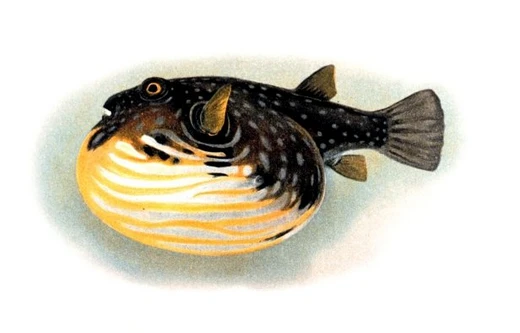
Lactoria fornasini
A boxfish with cow-like spines and toxic skin.

The thornback cowfish (Lactoria fornasini) is a marine ray-finned fish in the boxfish family Ostraciidae. It lives across the tropical Indo-Pacific, from East Africa to the Bass Islands in French Polynesia. This uncommon fish reaches a maximum length of 23 cm (9 in) and feeds on small invertebrates it picks up from the seafloor.
Italian zoologist Giovanni Giuseppe Bianconi first described the species in 1846 as *Ostracion fornasini*, with the type location given as Mozambique. The genus name *Lactoria* means "milkcow," referring to the large spines above the eyes that resemble cow horns. The species name *fornasini* honors Carlo Antonio Fornasini, an Italian amateur naturalist who worked in Mozambique. The 5th edition of *Fishes of the World* places *Lactoria* in the family Ostraciidae, suborder Ostracioidea, order Tetraodontiformes.
Like other boxfishes, the thornback cowfish has hexagonal, plate-like scales fused into a solid, boxy carapace, with only the eyes, mouth, fins, and tail protruding. Its small mouth has protruding lips, the snout’s upper profile is straight, the back is slightly convex, the flanks concave, and the belly rounded—giving the fish a purse-like shape. Small spines sit on each side of the head, a large spine projects from the dorsal ridge, and a moderate-sized spine sticks out from each pelvic ridge near the anal fin. The dorsal and anal fins lack spines but each has nine soft rays; the caudal fin is fan-shaped with ten rays. Typical length is 15 cm (6 in). Color varies and changes with surroundings, generally pale tan with yellow, mauve, or blue spots or wiggly markings. In some regions, the fish is toxic.
The species occurs between 32°N and 32°S, from East Africa (Tanzania to South Africa) and Madagascar to Japan, Indonesia, Australia, Hawaii, and Rapa Island. It lives over sand, rubble, corals, and algae in lagoons and on the seaward side of reefs. It can be found as deep as 132 m (433 ft), but more typically between 6 and 30 m (20 and 100 ft).
The thornback cowfish is usually solitary, though males become territorial during breeding season. It feeds on small invertebrates, exposing them by blowing jets of water from its mouth to clear sand, then sucking them up from the seabed. Like other boxfishes, it can release a soap-like toxin called pahutoxin through its skin when stressed, which can incapacitate or kill predators.
Quick Facts
- Taxon
- Lactoria fornasini
Facts from the source article.
Lore & Background
The thornback cowfish was first formally described as Ostracion fornasini in 1846 by Italian zoologist Giovanni Giuseppe Bianconi, with its type locality given as Mozambique. The genus name Lactoria means 'milkcow', referring to the large spines above the eyes that resemble cow horns. The specific epithet fornasini honors Italian amateur naturalist Carlo Antonio Fornasini, who worked in Mozambique.
Like other boxfishes, the thornback cowfish has hexagonal, plate-like scales fused into a solid carapace, with only the eyes, mouth, fins, and tail protruding. It has a small mouth with protruding lips, a straight upper snout profile, a convex back, concave flanks, and a rounded belly, giving it a purse-like shape. It possesses small pre-ocular spines, a large spine on the dorsal ridge, and moderate spines on the pelvic ridges near the anal fin. Its color is variable, changing to match surroundings, generally pale tan with spots or wiggly markings in yellow, mauve, or blue.
The species is found in areas of sand, rubble, corals, and algae in lagoons and on seaward reef sides. It is usually solitary, but males become territorial during the breeding season. It feeds on small invertebrates, which it exposes by blowing jets of water from its mouth and then picks up by suction from the sea bed.
Reader's Guide
The thornback cowfish is significant as a representative of the boxfish family Ostraciidae, known for its unique armored body and defensive toxin. The article notes that, like other boxfishes, it can release a soap-like toxin called pahutoxin through its skin when stressed, which can incapacitate or kill potential predators. This chemical defense is a notable adaptation among reef fishes. The species is also notable for its variable coloration, which changes to match its surroundings, aiding in camouflage. Its distribution across the tropical Indo-Pacific from East Africa to French Polynesia, and its occurrence at depths from shallow lagoons to over 130 meters, highlight its adaptability. The taxonomic history, with its original description by Bianconi in 1846 and its classification within the genus Lactoria and family Ostraciidae, places it within the broader context of tetraodontiform fishes. The article also notes that in some regions, this fish is toxic, underscoring its potential danger to predators and humans alike. Its diet of small invertebrates and its method of foraging by blowing sand away with water jets illustrate its ecological role as a benthic feeder. The species is described as uncommon, adding to its interest for marine biologists and aquarists.
Did You Know?
- It was first described in 1846 by Italian zoologist Giovanni Giuseppe Bianconi from a specimen collected in Mozambique.
- The fish can grow to a maximum length of 23 cm (9 in) and is typically found at depths of 6 to 30 m.
More in Pufferfish and Boxfish 1-24
Spotted an error? Know more?
Reader corrections go straight into our review queue. Suggest an edit · How this site is sourced