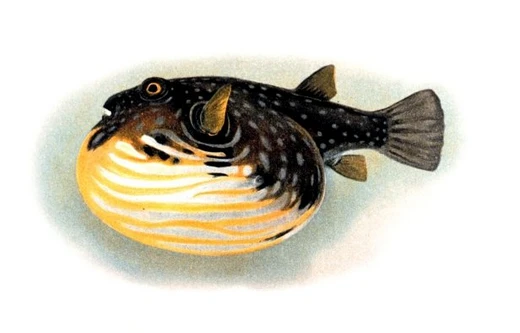
Lactoria diaphana
A boxfish with horn-like spines and a toxic defense.

The roundbelly cowfish, also called the diaphonous, many-spined, spiny, or transparent cowfish, is a marine ray-finned fish in the boxfish family Ostraciidae. It lives in the southeastern Atlantic Ocean and across the Indo-Pacific.
This species was first described in 1801 by Marcus Elieser Bloch and Johann Gottlob Theaenus Schneider, who named it *Ostracion diaphanum*. No specific location was given for the type specimen, though it likely came from the East Indies. In the 5th edition of *Fishes of the World*, the genus *Lactoria* sits within the family Ostraciidae, suborder Ostracioidea, order Tetraodontiformes.
The genus name *Lactoria* means "milkcow," a reference to the large spines above the eyes that resemble cow horns. Fish in this genus, along with some related species, are called cowfishes. The species name *diaphana* means "transparent," because the original specimen appears to have been a clear juvenile.
The roundbelly cowfish has a thick, rectangular body mostly enclosed in a carapace made of thickened, hexagonal, plate-like scales that are joined together. This carapace has five horizontal ridges: a weak one along the back, and a pair (upper and lower) on each side. A large spine sits above each eye, another spine is at the rear of each lower flank ridge, and a spine lies halfway along the back ridge. Its mouth is small, located at the front of the snout, with fleshy lips and no more than 15 moderately sized conical teeth in each jaw. The gill slits are short and slanting, positioned in front of the pectoral fin bases. The dorsal and anal fins are at the rear of the carapace, and the caudal peduncle is thin and flexible. The caudal fin is fan-shaped. Both the dorsal and anal fins have 9 soft rays. The snout’s upper profile is steep and concave, while the body’s lower profile is rounded. Overall color is pale greenish-gray, patterned with a honeycomb reticulation and brown blotches. This fish reaches a maximum total length of 34 cm (13 in).
The roundbelly cowfish has a wide Indo-Pacific range, from the eastern coast of Africa (off Mozambique and South Africa) through the Indian and Pacific Oceans to the eastern Pacific between Santa Barbara, California, and Chile. It extends north to Japan and south to Tasmania.
Quick Facts
- Taxon
- Lactoria diaphana
Facts from the source article.
Lore & Background
Lactoria diaphana was first formally described as Ostracion diaphanum in 1801 by Marcus Elieser Bloch and Johann Gottlob Theaenus Schneider, with no type locality given, though it is likely to be the East Indies. The genus name Lactoria means 'milkcow', referencing the large spines above the eyes that resemble cow horns, while the specific name diaphana means 'transparent', as the holotype appears to have been a transparent juvenile.
The roundbelly cowfish has a thick, rectangular body largely enclosed in a carapace of thickened, hexagonal plate-like scales jointed together. It has five horizontal ridges on the carapace, a large spine above each eye, a spine at the rear of each lower flank ridge, and a spine halfway along the back ridge. Its small mouth has fleshy lips and up to 15 conical teeth per jaw. The dorsal and anal fins each have 9 soft rays, and the caudal fin is fan-shaped. The overall color is pale greenish-grey with a honeycomb reticulation and brown blotches. Juveniles are semi-transparent and found in pelagic waters near the surface.
Reader's Guide
Lactoria diaphana holds significance as a widely distributed boxfish species, ranging from the eastern coast of Africa across the Indo-Pacific to the eastern Pacific between Santa Barbara, California and Chile, and from Japan south to Tasmania. It is the only member of the genus Lactoria found in the southeastern Atlantic, occurring around the Cape of Good Hope and along southwestern Africa as far north as Swakopmund, Namibia. The species inhabits coastal and outer reefs down to 50 meters depth. Its toxicity is notable: like other boxfishes, it can release a soap-like toxin called pahutoxin through its skin when stressed, which can incapacitate or kill predators. Additionally, a case in Japan reported a death from ingesting its flesh due to palytoxin poisoning. The species' transparent juveniles and distinctive horn-like spines contribute to its recognition among cowfishes.
Did You Know?
- The specific name diaphana means 'transparent', referring to the transparent juvenile holotype.
- It has a large spine above each eye and a spine at the rear of each lower flank ridge.
- The roundbelly cowfish can release a soap-like toxin called pahutoxin when stressed.
- A death in Japan was linked to ingesting its flesh due to palytoxin poisoning.
More in Pufferfish and Boxfish 1-24
Spotted an error? Know more?
Reader corrections go straight into our review queue. Suggest an edit · How this site is sourced