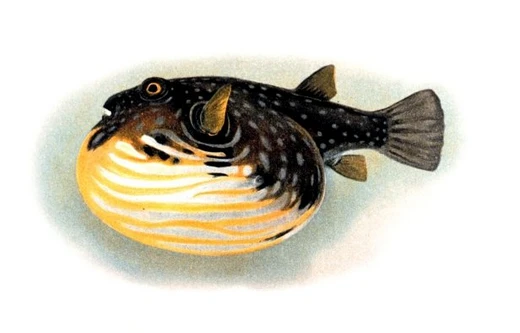
Bluetail trunkfish
A boxfish with a blue tail, found in the Red Sea.

The bluetail trunkfish (Ostracion cyanurus), also known as the Arabian trunkfish or Red Sea boxfish, is a species of marine ray-finned fish belonging to the family Ostraciidae. It is notable for its distinctive blue tail and its occurrence in the Western Indian Ocean, particularly the Red Sea and Arabian Peninsula.
Quick Facts
- Taxon
- Ostracion cyanurus
Facts from the source article.
Lore & Background
Ostracion cyanurus was first formally described in 1828 by the German naturalist and explorer Eduard Rüppell, with its type locality given as the Red Sea off Al Muwaylih in Tabuk Province, Saudi Arabia. The genus name Ostracion means 'little box', alluding to the body shape of its type species, while the specific name cyanurus means 'blue tail', referencing the fish's blue caudal fin. Some argue the spelling should be cyanurum due to the neuter gender of Ostracion.
Adult males are normally dark blue on the flanks and lower body with spots and an unspotted greenish-yellow upper body, while females are yellow with blue spots and red cheeks. The species has a maximum published total length of 15 cm, with 9 soft rays on both the dorsal and anal fins, and 10 in the caudal fin. Females have a slightly concave dorsal profile of the head, whereas males have a convex profile; the lips and chin are fleshy and stick out.
The bluetail trunkfish is a solitary species that remains near shelter. The apparent lack of smaller males may indicate it is protogynous. When it senses danger, it releases a toxin called pahutoxin, or ostracotoxin, into the water as a defense. It is found in areas with moderate coral growth at depths between 5 and 50 m.
Reader's Guide
The bluetail trunkfish holds significance as a distinct species within the boxfish family Ostraciidae, first described by the noted naturalist Eduard Rüppell in 1828. Its taxonomy places it in the genus Ostracion, within the suborder Ostracioidea of the order Tetraodontiformes. The species is notable for its sexual dimorphism, with males and females displaying markedly different coloration—males dark blue with greenish-yellow upper bodies, females yellow with blue spots and red cheeks. Its defense mechanism, releasing pahutoxin or ostracotoxin when threatened, is a characteristic shared with other boxfishes. The bluetail trunkfish is available in the aquarium trade, indicating its appeal to marine hobbyists. Its distribution is limited to the Western Indian Ocean, including the Red Sea and Persian Gulf, and it inhabits coral-rich areas at moderate depths. The potential protogynous nature of the species, suggested by the apparent lack of smaller males, adds to its biological interest. Overall, the bluetail trunkfish contributes to the diversity of reef-associated fishes in its range and is recognized by both scientists and aquarists.
Did You Know?
- The specific name cyanurus means 'blue tail', referring to the fish's blue caudal fin.
- It releases a toxin called pahutoxin or ostracotoxin as a defense when it senses danger.
- Adult males have a convex dorsal head profile, while females have a slightly concave one.
- The species was first described in 1828 by German naturalist Eduard Rüppell.
More in Pufferfish and Boxfish 1-24
Spotted an error? Know more?
Reader corrections go straight into our review queue. Suggest an edit · How this site is sourced