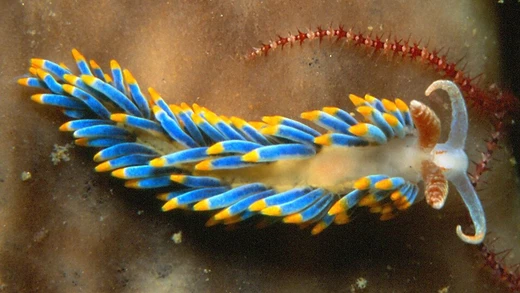
Vayssierea caledonica
A tiny red-orange dorid nudibranch from New Caledonia and Australia.

Vayssierea caledonica is a sea slug, specifically a dorid nudibranch belonging to the gastropod family Okadaiidae. It is closely related to the other members of its genus: *V. caledonica*, *V. felis*, *V. cinnabarea*, and *V. elegans*. The entire genus is sometimes treated as a single species under the name *V. felis*.
This red-orange nudibranch reaches a full-grown size of about 1–2.5 mm (0.04–0.10 in). It lacks external gills and has primitive rhinophores. Reproduction occurs through direct development, with a single clutch containing over ten eggs that take roughly 29 days to hatch.
The species is found in waters off New Caledonia and Australia, specifically in the territories of New South Wales, Victoria, and Queensland. It lives in water depths of 0–3 metres (0–10 ft), typically on rocks near the tube worms it eats. It can also be found under rocks at low tide or floating on brown algae.
Its diet consists of *Spirorbis* or other tube worms. In Victoria, it is usually found near its food source, the serpulid polychaete worm *Salmacina dysteri*.
The name *caledonica* derives from New Caledonia, where the nudibranch was first discovered. It was first described by Jean Risbec in 1928. Although many accept *V. caledonica* as a valid species, some argue that all *Vayssierea* should be grouped under *V. felis*. Risbec distinguished this species from others in the genus by its radula morphology—it has two lateral teeth instead of three. Critics note that examining such small specimens under a light microscope can be misleading.
Quick Facts
- Taxon
- Vayssierea caledonica
Facts from the source article.
Lore & Background
Vayssierea caledonica was first named by Jean Risbec in 1928. The species name derives from its discovery location, New Caledonia. It is considered a close relative of all other species in the genus Vayssierea (V. caledonica, V. felis, V. cinnabarea, and V. elegans), though the entire genus is sometimes referred to under one species name, V. felis. Risbec described this nudibranch as differing from other Vayssierea in radula morphology, having two lateral teeth instead of three, but some argue that viewing such small specimens under a light microscope can be misleading.
When full grown, this red-orange nudibranch reaches about 1–2.5 mm in size. It lacks external gills and has primitive rhinophores. The species reproduces by direct development and can lay over ten eggs, which take about 29 days to hatch. It is found in waters off New Caledonia and Australia, specifically in New South Wales, Victoria, and Queensland territories, at depths of 0–3 metres. Its habitat includes rocks associated with the tube worms it eats, and it can also be found underneath rocks during low tide or floating on brown algae.
This species feeds on Spirorbis or other tube worms. In Victoria, it is usually found near its food source, the serpulid polychaete worm Salmacina dysteri.
Reader's Guide
Vayssierea caledonica holds significance primarily as a subject of taxonomic debate. Although accepted as a distinct species by many, some argue that all Vayssierea should be united under the single species name V. felis. This dispute is rooted in the difficulty of distinguishing morphological features, such as radula tooth count, in specimens only 1–2.5 mm long when viewed under a light microscope. The species' direct development and relatively long egg incubation period (about 29 days) are notable life-history traits for such a small nudibranch. Its ecological role is tied to predation on tube worms, particularly the serpulid polychaete Salmacina dysteri in Victoria. The species' range across New Caledonia and multiple Australian territories, and its occurrence in shallow intertidal and subtidal habitats, contribute to its legacy as a well-documented but taxonomically contested member of the family Okadaiidae.
More in Nudibranchs and Sea Slugs, Part 2 1-24
Spotted an error? Know more?
Reader corrections go straight into our review queue. Suggest an edit · How this site is sourced