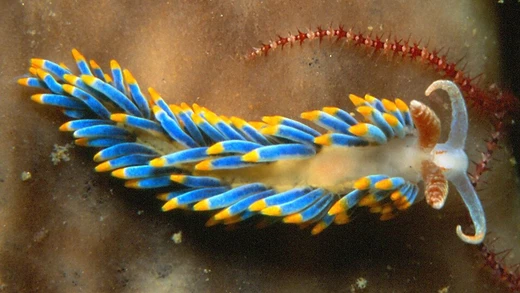
Coryphella trilineata
A striped aeolid nudibranch common along the Eastern Pacific coast.

**Coryphella trilineata**, commonly called the three-lined aeolid, is a type of aeolid nudibranch belonging to the family Coryphellidae. It is frequently encountered in California, though its range stretches from southern Canada down to northern Mexico.
**Taxonomy**
This species was first described in 1921 by Charles Henry O'Donoghue, based on a single specimen collected in Nanoose Bay, British Columbia. Although its current scientific name matches the original, it has gone by several synonyms over time. Adding to the confusion, other species—such as *Coryphella piunca* (1961) and *Coryphella fisheri* (1966)—were once thought to be the same animal. Later re-examination split the group: specimens with annulate rhinophores that carry only white pigment remain *O. trilineata*, while those with annulate rhinophores tipped in orange were moved to the sister species *Orienthella piunca*.
**Description**
Adults range from 5 to 20 mm in length, with a maximum recorded size of 35 mm. They have 32 to 34 conical cerata, all located behind the rhinophores, each ceras measuring 1 to 2 mm. The rhinophores do not contract and have blunt tips. The genital pore sits on the right side of the body, near the head.
This nudibranch closely resembles *Coryphella verrucosa*, *Coryphella lineata*, and *Pacifia goddardi*, but can be told apart by its perfoliate rhinophores, a distinct radula, and three lateral stripes. Within its own genus, it is easily distinguished by having annulated (not smooth or irregular) rhinophores, with white pigment only on the oral tentacles and rhinophores—no orange at all.
**Radula**
The radula is yellow and contains 24 to 26 rows of teeth, with three teeth per row. The central median tooth is U-shaped and bears a single spine in the middle. Six spines flank each side of the median tooth; these are noticeably sturdier than those in *Coryphella verrucosa*. The lateral teeth are shaped like right triangles, with the hypotenuse carrying one large spine and 8 to 10 smaller ones.
**Coloration**
The most striking feature is the three white lines running along the back and sides. The central line passes between the rhinophores, splits, and continues to the tips of the oral tentacles. The body is white or grey, while the cerata are transparent with red interiors.
**Distribution**
Found in the intertidal zone along the Eastern Pacific coast, *O.
Quick Facts
- Genus
- Coryphella
- Species
- trilineata
Facts from the source article.
Lore & Background
Coryphella trilineata was originally described in 1921 by Charles Henry O'Donoghue from a single specimen captured in Nanoose Bay, British Columbia. Though its current accepted name is Orienthella trilineata, it has also been referred to by several synonyms. Presumed species such as Coryphella piunca (1961) and Coryphella fisheri (1966) were later believed synonymous, but subsequent re-examination moved specimens with annulate rhinophores bearing orange tips into the sister species Orienthella piunca, leaving O. trilineata with annulate rhinophores bearing only white pigment.
This species reaches lengths of 5–20 mm, with a maximum of 35 mm, and possesses 32–34 conical cerata behind the rhinophores. Its most distinguishing characteristic is three white lines on the back and sides; the middle line passes between the rhinophores and splits to continue to the tips of the oral tentacles. The body is white or grey, and the cerata are transparent with red interiors. The radula is yellow with 24–26 rows of teeth, each row having three teeth; the central median tooth is U-shaped with a central spine, and the lateral teeth are shaped like right triangles.
Orienthella trilineata feeds on hydroids including those in the order Leptothecata, Tubularia spp., Eudendrium californicum, and Ectopleura crocea. The amphipod Podocerus cristatus is thought to mimic this species based on similar coloration, hypothesized as Batesian mimicry because O. trilineata possesses cnidosacs that discourage predators.
Reader's Guide
Coryphella trilineata holds significance as a well-known nudibranch of the Eastern Pacific intertidal zone, common from Vancouver Island to the Coronado Islands. Its taxonomy has been historically complex, with multiple synonyms and presumed species later redefined based on rhinophore pigmentation—specimens with white-only annulate rhinophores remain in O. trilineata, while those with orange tips were moved to Orienthella piunca. This species is distinguished from similar-looking congeners by its perfoliate rhinophores, distinct radula, and three lateral stripes. Its ecological role includes feeding on various hydroids, and it is involved in a hypothesized Batesian mimicry relationship with the amphipod Podocerus cristatus, which mimics its coloration to deter predators. The species' reproductive biology is documented in detail: it lays white eggs in a thin ribbon anchored to substrates like eelgrass, with 600–700 capsules per 2 mm of ribbon, each containing 1–2 embryos. Development proceeds rapidly, with gastrula stage reached in about 54 hours at 16°C, followed by trochophore and veliger larval stages before hatching. The larvae possess long cilia for swimming and feeding on phytoplankton, and lack eyespots.
Did You Know?
- This species can be distinguished from similar members of its genus by having annulate rhinophores with only white pigment and no trace of orange.
- The amphipod Podocerus cristatus is thought to mimic this species in a case of Batesian mimicry.
- Its egg ribbon contains 600–700 individual capsules for every 2 mm of ribbon, with 1–2 embryos per capsule.
Frequently Asked Questions
What is Coryphella trilineata?
It is a small aeolid nudibranch in the family Coryphellidae, commonly known as the three-lined aeolid. You'll recognize it by its striped coloration and a cluster of 32 to 34 cerata along its body.
Where can I find Coryphella trilineata in the wild?
This species is a regular sight off the California coast, but its range actually spans from southern Canada all the way down to northern Mexico along the Eastern Pacific. The original type specimen was pulled from Nanoose Bay, British Columbia.
How large does Coryphella trilineata grow?
Adults top out at roughly 35 millimeters, making it a modest-sized nudibranch. Its radula carries 24 to 26 rows of teeth, which is typical for aeolids that feed on cnidarian prey.
Who first described Coryphella trilineata and when?
Charles Henry O'Donoghue gave the species its scientific name back in 1921, working from a single specimen collected in Nanoose Bay. Despite that early description, the species has cycled through several synonyms over the decades.
Why do nudibranch enthusiasts sometimes mix up Coryphella trilineata with other species?
Taxonomists have lumped or split similar-looking aeolids under different names, and look-alikes such as Coryphella piunca (described in 1961) add to the confusion. The three-lined aeolid's own nomenclature has shifted enough that older field guides may list it under an outdated synonym.
More in Nudibranchs and Sea Slugs, Part 2 1-24
Spotted an error? Know more?
Reader corrections go straight into our review queue. Suggest an edit · How this site is sourced