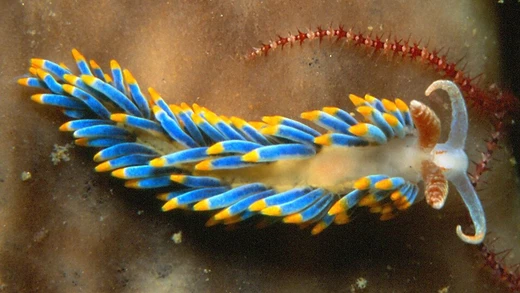
Fjordia capensis
A colourful aeolid nudibranch endemic to South African waters.

The white-edged nudibranch, *Fjordia capensis*, is a type of colourful sea slug known as an aeolid nudibranch. It belongs to the family Coryphellidae and is a marine gastropod mollusc.
This species is found only along the South African coast, from the Atlantic side of the Cape Peninsula to Port Elizabeth, living in water 10 to 30 metres deep.
The body is slender and pale, with many dark red cerata that each have a white edge. It usually grows to less than 40 millimetres. Its rhinophores are pale and rough-textured, and it has a pair of long oral tentacles marked with an opaque white stripe. It can be mistaken for *Coryphella lineata* and *Coryphella chriskaugei*, but neither of those species occurs in southern Africa. If location data is missing, *C. capensis* differs from *C. lineata* in having translucent cnidosacs that may show only a dot or two of white pigment from the ceratal stripes; in *C. lineata*, the cnidosacs are also mostly translucent but are often partly or fully hidden by white pigment that connects strongly to the stripes. Compared to *C. chriskaugei*, *C. capensis* has more continuous ceratal stripes, and white pigment can appear on the cnidosac, whereas *C. chriskaugei* has erratic markings made of dashes and dots that always stop short of the cnidosac.
This nudibranch feeds on hydroids of the genus *Eudendrium*. Like other aeolids, its cerata help with breathing and also contain parts of its digestive system. It eats the hydroid and moves the nematocysts unharmed through its gut to the tips of the cerata, where they mature and are used for defence. Its bright colours likely warn predators that it is toxic. The white-edged nudibranch is hermaphroditic, and its egg mass is highly convoluted and creamy white.
Quick Facts
- Taxon
- Fjordia capensis
Facts from the source article.
Lore & Background
The white-edged nudibranch is a slender pale-bodied aeolid with numerous dark red cerata all edged with white. It has rugose pale rhinophores and a pair of elongated oral tentacles with an opaque white stripe. It is usually smaller than 40 mm.
Visually, it can be easily confused with *Coryphella lineata* and *Coryphella chriskaugei*, but neither of these species occur in southern Africa. In the event geographical data isn’t available, *C. capensis* differs from *C. lineata* by having translucent cnidosacs that might only have a dot or two of white pigment from the ceratal stripes. While the cnidosacs of *C. lineata* are also mainly translucent, they are commonly partially obscured by white pigment that strongly connects to the ceratal stripes, on occasions fully obscured. *C. capensis* differs from *C. chriskaugei* by having generally far more continuous ceratal stripes, and white pigment capable of appearing on the cnidosac; *C. chriskaugei* ceratal markings always stop short of the cnidosac, and are far more erratic and composed of dashes and dots.
This aeolid feeds on hydroids of the genus *Eudendrium*. In common with other aeolid nudibranchs, the cerata aid in respiration but also contain extensions of the digestive system. The white-edged nudibranch eats the hydroid and passes its nematocysts unharmed through its digestive system to the tips of its cerata, where they mature and are used for defence. It is probable that the bright colours serve to advertise to predators that it is toxic. The white-edged nudibranch is hermaphrodite, and its egg mass is highly convoluted and creamy white.
Reader's Guide
The white-edged nudibranch is notable as a colourful aeolid nudibranch endemic to the South African coast, found only from the Atlantic coast of the Cape Peninsula to Port Elizabeth in 10–30 m of water. Its significance lies in its distinctive appearance—a slender pale body with numerous dark red cerata edged in white—and its ecological role as a predator of hydroids of the genus *Eudendrium*. Like other aeolids, it incorporates the hydroid's nematocysts into its own cerata for defence, and its bright colours likely serve as a warning to predators. The species is also notable for its potential confusion with *Coryphella lineata* and *Coryphella chriskaugei*, which do not occur in southern Africa; careful examination of ceratal stripe continuity and cnidosac pigmentation is required to distinguish them. As a hermaphrodite, it produces a highly convoluted, creamy white egg mass. Its legacy is tied to its role in the marine biodiversity of southern Africa and its contribution to understanding nudibranch defense mechanisms and mimicry.
Did You Know?
- It feeds on hydroids of the genus Eudendrium and uses their nematocysts for its own defence.
- It can be confused with Coryphella lineata and Coryphella chriskaugei, but neither occurs in southern Africa.
- The egg mass of the white-edged nudibranch is highly convoluted and creamy white.
Geographic Range and Coastal Setting
Fjordia capensis is a marine invertebrate whose documented range falls within the Cape Peninsula and False Bay region of South Africa's Western Cape province. This stretch of coastline extends from Bloubergstrand at the northern edge of Table Bay down to Cape Hangklip, the southeastern boundary of False Bay. The species inhabits waters that include the Table Mountain National Park Marine Protected Area, the Helderberg Marine Protected Area, and portions of the Robben Island Marine Protected Area. Most of this shoreline falls under the jurisdiction of the City of Cape Town, though a segment along the eastern coast of False Bay, south of Kogel Bay, belongs to the Overstrand Local Municipality. As a member of the broader South African marine fauna, Fjordia capensis occupies a position that may be deep within its range of endemism or near the borders of its distribution, reflecting the complex biogeographic patterns of the region's coastal waters and the movement of organisms through currents and wind-driven processes.
Ecological Community and Faunal Context
Within the Cape Peninsula and False Bay ecosystem, Fjordia capensis exists as part of a rich assemblage of marine and shore-based invertebrate species. This community includes a wide diversity of organisms ranging from calcareous sponges and fibre sponges to hexacorallian anemones and other cnidarians. Some members of this community are integral components of the local ecological web, while others may be transient visitors carried by ocean currents or wind-driven processes. Fjordia capensis, as a species recorded from this geographical range, contributes to the layered complexity of the intertidal and subtidal zones. The region supports organisms that live entirely marine lives, those that spend critical life stages at sea, and species that depend on the sea or intertidal shore for the majority of their dietary needs. This diversity of ecological strategies creates a dynamic habitat in which Fjordia capensis occupies its niche alongside numerous sponges, anemones, and other invertebrate taxa documented across the peninsula.
Research, Documentation, and Discovery
The proximity of the Cape Peninsula and False Bay waters to several universities and research institutions in Cape Town and Stellenbosch has made this region a focal point for marine biological study. Fjordia capensis, like many organisms in this area, has been the subject of investigation through both targeted ecological research and incidental collection during broader surveys. The popularity of these waters among recreational divers has further contributed to the species' documentation, with underwater photographic observations becoming an increasingly important source of records in recent years. This combination of academic inquiry and recreational exploration has enriched the understanding of the local invertebrate fauna. Species in this region have been described by researchers over many decades, with some taxonomic entries dating back to the nineteenth century while others represent more recent additions to the scientific record. Fjordia capensis benefits from this sustained attention, as the region's accessible coastline and protected waters facilitate ongoing study of its biology and distribution.
Conservation Framework and Protected Waters
Fjordia capensis inhabits waters that benefit from a structured conservation framework in South Africa's Western Cape. The Table Mountain National Park Marine Protected Area, the Helderberg Marine Protected Area, and part of the Robben Island Marine Protected Area collectively provide designated protection across the species' range. These protected zones span from Bloubergstrand to Cape Hangklip, encompassing the majority of the Cape Peninsula coastline within City of Cape Town boundaries, with a smaller eastern section of False Bay falling under the Overstrand Local Municipality. The establishment of these marine protected areas reflects recognition of the ecological importance of the invertebrate communities that thrive here. For Fjordia capensis, this means its habitat is subject to management measures designed to preserve the integrity of the broader marine ecosystem. The protected status of these waters helps safeguard not only the species itself but also the complex web of sponges, anemones, and other invertebrates that constitute the local fauna, ensuring that the ecological community remains intact for future study and enjoyment.
Frequently Asked Questions
What is Fjordia capensis?
Fjordia capensis, commonly called the white-edged nudibranch, is a small aeolid sea slug and marine gastropod mollusc. It is classified within the family Coryphellidae and is known for its striking colouration.
Where can you find Fjordia capensis in the wild?
This species is endemic to the South African coastline, occurring from the Atlantic-facing side of the Cape Peninsula down to Port Elizabeth. It lives at depths between 10 and 30 metres.
What does Fjordia capensis look like?
It has a slender, pale body densely covered in dark red cerata, each one trimmed with a distinct white edge. Its rhinophores are pale and rough-textured, and it carries a pair of long oral tentacles bearing an opaque white stripe.
How large does Fjordia capensis grow?
Adults typically remain under 40 millimetres in length, making it a relatively small nudibranch. It does not reach the sizes seen in some other marine gastropods.
What family does Fjordia capensis belong to?
It is placed in the family Coryphellidae, a group of aeolid nudibranchs. Within that family it is recognised as a distinct South African species.
More in Nudibranchs and Sea Slugs, Part 2 1-24
Spotted an error? Know more?
Reader corrections go straight into our review queue. Suggest an edit · How this site is sourced