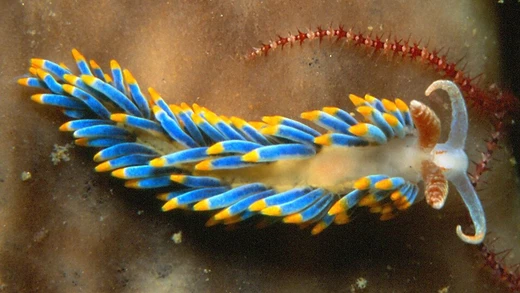
Dendronotus
A genus of nudibranchs with branched cerata and a serrated radula.

Dendronotus is a genus of nudibranchs in the superfamily Tritonioidea, within the clade Cladobranchia according to the taxonomy of the Gastropoda by Bouchet & Rocroi, 2005. This genus is notable for its elongated, broad body and distinctive branched cerata.
- Superfamily
- Tritonioidea
- Clade
- Cladobranchia
- Body shape
- elongated, broad
- Cerata pairs
- 4 to 8
- Oral veil extensions
- 2 to 5
- Diet
- hydroids
- Radula type
- serrated
Lore & Background
Dendronotus has an elongated, broad body with 4 to 8 pairs of branched cerata on the notum. Animals in this genus have an obvious oral veil with 2 to 5 extensions, which may be branched, and smaller unbranched extensions around the mouth. The rhinophores are surrounded by a sheath that itself has branched extensions, and a large extension is found on the side at the base of each rhinophore. The anal opening occurs between the first and second set of dorsal cerata on the right side of the body.
This genus feeds on hydroids, as reflected by its serrated radula. The article lists numerous species within the genus, including Dendronotus albopunctatus, Dendronotus albus, Dendronotus arcticus, and many others, along with several species brought into synonymy such as Dendronotus diversicolor (synonym of Dendronotus albus) and Dendronotus luteolus (synonym of Dendronotus frondosus).
Reader's Guide
The significance of Dendronotus lies in its distinctive morphology and its placement within the superfamily Tritonioidea and clade Cladobranchia. The genus is characterized by its branched cerata, oral veil extensions, and rhinophore sheaths with branched extensions, which are key features for identification. Its diet of hydroids, indicated by a serrated radula, reflects its ecological role. The extensive list of species and synonyms provided in the article demonstrates the taxonomic work done on this genus, including contributions by researchers such as Robilliard, MacFarland, Korshunova, Martynov, and others. The inclusion of synonyms like Dendronotus diversicolor and Dendronotus luteolus highlights historical taxonomic revisions. The article also references external SEM images of the radula from Thompson & Bebbington (1973), which aid in understanding its feeding apparatus. Overall, Dendronotus serves as a well-documented example of nudibranch diversity and taxonomy.
Frequently Asked Questions
What is Dendronotus?
Dendronotus is a genus of nudibranchs placed in the superfamily Tritonioidea and the clade Cladobranchia under the Bouchet & Rocroi (2005) gastropod taxonomy. Members of this genus are recognized by their elongated, broad bodies and uniquely branched cerata.
How many pairs of cerata does Dendronotus typically have?
Dendronotus species bear between four and eight pairs of cerata, and unlike many other nudibranchs these appendages are distinctly branched rather than simple and unbranched.
What does Dendronotus feed on?
The primary diet of Dendronotus consists of hydroids, which these sea slugs rasp using a serrated radula.
How does Dendronotus's body shape differ from other nudibranchs?
Dendronotus has a notably elongated and broad body plan, setting it apart from the more compact or rounded forms seen in many other nudibranch genera.
What features make Dendronotus easy to identify in the field?
The combination of branched cerata (in four to eight pairs), two to five oral veil extensions, and a serrated radula gives Dendronotus a distinctive look that separates it from closely related cladobranch nudibranchs.
More in Nudibranchs and Sea Slugs, Part 2 1-24
Spotted an error? Know more?
Reader corrections go straight into our review queue. Suggest an edit · How this site is sourced