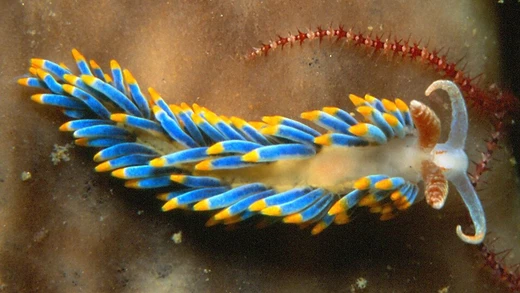
Doridoidea
A superfamily of shell-less sea slugs with hidden gills.

Doridoidea, also called dorid nudibranchs and formerly known as the taxon Cryptobranchia, is a superfamily of medium-to-large sea slugs. These marine gastropod mollusks lack shells and belong to the clade Doridacea within the larger clade Nudibranchia. The name "Doridoidea" derives from the genus *Doris*, which itself comes from Doris, a sea nymph in Greek mythology.
According to the 2005 taxonomy of Bouchet & Rocroi, the families in Doridoidea were Actinocyclidae, Chromodorididae, Discodorididae, and Dorididae. After 2005, the family Cadlinidae, previously considered a synonym of Chromodorididae, was reinstated. Research by R.F. Johnson in 2011 showed that the genus *Cadlina* does not belong in Chromodorididae, so she revived Cadlinidae. Without *Cadlina*, the remaining chromodorid nudibranchs form a monophyletic group and may be a sister group to Actinocyclidae. The currently recognized families are Actinocyclidae, Cadlinidae, Chromodorididae, Discodorididae, and Dorididae.
Some family names from older publications are now considered synonyms but still appear in many sources. The cryptobranch dorid nudibranchs, previously called Cryptobranchia, are nudibranch sea slugs in the clade Doridacea. They are called "cryptobranch," meaning "hidden gill," because they can retract their gills into a pocket. This contrasts with the phanerobranchs, a traditional group that is probably paraphyletic. A. Valdés distinguishes two major clades within Cryptobranchia: the Porostomata, which lack a radula, and the Labiostomata, which have a radula. The Labiostomata include the monophyletic families Actinocyclidae, Chromodorididae, Dorididae, and Discodorididae.
Quick Facts
- Taxon
- Doridoidea
Facts from the source article.
Lore & Background
Doridoidea were previously known under the taxon Cryptobranchia, meaning 'hidden gill,' because these slugs can retract their gills into a gill pocket. This contrasts with nudibranchs in the traditional group phanerobranchs, which taxon is probably paraphyletic. A. Valdés distinguishes two major clades within the Cryptobranchia: the dorids that have no radula (the Porostomata) and those with a radula (the Labiostomata). The Labiostomata include the monophyletic families Actinocyclidae, Chromodorididae, Dorididae and Discodorididae.
According to the Taxonomy of the Gastropoda (Bouchet & Rocroi, 2005), families within the superfamily included Actinocyclidae, Chromodorididae, Discodorididae, and Dorididae. Later research by R.F. Johnson in 2011 showed that Cadlina does not belong to the family Chromodorididae, bringing back the name Cadlinidae from synonymy with Chromodorididae. The chromodorid nudibranchs without Cadlina are now monophyletic and turn out to be a possible sister to the Actinocyclidae. Currently recognized families are Actinocyclidae, Cadlinidae, Chromodorididae, Discodorididae, and Dorididae.
Reader's Guide
The significance of Doridoidea lies in its role as a major superfamily within Nudibranchia, representing medium to large shell-less sea slugs. Its historical classification as Cryptobranchia highlights a key anatomical feature: the ability to retract gills into a pocket, distinguishing them from phanerobranchs. The taxonomic history shows ongoing refinement, particularly the 2011 resurrection of Cadlinidae as a separate family from Chromodorididae, based on research by R.F. Johnson. This change made the chromodorid nudibranchs without Cadlina monophyletic and possibly sister to Actinocyclidae. The superfamily's legacy includes the recognition of two major clades within Cryptobranchia—Porostomata (without radula) and Labiostomata (with radula)—the latter containing several monophyletic families. The continued use of older family names as synonyms in publications and online reflects the evolving understanding of their relationships.
Did You Know?
- The name Doridoidea comes from the sea nymph Doris in Greek mythology.
- Research by R.F. Johnson in 2011 brought back the family Cadlinidae from synonymy with Chromodorididae.
- A. Valdés distinguishes two major clades within Cryptobranchia: Porostomata (no radula) and Labiostomata (with radula).
Frequently Asked Questions
Who is Doridoidea?
Doridoidea is a superfamily of medium-to-large shell-less sea slugs that live in the ocean. They sit within the broader nudibranch group, specifically in the clade Doridacea, and are commonly referred to as dorid nudibranchs.
What makes Doridoidea different from other sea slugs?
Dorid nudibranchs are defined by their lack of an external shell and by having their gills tucked away rather than exposed on the back. This hidden-gill trait is what set them apart taxonomically from other nudibranch lineages.
Where does the name 'Doridoidea' come from?
The superfamily takes its name from the genus Doris, which was itself named after Doris, a sea nymph from Greek mythology. So the whole group carries a mythological nod to the ancient Greek seafaring imagination.
What families are in Doridoidea right now?
As of the most recent taxonomic revisions, five families are recognized: Actinocyclidae, Cadlinidae, Chromodorididae, Discodorididae, and Dorididae. Cadlinidae was split out from Chromodorididae after the 2005 Bouchet & Rocroi framework, and the work of researchers like R.F. Johnson helped solidify these boundaries.
What does 'Cryptobranchia' have to do with Doridoidea?
Cryptobranchia was the older taxonomic label used for this same superfamily before it was formally renamed Doridoidea. You will still see the old name pop up in older field guides and literature, but modern classifications use Doridoidea.
More in Nudibranchs and Sea Slugs, Part 2 1-24
Spotted an error? Know more?
Reader corrections go straight into our review queue. Suggest an edit · How this site is sourced