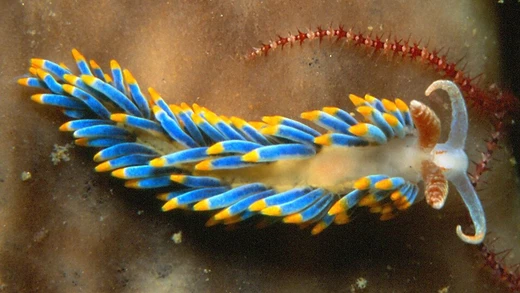
Coryphella verrucosa
A variable North Atlantic aeolid nudibranch with short cerata.

Coryphella verrucosa is a sea slug, specifically an aeolid nudibranch, belonging to the family Flabellinidae. Its original description comes from Bergen, Norway, and it is now known to be widespread across the North Atlantic Ocean, reaching as far north as the Barents Sea. In North America, it is found in the Gulf of St. Lawrence and the Gulf of Maine. Animals from British Columbia and Alaska differ significantly in colour pattern and are a sibling species, described as Coryphella longicaudata O'Donoghue, 1922. Another separate species, *Coryphella pseudoverrucosa*, has recently been described from the Northwest Pacific near the Sea of Japan, though its range overlaps somewhat with *C. longicaudata* in the Kuril Islands. The species was originally described with unusually short, rounded cerata, which gave it the name *verrucosa*. However, this name has been widely applied to animals with longer cerata, including *Coryphella rufibranchialis*, the type species of the genus. The body is translucent white, with a long, pointed tail marked by a mid-dorsal line of opaque white pigment containing round translucent spots. This line may extend forward among the cerata, breaking into spots. Color varies across its range; in some areas the digestive gland inside the cerata is red, while in others it is brown, though diet is known to influence this color. The tips of the cerata also vary, from narrow broken rings to broad white bands or nearly solid white tips. The oral tentacles have a broad white stripe on their upper surfaces. Maximum recorded body length is 35 mm, with some sources giving up to 40 mm. It resembles *Microchlamylla gracilis* and many other Flabellinidae species. In Norway, it is common at depths of 2–10 meters, with a recorded range from 0 m to 183 m. *Flabellina verrucosa* sensu lato has been reported as deep as 300 meters, in both sandy and rocky habitats. It grazes on sessile invertebrates, detritus, and plankton. In the United Kingdom, adults feed almost exclusively on the oaten pipes hydroid (*Tubularia indivisa*), while juveniles have a broader diet. The species is hermaphroditic but does not self-fertilize. Two adults engage in an elaborate touching ritual—involving repeated tentacle contact, biting, lunging, and sidling—that was initially mistaken for aggression. Actual copulation is very brief.
Quick Facts
- Taxon
- Coryphella verrucosa
Facts from the source article.
Lore & Background
The original description of Coryphella verrucosa is of an animal with unusually short, rounded cerata, hence the name verrucosa. The name has been extensively used for animals of different appearance, with long cerata, including Coryphella rufibranchialis, the type species of the genus Coryphella. The body is translucent white, with an elongated pointed tail bearing a mid-dorsal line of opaque white pigment with round translucent spots; this line may extend among the cerata, breaking into spots. In different parts of its range the species has differently coloured forms, which may be different species. In some places the digestive gland in the cerata is red, while in others brown, though the colour is known to be diet-dependent. The tips of the cerata vary from narrow broken rings through broad white bands to white almost covering the tips. The oral tentacles have a broad white stripe on the upper surfaces. This nudibranch is similar in appearance to Microchlamylla gracilis and many other species of Flabellinidae.
Reader's Guide
Coryphella verrucosa is significant as a common North Atlantic nudibranch whose variable appearance has caused taxonomic confusion. The type locality is Bergen, Norway, and it is widespread in the North Atlantic, ranging as far north as the Barents Sea. In North America, it occurs in the Gulf of St Lawrence and the Gulf of Maine. Animals from British Columbia and Alaska differ significantly in colour pattern and are considered a sibling species, Coryphella longicaudata. Another separate species, Coryphella pseudoverrucosa, lives in the Northwest Pacific near the Sea of Japan, overlapping somewhat with C. longicaudata in the Kuril Islands. The species grazes on sessile invertebrates, detritus, and plankton; in the United Kingdom it lives almost exclusively on the oaten pipes hydroid Tubularia indivisa, while juveniles have a wider diet. It is a hermaphrodite that does not self-fertilize, engaging in an elaborate touching ritual before quick copulation. Eggs are laid in a gelatinous spiral string, and veliger larvae drift as plankton before settling. Like most aeolid nudibranchs, it incorporates nematocysts from prey into its cerata for defence, and experiments showed it incorporates more nematocysts when kept near predators such as the common sunstar, the bergall fish, and the shore crab.
Did You Know?
- The name 'verrucosa' refers to the unusually short, rounded cerata in the original description.
- Animals from British Columbia and Alaska are considered a sibling species, Coryphella longicaudata.
- In the United Kingdom, adults live almost exclusively on the oaten pipes hydroid Tubularia indivisa.
- When kept near predators like the common sunstar, the nudibranch incorporates more nematocysts into its cerata.
Taxonomy and Geographic Reach
Coryphella verrucosa was first described from specimens collected in Bergen, Norway, and since then its known range has expanded across much of the North Atlantic, stretching as far north as the Barents Sea. In North American waters, the species occupies the Gulf of St Lawrence and the Gulf of Maine. However, populations found in British Columbia and Alaska display markedly different colour patterns and were formally separated as the sibling species Coryphella longicaudata by O'Donoghue in 1922. More recently, a third entity, Coryphella pseudoverrucosa, was recognised as a distinct species inhabiting the Northwest Pacific near the Sea of Japan, with a partial range overlap with C. longicaudata in the Kuril Islands. The taxonomic history of the name verrucosa is complicated: it has been applied broadly to animals of quite different appearances, including those with long cerata, and even encompasses Coryphella rufibranchialis, which serves as the type species of the genus itself. This tangled nomenclature underscores how much the species concept for this group has been refined over time.
Morphology and Colour Polymorphism
The species epithet verrucosa refers to the unusually short, rounded cerata that characterise the original description, setting it apart from many congeners with elongated projections. The body itself is a translucent white, and the tail tapers to an elongated point bearing a mid-dorsal stripe of opaque white pigment punctuated by small round translucent spots. This white line can extend forward along the back between the cerata, fragmenting into scattered spots. Maximum recorded body length reaches 35 to 40 millimetres, roughly 1.6 inches. Despite this baseline description, colour variation across the species' range is striking. The digestive gland visible within the cerata appears red in some populations and brown in others, a difference that tracks with dietary variation rather than genetic distinction. The tips of the cerata show even broader variation, ranging from narrow broken rings reminiscent of the rufibranchialis form, through broad white bands, to near-complete white coverage in the typical form. The oral tentacles carry a broad white stripe along their upper surfaces. Because of its general shape and size, C. verrucosa can be easily confused with Microchlamylla gracilis and numerous other members of the family Flabellinidae.
Habitat and Feeding Ecology
In its Norwegian home range, Coryphella verrucosa is a common sight at depths between two and ten metres, though its recorded depth tolerance extends from the intertidal zone at zero metres down to 183 metres. Broader surveys of the Flabellina verrucosa complex sensu lato have placed individuals at approximately 300 metres, and the species occupies both sandy and rocky seabed habitats. As a grazer, it primarily feeds on sessile invertebrates attached to the sea floor, supplementing this with detritus and planktonic material. In United Kingdom waters, the adult diet becomes remarkably specialised: individuals live almost exclusively on the oaten pipes hydroid, Tubularia indivisa. Juveniles, by contrast, maintain a broader menu of prey items before settling into this narrow dietary niche. This shift from generalist to specialist feeding across ontogeny is notable and suggests that the hydroid provides a particularly rich or accessible source of nutrition for the larger animal. The species' ability to exploit a range of depth zones and substrate types, combined with its flexible early-life diet, contributes to its widespread distribution across the North Atlantic.
Reproduction and Defensive Biology
Like most aeolid nudibranchs, Coryphella verrucosa is a simultaneous hermaphrodite, yet self-fertilisation does not occur. Instead, two adults perform an elaborate courtship sequence that was initially misinterpreted as agonistic or competitive behaviour. During this ritual, the pair repeatedly touch and withdraw their tentacles, interspersed with biting, lunging, and sidling movements. Once the ritual concludes, the actual copulation is extremely brief. The female then deposits her eggs as a gelatinous string, neatly coiled into a spiral on the seabed. Upon hatching, the veliger larvae enter the plankton, drifting until they settle onto the seabed to begin benthic life. On the defensive side, C. verrucosa sequesters nematocysts from its prey and incorporates them into the tissue of its cerata. Experimental work demonstrated that when the nudibranch is held in the presence of potential predators such as the common sunstar Crossaster papposus, the fish Tautogolabrus adspersus, or the shore crab Carcinus maenas, it accumulates significantly more nematocysts than it does in a predator-free setting, suggesting a responsive, inducible defence mechanism.
Frequently Asked Questions
What is Coryphella verrucosa?
It is a small aeolid nudibranch in the family Flabellinidae, easily recognised by its short cerata. The species was originally described from Bergen, Norway, and is now recognised as a variable North Atlantic sea slug.
Where can Coryphella verrucosa be found?
Its range stretches across the North Atlantic, reaching as far north as the Barents Sea and, in North America, into the Gulf of St. Lawrence and Gulf of Maine. Around its type locality in Bergen it is most often seen in shallow water between 2 and 10 metres, though records extend down to 183 metres.
How big does Coryphella verrucosa get?
Adults top out at roughly 40 millimetres in body length, placing it in the smaller end of the nudibranch spectrum.
What does Coryphella verrucosa look like?
It is a variable aeolid with short cerata, and its colour pattern can shift noticeably from one population to another. That high degree of variation is one reason it was long confused with closely related lookalikes.
Is Coryphella verrucosa the same as Coryphella longicaudata?
No—individuals from British Columbia and Alaska that were once assigned to C. verrucosa actually belong to a distinct sibling species, Coryphella longicaudata O'Donoghue, 1922. A third separate species, Coryphella pseudoverrucosa, has also been described recently, so careful identification is essential.
More in Nudibranchs and Sea Slugs, Part 2 1-24
Spotted an error? Know more?
Reader corrections go straight into our review queue. Suggest an edit · How this site is sourced