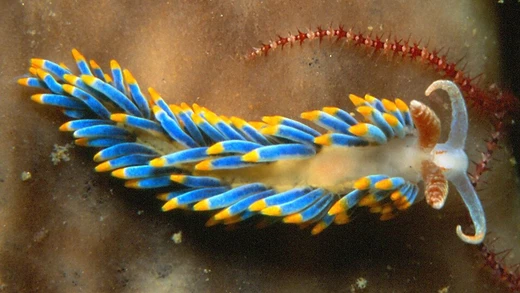
Dendronotus albus
A translucent white sea slug with orange-yellow cerata tips.

Dendronotus albus is a shell-less marine sea slug belonging to the family Dendronotidae. It is found along the west coast of North America, from Alaska to Baja California, Mexico. The species was first described from shallow waters at Point Pinos in Monterey Bay, California.
Its taxonomic history is tangled. Robilliard correctly identified two species of *Dendronotus* in the northeastern Pacific and named one *Dendronotus diversicolor*. However, *D. albus* and *D. diversicolor* were later treated as the same species by Stout et al. in 2010, likely because their study specimens did not include both forms. In fact, Robilliard had consistently used the name *D. albus* for what is now called *Dendronotus robilliardi*, and he redescribed the true *D. albus* as *D. diversicolor*.
This species reaches a maximum length of 73 mm. It differs from *D. robilliardi* in having only four pairs of large cerata (with two extra, small cerata in larger animals), whereas *D. robilliardi* is smaller but has five to seven pairs. The body and cerata are translucent white, with opaque white and orange-yellow tips on the cerata, though the orange-yellow is sometimes absent.
Its diet consists mainly of the hydroids *Abietinaria greenei*, *Hydrallmania distans*, and *Abietinaria amphora*. In contrast, *D. robilliardi* is said to prefer the hydroid *Thuiaria argentea* in the family Sertulariidae.
Quick Facts
- Taxon
- Dendronotus albus
Facts from the source article.
Lore & Background
This species was described from shallow water at Point Pinos, Monterey Bay, California. It has been reported from the west coast of North America from Alaska to Baja California, Mexico. Robilliard correctly recognised that there were two species of Dendronotus in the NE Pacific and described Dendronotus diversicolor as a new species. D. albus and D. diversicolor were synonymised by Stout et al., 2010, probably because the specimens they studied did not include both species. In fact Robilliard consistently used the name D. albus for Dendronotus robilliardi and redescribed the true D. albus as D. diversicolor.
Dendronotus albus grows to a maximum length of 73 mm. It is distinguished from Dendronotus robilliardi by having only four pairs of large cerata (and two extra, small cerata in big animals). D. robilliardi is a smaller animal but has 5–7 pairs. The body and cerata are translucent white with opaque white and orange-yellow tips to the cerata, although in some cases the orange-yellow is absent.
This species feeds preferentially on the hydroids Abietinaria greenei, Hydrallmania distans and Abietinaria amphora. Dendronotus robilliardi is said to prefer Thuiaria argentea in the family Sertulariidae.
Reader's Guide
The significance of Dendronotus albus lies in its taxonomic history and its role in clarifying species boundaries within the genus Dendronotus in the northeastern Pacific. Robilliard's work correctly identified two species, but subsequent synonymization by Stout et al. in 2010 obscured the distinction, likely due to incomplete sampling. This confusion highlights the importance of careful morphological and ecological study in nudibranch taxonomy. The species is also notable for its specific dietary preference for certain hydroids, which contrasts with the diet of its close relative Dendronotus robilliardi. Its distribution along the west coast of North America from Alaska to Baja California makes it a broadly occurring but easily misidentified member of the dendronotid fauna. The species' translucent white body with orange-yellow cerata tips provides a diagnostic field mark, though the occasional absence of the orange-yellow color adds complexity to identification.
Frequently Asked Questions
What is Dendronotus albus?
It is a shell-less marine sea slug in the family Dendronotidae, recognizable by its translucent white body and cerata tipped in orange-yellow. It grows to roughly 73 mm at most and carries four pairs of large cerata, with larger individuals adding two extra small ones.
Where can you find Dendronotus albus in the wild?
Its range stretches along the Pacific coast of North America, from Alaska down to Baja California, Mexico. The original type specimens were collected in shallow water at Point Pinos in Monterey Bay, California.
What does Dendronotus albus feed on?
It specializes on a handful of hydroid species, most notably Abietinaria greenei, Hydrallmania distans, and Abietinaria amphora. These colonial cnidarians make up essentially its entire diet.
Why is the taxonomy of Dendronotus albus so messy?
Robilliard originally separated two northeastern Pacific Dendronotus species, naming one D. diversicolor, but Stout and colleagues in 2010 collapsed D. albus and D. diversicolor back into a single species—likely because their study material simply didn't capture the distinguishing variation. That lumping has kept the identity of the white form in question among specialists ever since.
How big does Dendronotus albus get and what does it look like up close?
Adults top out around 73 mm in length, with a mostly see-through white body and four pairs of prominent cerata that end in vivid orange-yellow tips. Bigger specimens also sprout two additional small cerata near the base, a detail that helps separate them from look-alikes.
More in Nudibranchs and Sea Slugs, Part 2 1-24
Spotted an error? Know more?
Reader corrections go straight into our review queue. Suggest an edit · How this site is sourced