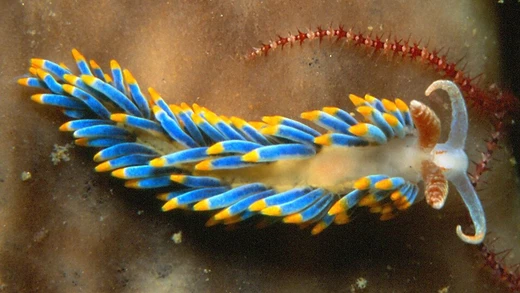
Dotidae
A family of nudibranchs with sheathed tentacles and fusiform gills.

Dotidae is a family of nudibranchs—shell-less marine gastropod molluscs, also called sea slugs—that belongs to the superfamily Dendronotoidea. Members of this family have tentacles that are sheathed at the base and can be retracted, along with spindle-shaped gills positioned along the sides of the back. The family occurs worldwide in both cold and warm seas.
The family’s name has historically been spelled as "Dotonidae" and "Dotoidae," but in 1964 the International Commission on Zoological Nomenclature ruled that neither spelling was correct and adopted Dotidae Gray, 1853 as the accepted name.
The following genera are recognised within the family: *Caecinella* (Bergh, 1870), *Doto* (Oken, 1815), *Kabeiro* (Shipman & Gosliner, 2015), and *Miesea* (Marcus, 1961). Several names are considered synonyms of *Doto*, including *Bornellopsis*, *Dotilla*, *Dotona*, *Gellina*, *Idalia*, *Idulia*, *Iduliella*, and *Timorella*. The subfamily Embletoniinae is also a synonym, now ranked as Embletoniidae.
Quick Facts
- Taxon
- Dotidae
Facts from the source article.
Lore & Background
The family Dotidae has undergone several spelling variations, including 'Dotonidae' and 'Dotoidae', before the International Commission on Zoological Nomenclature (ICZN) ruled in 1964 that neither was correct and adopted Dotidae Gray, 1853 as the accepted name. The original description notes that members of this family have tentacles that are sheathed at the base and retractile, and gills that are fusiform in shape and positioned along the sides of the back.
Four genera are currently recognized within Dotidae: Caecinella Bergh, 1870; Doto Oken, 1815; Kabeiro Shipman & Gosliner, 2015; and Miesea Marcus, 1961. Several former genera and names are now considered synonyms of Doto, including Bornellopsis, Dotilla, Dotona, Gellina, Idalia, Idulia, Iduliella, and Timorella. The subfamily Embletoniinae is a synonym of Embletoniidae at a superseded rank.
The family occurs worldwide in both cold and warm seas, indicating a broad ecological range.
Reader's Guide
Dotidae holds significance as a family of nudibranchs whose taxonomic history reflects the careful work of the ICZN in stabilizing nomenclature. The 1964 ruling resolved long-standing confusion over the family's spelling, establishing Dotidae Gray, 1853 as the correct name. The family's description—featuring sheathed, retractile tentacles and fusiform gills along the sides of the back—provides key morphological characters for identification. The recognition of four genera, with Doto as the most speciose and the subject of numerous synonyms, underscores the historical complexity of classification within this group. The worldwide distribution in cold and warm seas highlights the family's adaptability and presence across diverse marine environments. The inclusion of a genus described as recently as 2015 (Kabeiro) indicates ongoing taxonomic refinement. The family's legacy lies in its contribution to understanding dendronotoid diversity and the importance of nomenclatural stability in biological classification.
Did You Know?
- The family name Dotidae was officially adopted by the ICZN in 1964 after rejecting the spellings 'Dotonidae' and 'Dotoidae'.
- The genus Doto Oken, 1815 has at least eight synonyms, including Idalia, Iduliella, and Timorella.
Taxonomic Placement
Doto africana occupies a specific position within the broader tree of marine invertebrate life. As a member of the family Dotidae, it belongs to a group of organisms that share a common evolutionary lineage. More broadly, it is classified as a nudibranch, which places it among the sea slugs — a diverse and visually striking subset of marine gastropod molluscs. The term gastropod itself signals its membership in one of the most species-rich classes of molluscs, encompassing creatures that range from common garden snails to the elaborate nudibranchs found in tropical and temperate waters alike. Within this framework, Doto africana is a small, soft-bodied marine creature that, like other nudibranchs, lacks the prominent external shell characteristic of many of its gastropod relatives. Its placement in the family Dotidae distinguishes it from other nudibranch families while connecting it to close relatives that share similar morphological and ecological traits within the order.
African Waters of Origin
The species Doto africana was formally described from a specific locality along the coast of Tanzania, in East Africa. The type locality is recorded as Chuaka, situated in the Mkoani area of Pemba, an island region of the Tanzanian archipelago. This geographic provenance is significant both for the species' scientific nomenclature — the specific epithet africana directly references its African origin — and for understanding the biogeographic range of the family Dotidae in the western Indian Ocean. Pemba, as part of the Zanzibar archipelago, sits within a region of notable marine biodiversity, where warm currents and coastal habitats support a rich assemblage of small invertebrates. The fact that this particular nudibranch was identified and described from this Tanzanian coastal site underscores the ongoing importance of African marine biodiversity surveys in documenting the full scope of gastropod diversity in the region.
A Small but Defined Form
Among the many nudibranchs that inhabit marine environments, Doto africana is a creature of modest dimensions. The body of this species attains a maximum length of 15 millimetres, placing it firmly in the category of small marine invertebrates. At this scale, the animal is roughly the size of a small fingernail, a size well suited to navigating the intricate microhabitats of reef and coastal environments. The 15-millimetre measurement refers to the body proper, a characteristic way of sizing soft-bodied gastropods that lack the rigid external shell found in many other mollusc groups. For a nudibranch of the family Dotidae, this compact body plan reflects the general morphology of the group, where the animal's form is defined by its soft tissues, gill structures, and sensory organs rather than by any hard skeletal element. The small size also means that Doto africana occupies a particular niche among the microfauna of its immediate surroundings.
The Dotidae Connection
Within the family Dotidae, Doto africana represents a species documented from African coastal waters, adding to the known geographic distribution of this nudibranch family. The family Dotidae is a recognized grouping within the broader order of nudibranchs, and its members share a suite of morphological characteristics that distinguish them from other sea slug families. As a marine gastropod mollusc, Doto africana inherits the fundamental body plan of the gastropods — a muscular foot, a visceral mass, and a head region bearing sensory structures — while also exhibiting the derived features of nudibranchs, including the absence of a prominent external shell and the development of exposed gill and mantle structures. The species name, combining the genus Doto with the specific epithet africana, follows the standard binomial nomenclature of zoological taxonomy, linking the organism to its genus-level relatives while marking its African provenance. Its description from the Pemba region of Tanzania contributes a data point to the growing understanding of Dotidae diversity across the Indian Ocean basin.
Frequently Asked Questions
What is Dotidae?
Dotidae is a family of shell-less marine gastropod molluscs, commonly grouped with sea slugs and nudibranchs, that falls under the superfamily Dendronotoidea. It is recognized as containing four distinct genera.
What physical features set Dotidae apart from other sea slugs?
Members of this family have a pair of tentacles whose bases are enclosed in a sheath and can be pulled back, plus spindle-shaped (fusiform) gill structures running along the lateral edges of the back.
Where in the world do Dotidae species live?
They are found worldwide, inhabiting both cold and warm marine environments, so you can encounter them across a wide range of oceanic temperatures.
Why is the family called 'Dotidae' instead of 'Dotonidae' or 'Dotoidae'?
For a long time the name appeared in the literature under those two alternative spellings, but in 1964 the International Commission on Zoological Nomenclature issued a ruling that neither was valid. The commission formally adopted Dotidae Gray, 1853 as the single correct name.
How many genera does Dotidae include?
Current taxonomy recognizes four genera within the family, each distinguished by subtle differences in their sheathed tentacles and fusiform gill arrangement.
More in Nudibranchs and Sea Slugs, Part 2 1-24
Spotted an error? Know more?
Reader corrections go straight into our review queue. Suggest an edit · How this site is sourced