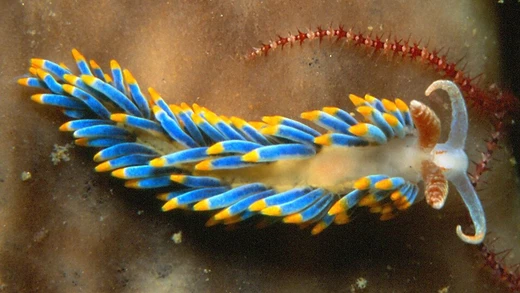
Dendrodoris krebsii
A common Caribbean sea slug with extremely variable coloration.

Dendrodoris krebsii is a sea slug, specifically a dorid nudibranch, belonging to the mollusc family Dendrodorididae. Its range spans the Atlantic coast of the Americas from Georgia south to Rio de Janeiro in Brazil, and it is also found across the Caribbean, including the Bahamas, Cuba, the Cayman Islands, Jamaica, the Dominican Republic, the Virgin Islands, St. Martin, Antigua, Guadeloupe, Martinique, St. Lucia, St. Vincent and the Grenadines, Barbados, Aruba, Curaçao, Bonaire, Grenada, and Panama.
The body is oval to elongated in shape, with a soft back lacking tubercles. Its coloration is highly variable—white, black, orange, red, or light green—with or without spots of red, black, gray, or white. The rhinophores and gill usually match the body color but have white tips. Maximum recorded body length is 120 mm, though some reach 150 mm.
In Panama, this species is found under coral rubble or rocks. Its depth range spans from the surface (0 m) down to 25 m. It is one of the most common nudibranchs in the Caribbean. Members of the family Dendrodorididae are suctorial sponge feeders, and this species preys on the sponge *Haliclona* sp.
Quick Facts
- Taxon
- Dendrodoris krebsii
Facts from the source article.
Lore & Background
The body of Dendrodoris krebsii is oval to elongate, with a soft dorsum lacking tubercles. Its background color is extremely variable, including white, black, orange, red, or light green, with or without spots of red, black, gray, or white. The rhinophores and gill are usually the same color as the rest of the body, with white tips. The maximum recorded body length is 120 mm or up to 150 mm.
This species was found under coral rubble or rocks in Panama, at depths from 0 m to 25 m. Members of the family Dendrodorididae are suctorial sponge feeders, and the prey of Dendrodoris krebsii includes the sponge Haliclona sp.
Reader's Guide
Dendrodoris krebsii is recognized as one of the most common species of Nudibranchia in the Caribbean, indicating its ecological prevalence in shallow marine environments. Its distribution spans a wide geographic range, from Georgia in the United States to Rio de Janeiro in southeastern Brazil, as well as numerous Caribbean islands and Panama. The species' extreme color variability—ranging from white, black, orange, red, or light green, with or without spots—makes it a visually diverse member of its family. As a suctorial sponge feeder, it preys on Haliclona sp., contributing to the ecological dynamics of coral rubble and rocky habitats. Its recorded depth range from 0 m to 25 m underscores its presence in both intertidal and subtidal zones. The maximum body length of up to 150 mm places it among the larger dorid nudibranchs in its region.
Frequently Asked Questions
What is Dendrodoris krebsii?
It is a dorid nudibranch—a soft-bodied sea slug—classified within the mollusc family Dendrodorididae. In plain terms, it's a Caribbean reef mollusc you'll often spot while exploring shallow tropical waters.
Where can I find Dendrodoris krebsii?
Its range stretches along the western Atlantic from Georgia's coastline all the way south to Rio de Janeiro in southeastern Brazil. It is also common throughout the Caribbean, occurring in the Bahamas, Cuba, the Cayman Islands, Jamaica, the Dominican Republic, the Virgin Islands, and numerous Lesser Antilles islands.
How large does Dendrodoris krebsii grow?
Typical specimens reach around 120 mm in body length, though some records note individuals up to roughly 150 mm. That places it among the larger dorid nudibranchs you might encounter on a Caribbean dive.
What does Dendrodoris krebsii look like?
It has an oval-to-elongated body with a smooth, soft dorsum that lacks the tubercles characteristic of many other dorids. Its coloration is extremely variable, which is why it's a popular and sometimes puzzling subject for reef photographers.
At what depths does Dendrodoris krebsii live?
It has been recorded from the surface (0 m) down to approximately 25 m. That shallow window makes it readily accessible to both snorkelers and scuba divers exploring Caribbean reefs.
More in Nudibranchs and Sea Slugs, Part 2 1-24
Spotted an error? Know more?
Reader corrections go straight into our review queue. Suggest an edit · How this site is sourced