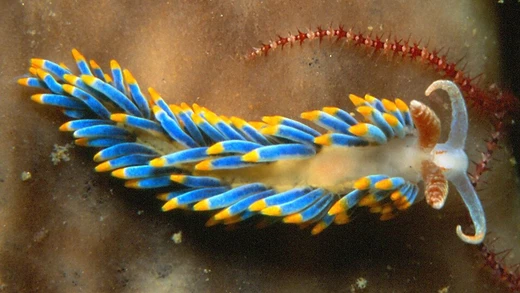
Spanish dancer
A large, colorful sea slug that swims like a dancer.

The Spanish dancer, scientific name Hexabranchus sanguineus, is a dorid nudibranch, a very large and colorful sea slug and a marine gastropod mollusk in the family Hexabranchidae. Its common name comes from its particular swimming defense, in which it unfolds its mantle edges and moves through contractions and undulations of the body.
Quick Facts
- Taxon
- Hexabranchus sanguineus
Facts from the source article.
Lore & Background
The Spanish dancer is a dorid nudibranch with a soft, flattened body. Its anterior dorsal portion has a pair of retractable rhinophores, and the posterior part has six contractile gills inserted independently. The pair of oral tentacles are constituted by a fine flexible membrane provided with large digital lobes. When crawling normally, the edges of its mantle are curled upwards, creating a peripheral blister. If disturbed, it unfolds its edges and can swim through contractions and undulations of the body to move away from the disturbing element, which gives it its common name.
This species is reported from the Red Sea, the Western Indian Ocean, French Polynesia, and the Western Pacific, with different color morphs in each region that are not differentiated by morphology or DNA barcodes. It inhabits rocky and coral reefs with many sponges, from 1 to 50 meters deep. During daytime, it hides in crevices and only comes out late at night.
The taxonomy of the genus Hexabranchus has been controversial, but a thorough molecular and morphological study published in 2023 showed that the name H. sanguineus was being used for at least five distinct species. The Spanish dancer consumes sponges from the family Halichondriidae, deriving a potent chemical for defense, which it passes into its egg ribbons via macrolides. The emperor shrimp, Periclimenes imperator, is a commensal shrimp commonly found living on it.
Reader's Guide
The Spanish dancer is notable for its size, color, and distinctive swimming behavior, which earned it the common name. Its scientific name, Hexabranchus sanguineus, literally means 'blood-colored six-gills,' referencing its six contractile gills and red coloration. The species is a key example of chemical defense in nudibranchs: after consuming sponges from the family Halichondriidae, it derives a potent chemical that it uses for its own defense and passes into its egg ribbons via macrolides, protecting the otherwise defenseless eggs. This defense is coveted by other nudibranch species such as Favorinus tsuruganus and Favorinus japonicus. The Spanish dancer also hosts a commensal shrimp, Periclimenes imperator, commonly found living on its body. The 2023 molecular and morphological study resolved that the name H. sanguineus had been applied to at least five distinct species, highlighting ongoing taxonomic complexity. Its egg ribbons, ranging in color from bright red to pink, have a spiral shape related to the size of the animal. The species is reported from the Red Sea, Western Indian Ocean, French Polynesia, and the Western Pacific, with regional color morphs that are not differentiated by morphology or DNA barcodes.
Did You Know?
- The Spanish dancer can grow up to 40 cm in the Red Sea.
- Its common name comes from its swimming defense, using contractions and undulations of the body.
- It passes defensive compounds from consumed sponges into its egg ribbons via macrolides.
Frequently Asked Questions
What is the Spanish dancer?
The Spanish dancer (Hexabranchus sanguineus) is a large, vividly colored dorid nudibranch belonging to the family Hexabranchidae. It is one of the most visually striking marine gastropods found in tropical and subtropical waters.
How big can a Spanish dancer grow?
In most parts of its range, the slug reaches roughly 25 centimeters, but Red Sea specimens have been measured at up to 40 centimeters. That size makes it one of the largest nudibranchs known.
What does the Spanish dancer eat?
Its diet is essentially limited to sponges in the family Halichondriidae, which it scrapes and consumes with its radula. This narrow specialization is typical of many dorid nudibranchs.
How does the Spanish dancer reproduce?
Each individual is a simultaneous hermaphrodite, so any two slugs can exchange gametes. After mating, the slug deposits long, spiral-shaped ribbons of eggs that range in color from bright red to pale pink.
Why is it called the 'Spanish dancer'?
The common name refers to its swimming defense: when disturbed, the slug unfurls the margins of its mantle and propels itself through the water with rhythmic body contractions and undulations. The fluttering, skirt-like motion of the spread mantle edges is what inspired the dancer comparison.
More in Nudibranchs and Sea Slugs, Part 2 1-24
Spotted an error? Know more?
Reader corrections go straight into our review queue. Suggest an edit · How this site is sourced