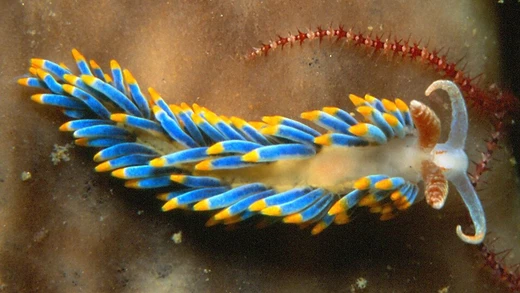
Phylliroe
A transparent, fish-like pelagic nudibranch that hunts jellies.

Phylliroe is a genus of open-ocean nudibranchs, averaging up to 5.5 centimeters in length and highly transparent. It includes two known species. These marine gastropods belong to the order Opisthobranchia and are notable for their fish-like body shape and swimming style, a clear case of convergent evolution.
**Distribution and habitat** *Phylliroe atlantica* lives in subtropical and tropical waters of the Atlantic and Pacific Oceans. *Phylliroe bucephalum* is found in the Mediterranean Sea.
**Ecology** Juveniles of *P. bucephalum* feed exclusively on the bell of the hydromedusa *Zanclea costata*. Initially, the nudibranch attaches to the inside of the medusa’s bell with its tiny foot, sucking tissue from the ring, radial canals, and manubrium. It grows from 1.6 mm to 11 mm in just ten days, while the medusa shrinks. Once the slug matches the medusa in size, it begins swimming and consumes the remaining parts, including the tentacles.
As adults, their diet broadens beyond *Zanclea*, though feeding observations are limited. *Phylliroe* uses its long rhinophores to hunt jellies and its nearly vestigial foot to cling to prey. It has been seen approaching swarms of the larvacean *Oikopleura albicans* from below, grabbing individuals with its paired, toothed jaws and swallowing them in half a minute. Adults have also been observed preying on the medusa *Aequoria*.
Branches of the digestive tract may contain symbiotic zooxanthellae, but this relationship remains unstudied. It is unclear whether all *P. bucephalum* specimens harbor these symbionts, which may be obtained from prey. *P. bucephalum* sometimes hosts parasitic trematodes, both on its skin and inside its body.
Quick Facts
- Taxon
- Phylliroe
Facts from the source article.
Lore & Background
Phylliroe comprises two species: P. atlantica, found in (sub)tropical Atlantic and Pacific waters, and P. bucephalum, known from the Mediterranean. Juveniles of P. bucephalum feed exclusively on the bell of the hydromedusa Zanclea costata, attaching inside the bell with a very small foot and sucking tissue from the ring, radial canals, and manubrium. The nudibranch grows from 1.6 mm to 11 mm in just ten days while the medusa shrinks; when the slug matches the medusa in size, it begins swimming and consumes the remaining parts, including tentacles. In adulthood, its diet broadens, though feeding observations are sparse. Phylliroe uses its rhinophores (long horns) to prey on jellies and its nearly vestigial foot to adhere to prey. It has been seen approaching the larvacean Oikopleura albicans from below, grabbing a specimen with paired denticulate jaws and swallowing it in half a minute. Adults also prey on the medusa Aequoria. Branches of the digestive tract may contain symbiotic zooxanthellae, but this relationship is unstudied; it is unclear if all P. bucephalum harbor them, and they may be obtained from prey. P. bucephalum sometimes suffers from parasitic trematodes attached to its skin and inside its body.
Reader's Guide
Phylliroe is significant as a striking example of convergent evolution, having evolved a fish-like body plan and locomotion for open-ocean hunting despite being a nudibranch. Its transparency and pelagic lifestyle distinguish it from typical benthic sea slugs. The genus comprises only two known species, with P. bucephalum's ecology better documented: juveniles are obligate predators of the hydromedusa Zanclea costata, exhibiting rapid growth and a shift from attached feeding to free-swimming predation as they outgrow their prey. Adults expand their diet to other jellies and larvaceans, using rhinophores and vestigial foot to capture prey. The potential presence of symbiotic zooxanthellae in the digestive tract suggests a possible nutritional relationship, though it remains unstudied and may be derived from prey. Parasitic trematodes affect P. bucephalum, indicating a role in marine parasite life cycles. The genus's rarity and specialized hunting behavior make it a subject of interest for evolutionary biology and marine ecology, though observations of adult feeding are sparse. Its transparent body allows visualization of internal organs, as shown in external film resources.
Did You Know?
- Phylliroe juveniles of P. bucephalum grow from 1.6 mm to 11 mm in just ten days while feeding on the hydromedusa Zanclea costata.
- The genus is an example of convergent evolution, resembling a fish in body plan and locomotion.
More in Nudibranchs and Sea Slugs, Part 2 1-24
Spotted an error? Know more?
Reader corrections go straight into our review queue. Suggest an edit · How this site is sourced