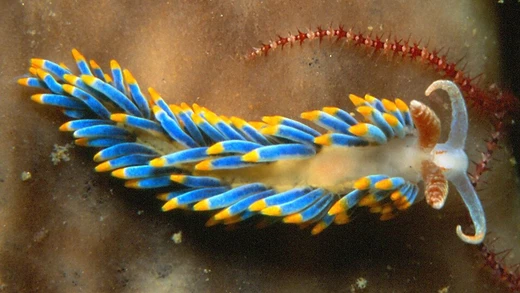
Phyllidiopsis
Largest genus in Phyllidiidae, with fused oral tentacles and elongate foregut.

Phyllidiopsis is a genus of sea slugs, specifically dorid nudibranchs, which are shell-less marine gastropod molluscs. It is the largest genus within the family Phyllidiidae.
Quick Facts
- Taxon
- Phyllidiopsis
- Type Species
- Phyllidiopsis cardinalis
- Type Species Authority
- Bergh, 1876
Facts from the source article.
Lore & Background
Species in Phyllidiopsis differ from other genera in the family Phyllidiidae by possessing an elongate foregut and fused oral tentacles. These nudibranchs are found in the tropical Indo-Pacific region, the eastern Pacific region, the Red Sea, the Caribbean Sea, and a few in the Northwest Atlantic Ocean. About half of the described species occur in deep waters, and among these deep-water sea slugs there is a group of white species lacking all contrasting colors.
The genus includes approximately 30 species, with Phyllidiopsis cardinalis designated as the type species. A maximum-parsimony analysis of the nucleotide sequence of the 16S mtDNA gene, performed in 2003, has shown that the genus Phyllidiopsis is paraphyletic. Several species have been brought into synonymy, including Phyllidiopsis carinata (synonym of Phyllidia ocellata) and Phyllidiopsis papilligera (synonym of Ceratophyllidia papilligera).
Reader's Guide
Phyllidiopsis is notable as the largest genus within the family Phyllidiidae, comprising about 30 described species. Its distinct morphology—an elongate foregut and fused oral tentacles—sets it apart from other genera in the family. The genus has a broad geographic distribution across tropical and subtropical waters, including the Indo-Pacific, eastern Pacific, Red Sea, Caribbean, and Northwest Atlantic. A significant proportion of its species inhabit deep waters, where a group of white, unpigmented forms occurs. The 2003 molecular analysis indicating paraphyly suggests that the current classification may not reflect evolutionary relationships, highlighting the need for taxonomic revision. The genus includes several species that have been synonymized, reflecting ongoing refinement in nudibranch systematics. Its type species, Phyllidiopsis cardinalis, was described by Bergh in 1876. The genus serves as an important subject for studies of deep-sea adaptation and phylogenetic relationships within Phyllidiidae.
Did You Know?
- About half of the described Phyllidiopsis species are found in deep waters.
- A 2003 analysis of 16S mtDNA showed the genus Phyllidiopsis is paraphyletic.
- The type species of the genus is Phyllidiopsis cardinalis, described by Bergh in 1876.
More in Nudibranchs and Sea Slugs, Part 2 1-24
Spotted an error? Know more?
Reader corrections go straight into our review queue. Suggest an edit · How this site is sourced