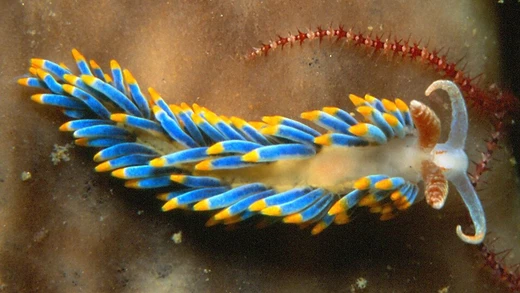
Phyllidiidae
A family of sea slugs lacking radulae, with warning colors.

Phyllidiidae are a family of sea slugs, a type of dorid nudibranch within the marine gastropod superfamily Phyllidioidea. In the Bouchet & Rocroi (2005) taxonomy, they belong to the clade Doridacea. Most species live in the tropical Indo-Pacific, though a few occur in the tropical Atlantic and the Mediterranean. These nudibranchs have an oval, flattened body. Their mantle is covered with hard, colorful tubercles and marked with bold patterns and contrasting colors that serve as warning signals to predators. The rhinophores are lamellate and can be retracted. Like other dorid nudibranchs, they have a dorsal anus—except for species in the genus *Fryeria*, where the anus is posteroventral and protrusible. Unlike other members of the Doridacea, phyllidiids lack buccal armature: they have no radula or jaws. Their gill leaflets are positioned ventrolaterally, not in a dorsomedian circlet. The oral glands, which are closely tied to the pharynx and sit inside the oral tube, as well as the stomach, are modified. Their reproductive system is triaulic, with two separate female openings and one male opening, matching the condition of advanced dorids. Most phyllidiids are active and conspicuous during the day, exposing themselves to predators. Their bright colors are aposematic, signaling chemical defenses that deter attack. Only one species, *Phyllidiopsis cardinalis*, has been observed always hiding. Reports on their ecology and feeding are scarce. Because their small mouth lacks a radula and other hard parts, they are suction-feeders that prey on sponges. *Phyllidia varicosa* has been seen feeding on a sponge from the genus *Hymeniacidon*, and *Phyllidia flava* on the sponge *Acanthella acuta*. The family was originally spelled Phyllidia. Jean-Baptiste Lamarck coined "les Phyllidiens" and "les phyllidéens" (1801; 1809). J.G. Children later Latinized these to Phyllidiana (1823), placing them in Hydrobranchiae. The current name Phyllidiidae is attributed to Rafinesque, not Lamarck. Taxonomy has long been confused due to poor early descriptions and the difficulty of classifying species that all lack radulae. David J.
Quick Facts
- Taxon
- Phyllidiidae
- Type Genus
- Phyllidia
Facts from the source article.
Lore & Background
The family Phyllidiidae was originally spelled as family Phyllidia, with Jean-Baptiste Lamarck coining the words 'les Phyllidiens' and 'les phyllidéens' (1801; 1809). These were later Latinized by J.G. Children (1823) to Phyllidiana, placed in Hydrobranchiae. The present name Phyllidiidae is attributed to Rafinesque, not Lamarck. There has been much taxonomic confusion, largely due to inadequate early descriptions and the difficulty of classifying a family where all species lack radulae. David J. Brunckhorst reviewed the family, clarifying many species and describing new ones and a genus. Cladistic analysis shows the family is monophyletic, with Ceratophyllidia sister to the rest, Phyllidiopsis sister to the remaining genera, Phyllidiella sister to the remaining, and Reticulidia sister to Phyllidia and Fryeria. This analysis was not entirely supported by a 16S gene study. Many undescribed species are being revealed by DNA analyses. The mantle of these oval nudibranchs is flattened dorsoventrally and covered with hard, colored tubercles, decorated with contrasting colors and patterns as warning signals to predators. The lamellate rhinophores can be retracted. Like other dorid nudibranchs, all species have a dorsal anus, except those in the genus Fryeria, where the anus is posteroventral and protrusible. They lack buccal armature (radulae and jaws). Gill leaflets are ventrolateral, not a dorsomedian circlet. The oral glands and stomach have undergone modifications. The reproductive system is triaulic (two female openings, one male). Most phyllidiids appear conspicuously during daytime, using aposematism (warning colors) to deter predators; only Phyllidiopsis cardinalis was found to be always hidden.
Reader's Guide
The family Phyllidiidae holds significance as a distinct group within the clade Doridacea, characterized by the absence of radulae and jaws, a rare trait among nudibranchs. Their feeding habits are poorly documented, but they are known as predators adapted for sucking on sponges, with specific observations of Phyllidia varicosa feeding on Hymeniacidon and Phyllidia flava on Acanthella acuta. The family's taxonomy has been historically confused, but Brunckhorst's cladistic analysis established a monophyletic framework, though not fully supported by 16S gene data. The presence of many undescribed species, revealed by DNA analyses, underscores ongoing discovery. Their aposematic coloration and chemical defenses highlight evolutionary adaptations for predator deterrence. The triaulic reproductive system aligns with advanced dorids. The family includes five genera (Phyllidia, Ceratophyllidia, Phyllidiella, Phyllidiopsis, Reticulidia) and over 80 species, with Fryeria and Reyfria now considered synonyms of Phyllidia. Their distribution is primarily tropical Indo-Pacific, with a few species in the tropical Atlantic and Mediterranean.
Did You Know?
- Phyllidiidae lack buccal armature (radulae and jaws), unlike most other dorid nudibranchs.
- The anus is dorsal in most species, but in the genus Fryeria it is posteroventral and protrusible.
- Only one species, Phyllidiopsis cardinalis, was observed to be always hidden; most are conspicuous during daytime.
- The family contains more than 80 species across five genera, with many undescribed species revealed by DNA analyses.
More in Nudibranchs and Sea Slugs, Part 2 1-24
Spotted an error? Know more?
Reader corrections go straight into our review queue. Suggest an edit · How this site is sourced