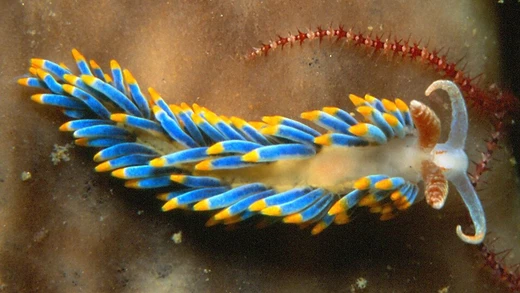
Phyllidia varicosa
A large, toxic nudibranch mimicked by juvenile sea cucumbers.

Phyllidia varicosa is a sea slug belonging to the dorid nudibranch group, a type of shell-less marine gastropod mollusc in the family Phyllidiidae. It is widely found across the Indo-West Pacific Oceans, including the central Pacific and the Red Sea. This species can grow to at least 115 mm, making it a large nudibranch. It is identified by three to six longitudinal, tuberculate ridges on its back. These ridges and the bases of the tubercles are blue-grey, while the tubercle tips are yellow. A black stripe runs lengthwise along the foot sole, and the rhinophoral clavus has 27 to 30 lamellae. The juvenile sea cucumber *Pearsonothuria graeffei* mimics this nudibranch. The young sea cucumber is brightly colored—white and blue or black, with a few large, yellow, thornlike projections—which warns predators of the nudibranch’s toxicity. This mimicry protects the sea cucumber. As an adult, the sea cucumber becomes much duller in color, grows larger than the sea slug, and produces its own toxic chemicals.
Quick Facts
- Taxon
- Phyllidia varicosa
Facts from the source article.
Lore & Background
Phyllidia varicosa is widely distributed throughout the Indo-West Pacific Oceans, including the central Pacific and the Red Sea. It is a large species, growing to at least 115 mm. It can be distinguished by its numerous (3 to 6) longitudinal, tuberculate notal ridges. The ridges and bases of the tubercles are a blue-grey colour, while the tubercles are capped in yellow. The foot sole has a black longitudinal foot stripe, and the rhinophoral clavus possesses 27 to 30 lamellae.
Juveniles of the sea cucumber Pearsonothuria graeffei are brightly coloured and closely resemble Phyllidia varicosa. They are white and blue or black, with a few large, yellow, thornlike projections. These bright colours warn predators of the toxicity of the nudibranch, and this mimicry on the part of the sea cucumber species serves to protect it also. The adult sea cucumber has much duller colouration, but it is also much larger than the sea slug and has its own toxic chemicals at this stage.
Reader's Guide
Phyllidia varicosa is significant as a chemically defended nudibranch whose bright coloration serves as a warning to predators. Its toxicity is so effective that juveniles of the sea cucumber Pearsonothuria graeffei have evolved to mimic its appearance, gaining protection from predators. This mimicry is notable because the sea cucumber changes its coloration as it matures, becoming duller and relying on its own toxic chemicals when larger. The species is widely distributed across the Indo-West Pacific Oceans, including the central Pacific and the Red Sea, and is one of the larger nudibranchs, reaching at least 115 mm. Its diagnostic features—blue-grey notal ridges with yellow-capped tubercles, a black foot stripe, and 27 to 30 rhinophoral lamellae—make it readily identifiable. The mimicry relationship highlights the ecological importance of Phyllidia varicosa as a model species in marine environments, demonstrating how toxicity can shape the evolution of other organisms.
Did You Know?
- Phyllidia varicosa grows to at least 115 mm.
- It has 3 to 6 longitudinal, tuberculate notal ridges with blue-grey bases and yellow caps.
- Juveniles of the sea cucumber Pearsonothuria graeffei mimic the coloration of Phyllidia varicosa for protection.
- The rhinophoral clavus of this species possesses 27 to 30 lamellae.
More in Nudibranchs and Sea Slugs, Part 2 1-24
Spotted an error? Know more?
Reader corrections go straight into our review queue. Suggest an edit · How this site is sourced