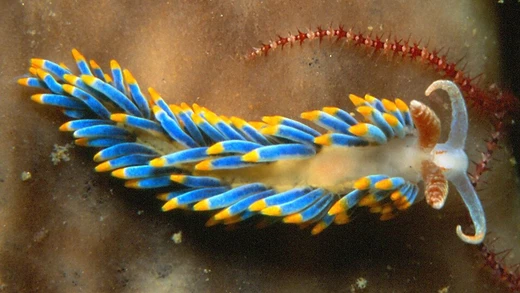
Phyllidia ocellata
A dorid nudibranch with orange-brown body and black-ringed tubercles.

Phyllidia ocellata is a type of sea slug, specifically a dorid nudibranch, belonging to the family Phyllidiidae. This shell-less marine mollusk is found mainly in the central Indo-West Pacific, with a range from Malaysia to the Solomon Islands, and is especially common in Indonesia. It grows up to 35 millimeters long. The animal’s orange-brown body is marked by large, stalked tubercles that are white or grey and often clustered together. These tubercles run in a line from between the rhinophores to the tail, with smaller, scattered ones near the edge of the mantle. Four black rings encircle tubercles arranged symmetrically across the middle of the back. Larger individuals may also have two additional black patches or two more ringed tubercles near the tail, and a single tubercle in front of the rhinophores is also ringed in black. The rhinophores themselves are orange-yellow. This species has often been mistaken for others, including *Phyllidia japonica*, *Phyllidia multituberculata*, and *Phyllidia undula*. Like many nudibranchs, it feeds on sponges.
Quick Facts
- Genus
- Phyllidia
- Species
- ocellata
Facts from the source article.
Lore & Background
Phyllidia ocellata has been confused with several other species, including Phyllidia japonica, Phyllidia multituberculata, and Phyllidia undula, by most workers. Its distribution is probably confined to the central Indo-West Pacific Ocean, where it is common in Indonesia and occurs from Malaysia to the Solomon Islands. The animal can measure up to 35 mm in length. Its dorsum is orange-brown, interrupted by large white or grey compound stalked tubercles. These tubercles are distributed along a line from between the rhinophores to the tail, with more scattered and mostly smaller tubercles towards the mantle edge. Four black rings surround tubercles placed symmetrically in the middle region of the back. Large individuals may have two more black patches towards the tail, or two more tubercles surrounded by black rings. A single tubercle in front of the rhinophores is also surrounded by a black ring. The rhinophores are orange-yellow. Like many nudibranchs, Phyllidia ocellata feeds on sponges.
Reader's Guide
Phyllidia ocellata is significant as a species within the family Phyllidiidae, often misidentified due to its similarity to other species such as Phyllidia japonica, Phyllidia multituberculata, and Phyllidia undula. Its distribution is probably confined to the central Indo-West Pacific Ocean, with common occurrence in Indonesia and a range extending from Malaysia to the Solomon Islands. The species is characterized by its orange-brown dorsum with large white or grey compound stalked tubercles, and symmetrical black rings surrounding certain tubercles—four in the middle region, one in front of the rhinophores, and possibly additional rings in larger individuals. Its rhinophores are orange-yellow. Like many nudibranchs, it feeds on sponges. The species has been documented in external links such as photos in the Sealife Collection. Its legacy lies in its role as a frequently confused but distinct dorid nudibranch, contributing to the understanding of phyllidiid diversity and identification challenges.
Did You Know?
- It has been confused with Phyllidia japonica, Phyllidia multituberculata, and Phyllidia undula.
- Its rhinophores are orange-yellow.
More in Nudibranchs and Sea Slugs, Part 2 1-24
Spotted an error? Know more?
Reader corrections go straight into our review queue. Suggest an edit · How this site is sourced