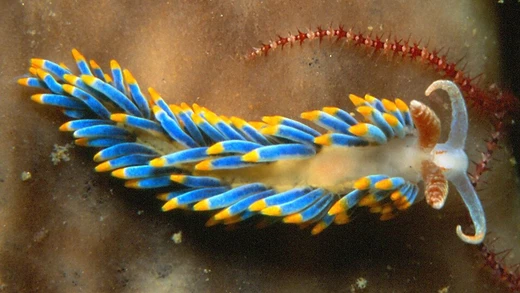
Phyllidia coelestis
A tropical nudibranch with aposematic colors and a Y-shaped black line.

Phyllidia coelestis is a shell-less marine gastropod, a type of nudibranch sea slug belonging to the family Phyllidiidae.
This species is found across the tropical Indo-West Pacific, from the western Pacific Ocean and South China Sea through the Timor Sea and Indian Ocean to South Africa. It inhabits coral reef environments, including the outer slope, reef top, and lagoon, at depths down to 30 meters.
The slug can reach up to 6 centimeters in length and has an elongated, slug-shaped body. Its mantle is grey-blue, with a margin covered in many small tubercles. Larger, yellow-capped tubercles run along the midline. Three black longitudinal lines are present: two along the sides of the mantle and one along the midline that splits into a "Y" shape toward the front. This Y-shaped line is a key identifying feature. The rhinophores are yellow and have lamellae.
This species is benthic and active during the day. Its bright, aposematic coloration allows it to move openly in daylight while feeding. Its diet consists of sponges.
Quick Facts
- Taxon
- Phyllidia coelestis
Facts from the source article.
Lore & Background
Phyllidia coelestis occurs in the tropical Indo/West-Pacific, living on the external slope of coral reefs, on top of the reef, and in the lagoon, down to 30 m in depth. It is found in the western Pacific Ocean, South China Sea, Timor Sea, and across the Indian Ocean to South Africa. The sea slug is up to 6 cm in length, with an elongated, slug-shaped body. The mantle has a grey-blue background color, with a margin covered in many small tubercles. Bigger tubercles that are yellow capped run along the median line. There are three black longitudinal lines: two on each side of the mantle, and one on a median line ending on the anterior part as a 'Y'. This particular line shape constitutes a distinctive element to identify this species. The rhinophores possess lamellae and are yellow in color. This species is benthic and diurnal. Because of its aposematic colors, it is able to crawl around in the daylight to feed. Phyllidia coelestis has a diet based on sponges.
Reader's Guide
Phyllidia coelestis is significant as a well-documented example of aposematic coloration in nudibranchs, allowing it to move and feed during daylight without predation. Its distinctive Y-shaped black line on the median line is a key identifying feature, aiding researchers and enthusiasts in field identification. The species' diet based on sponges places it within the ecological role of sponge-feeding nudibranchs in coral reef ecosystems. Its distribution across the tropical Indo/West-Pacific, from the western Pacific Ocean to South Africa, highlights its adaptability to various reef habitats, including slopes, tops, and lagoons, down to 30 m depth. The presence of lamellae on the yellow rhinophores is a characteristic trait of the family Phyllidiidae. The species' legacy is tied to its use in taxonomic studies and as a subject in guides on nudibranch behavior and identification, as referenced in works by Behrens, Cobb and Willan, and the Sea Slugs Forum.
Did You Know?
- Phyllidia coelestis has a Y-shaped black line on the median line that ends on the anterior part, a distinctive identification feature.
- This species is benthic and diurnal, crawling in daylight due to its aposematic colors.
- Its diet consists entirely of sponges.
- The rhinophores are yellow and possess lamellae.
More in Nudibranchs and Sea Slugs, Part 2 1-24
Spotted an error? Know more?
Reader corrections go straight into our review queue. Suggest an edit · How this site is sourced