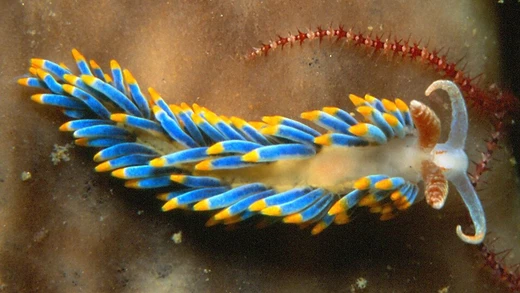
Lomanotus vermiformis
A circumtropical sea slug with a worm-like body.

Lomanotus vermiformis is a sea slug, a marine gastropod mollusk belonging to the family Lomanotidae. Its body is extremely long and slender, which gives it a worm-like appearance—hence its Latin name, *vermiformis*, meaning "in the shape of a worm."
In 1988, this species was considered the same as the Caribbean species *Lomanotus stauberi*. It is found in tropical waters around the world, first described from the Red Sea, and widely reported across the Indo-Pacific. In the western Atlantic, it has been recorded off Florida, the Bahamas, and Panama.
The body is very elongated and narrow. The sheaths around the rhinophores are covered in papillae and rise to cover about three-quarters of the rhinophores. The cerata are very short and pointed. The background color is brown, marked with dark brown spots and opaque yellow lines, and there are also opaque white reticulations across the body. The largest recorded length is 40 mm, though it is usually under 25 mm.
This sea slug lives at depths between 1 and 4.5 meters. It feeds on the stinging hydroid *Lytocarpus philippinus* and on hydroids of the genus *Macrorhynchia*. In Panama, it was found feeding on an unidentified hydroid species, on which it is extremely cryptic. When disturbed, *Lomanotus vermiformis* can swim by flexing its body from side to side.
Quick Facts
- Taxon
- Lomanotus vermiformis
Facts from the source article.
Lore & Background
The species Lomanotus vermiformis was described from the Red Sea and has a circumtropical distribution, reported widely from tropical seas in the Indo-Pacific region and from the Western Atlantic including Florida, Bahamas, and Panama. In 1988, it was synonymised with the Caribbean species Lomanotus stauberi. The specific name vermiformis is from Latin, meaning 'in the shape of a worm,' referring to its elongate body. The body shape is very elongate and narrow, with rhinophoral sheaths that have papillae and are elevated to cover three quarters of the rhinophores. Its cerata are very short and pointed. The background color is brown with dark brown spots and opaque yellow lines, and opaque white reticulations are also present across the body. The maximum recorded body length is 40 mm, but it is usually smaller than 25 mm.
Reader's Guide
Lomanotus vermiformis occupies a specific ecological niche as a predator of hydroids. It feeds on the common stinging hydroid Lytocarpus philippinus and on hydroids of the genus Macrorhynchia. In Panama, it was also found feeding on an unidentified species of hydroid, on which it is extremely cryptic. This cryptic coloration likely aids in avoiding predators while foraging. When disturbed, the species can swim with lateral flexions of the body, a behavior that may help it escape threats. Its recorded depth range is from 1 m to 4.5 m, indicating it inhabits shallow tropical waters. The synonymy with Lomanotus stauberi in 1988 reflects taxonomic uncertainty that remains unresolved in the literature. The species' elongate, worm-like form and distinctive color pattern of brown with dark spots, yellow lines, and white reticulations make it visually distinct among sea slugs.
More in Nudibranchs and Sea Slugs, Part 2 1-24
Spotted an error? Know more?
Reader corrections go straight into our review queue. Suggest an edit · How this site is sourced